Stuck on Duolingo? How to Really Grow Your Spanish Vocabulary

You know the picture: a three-hundred-day streak, half the lesson tree golden, the app congratulating you every morning. Then you put on a Spanish-language show or try to write a message to a colleague in Madrid — and the words you need aren't there. You understand the sentences from the lessons, but outside them the language barely responds.
That doesn't mean the three hundred days were wasted. You've simply hit the ceiling that every course has. Here's where it comes from and what to do next so your vocabulary starts growing again.
Why vocabulary growth stalls
There are exactly four reasons, and all of them are about how a course is built, not about your discipline.
1. A course has a finite word list
Any course is a word list decided in advance. In the biggest courses that's a few thousand words; in the smaller ones, noticeably fewer. For the first months you move through that list and grow fast. Once most of it is behind you, new lessons mostly recombine words you already know. The feeling of "I study every day and my vocabulary isn't growing" shows up right here, and it's accurate.
2. The words are generic, and you need yours
A course is written for everyone at once, which is why it contains "the apple", "the turtle" and "the boy drinks milk". What you need are the words from your own life: the vocabulary of your job, expressions from the series you're watching, phrases for a message to a client. Those words aren't in the course and never will be — not because it's a bad course, but because it isn't about you specifically.
3. The exercises test recognition
Choosing a translation out of four options, or building a sentence from ready-made blocks, is recognition. The word is handed to you; all you do is identify it. In a real conversation nothing is handed to you — you have to retrieve the word yourself. The skill the lessons train and the skill speaking requires are different, which is why one transfers so poorly into the other. We went into that gap in detail in how to learn Spanish words so you can actually speak.
4. The streak becomes the goal
Once the day counter is high, protecting it becomes a motive of its own. So in the evening you do the easiest lesson you've already finished: the streak survives, and nothing new is learned. This is the quiet kind of plateau — you study every day and haven't moved in months.
Is that a reason to delete the app? No. A course does its job well at the start: basic grammar, the first few hundred words, and the habit of studying daily. We wrote separately about whether Duolingo alone is enough to build a vocabulary. Short answer: as your only tool, no; as one half of a pair, absolutely.
Get Duolingo: App Store · Google Play
What to do instead of running the course a second time
The plan is simple: stop waiting for a program to hand you words and start collecting them yourself.
Step 1. Find a source of real words
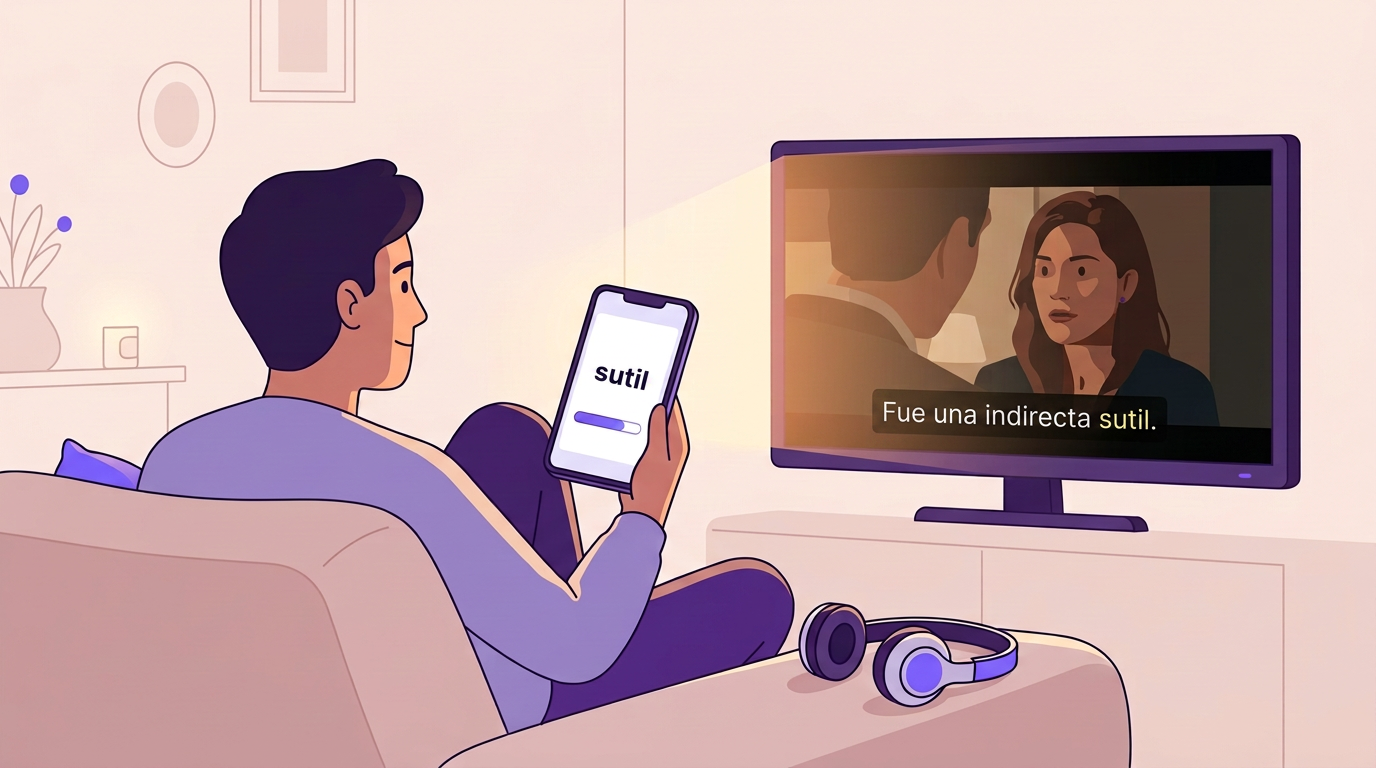
Pick something you already watch, read or listen to: a series, a podcast, a YouTube channel, a work chat in Spanish. It matters that the source isn't educational. Textbook material is written to fit a level; real speech is written to carry meaning, and its words are the ones you'll actually need.
Step 2. Collect 5–10 words a day
Not everything — just what blocks your understanding or clearly looks useful. Ten new words a day is three hundred a month, already more than continuing the course would give you.
Step 3. Learn the word together with its sentence
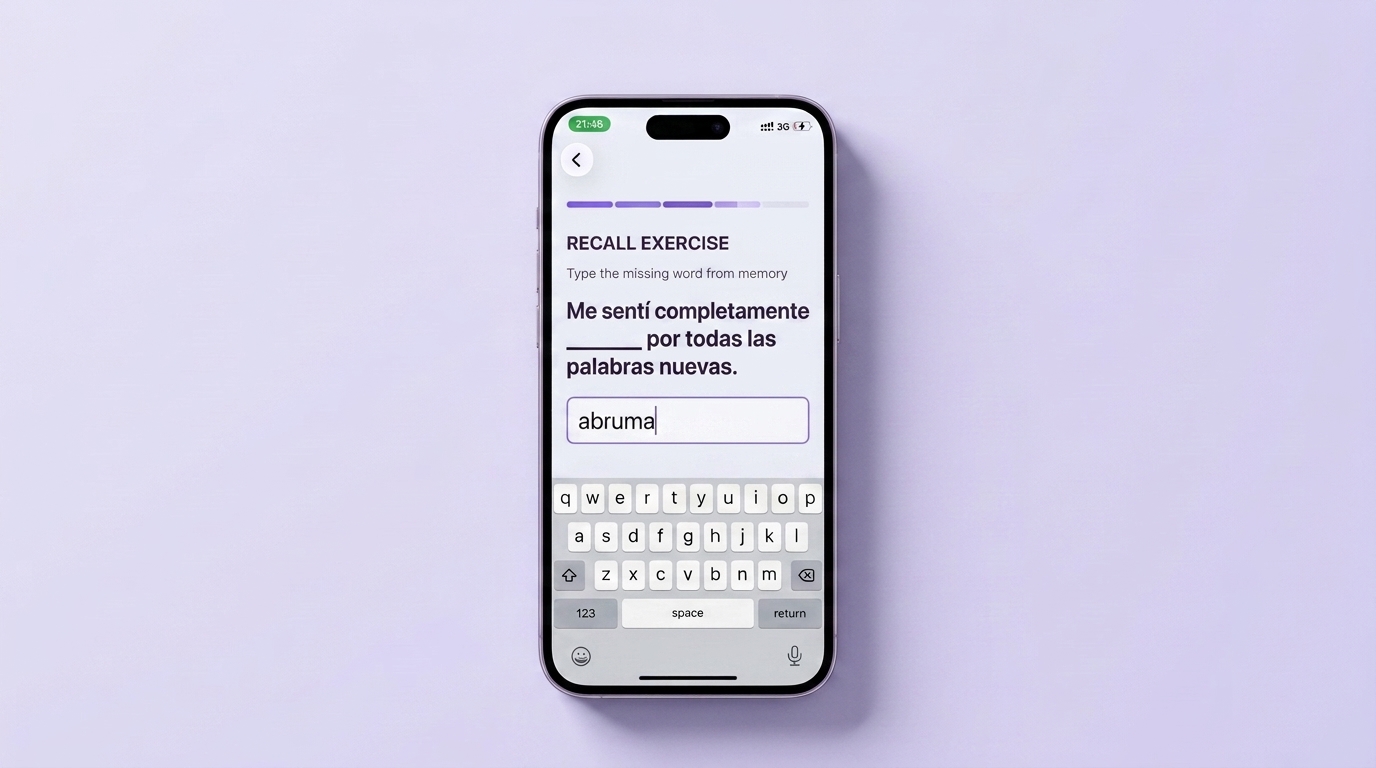
A bare "word — translation" pair holds badly in memory and tells you nothing about usage. Save the whole phrase: not abrumado, but me sentí completamente abrumado por todas las palabras nuevas. Then what surfaces when you speak is a ready-made construction, not a lone word you still have to fit grammar around.
Step 4. Review by recall, on a schedule
A word should return shortly before you'd forget it, and return in a form that forces you to retrieve it: spell it out, type it into a gap, say it aloud. That's noticeably harder than picking from options — which is the whole point.
What this looks like in practice
VibeLing is built for exactly this scenario. You paste a word or a phrase you ran into, and the app pulls in the translation, audio and example sentences, so there's no card to assemble by hand. The word then enters spaced repetition, and the training is recall-based: type the missing word into a sentence, spell it out, say it aloud. One session is ten words and a few minutes.
The app is free in full: no cap on words, no sign-up required. Now and then — before a training session, or when you add a lot of words at once — an ad appears; the paid version simply removes it.
Get VibeLing: App Store · Google Play
A pair, not a replacement
The easiest setup is to keep both tools and split the jobs between them.
| Job | What covers it |
|---|---|
| Basic grammar and the habit of studying | A course: Duolingo and similar |
| Your own words from shows, books and work | An app for a personal word list |
| Reviewing what you've already added | A spaced repetition algorithm |
| Speaking | Conversation practice with a human |
Keep the course going in a relaxed mode, without chasing the streak — it's still useful for grammar. Move the vocabulary growth to where the words are yours.
How to tell you've moved
Count words, not days. Once a week check yourself the simple way: take ten words you added last week and try to recall them with no hints and no answer options. Seven or eight out of ten is a healthy result — the system is working. Three out of ten means too many words or too few reviews.
The second sign is more honest than any counter: you put on a show in Spanish and notice there are fewer unknown words in it. After a month of this work, that difference is visible.
The takeaway
A plateau in a language app isn't a reason to quit the language, and it isn't evidence that you have no talent for it. It's a signal that the course has done its part and what you need next is your own words, not the next level of someone else's tree. Start small: try VibeLing, add ten words from the last episode you watched, and see in a week how many come back on their own.