Is Duolingo Enough to Build Your Vocabulary?

The green owl, 300-day streaks, cheerful reminders — Duolingo is genuinely good at keeping you coming back. But at some point an uncomfortable feeling creeps in: you're two-thirds down the tree, yet in a real conversation the words just aren't there. Which raises a fair question: is Duolingo enough to build your vocabulary, or is it just a warm-up?
Short answer: Duolingo is a great start and a superb habit-builder, but as a tool for growing a large, usable vocabulary it has a ceiling. Let's look at what it does well, where it stalls specifically on words, and what to add.
What Duolingo genuinely does well
Let's be fair — there's plenty to love:
- Habit and motivation. Streaks, XP and reminders really do pull you back every day. Consistency is half the battle in any language.
- A gentle start from zero. For a beginner it's a low barrier to entry: not scary, clear, bite-sized.
- Grammar basics and structure. Word order, simple tenses and common patterns sink in almost by themselves.
- It's free. A huge amount of content costs nothing.
As an on-ramp into a language, Duolingo works. The trouble starts when the goal is vocabulary itself.
Where Duolingo stalls, specifically on words
Vocabulary isn't just "recognize a word in an app" — it's being able to pull the right word out in your own speech. Here's where a course-style trainer hits its ceiling:
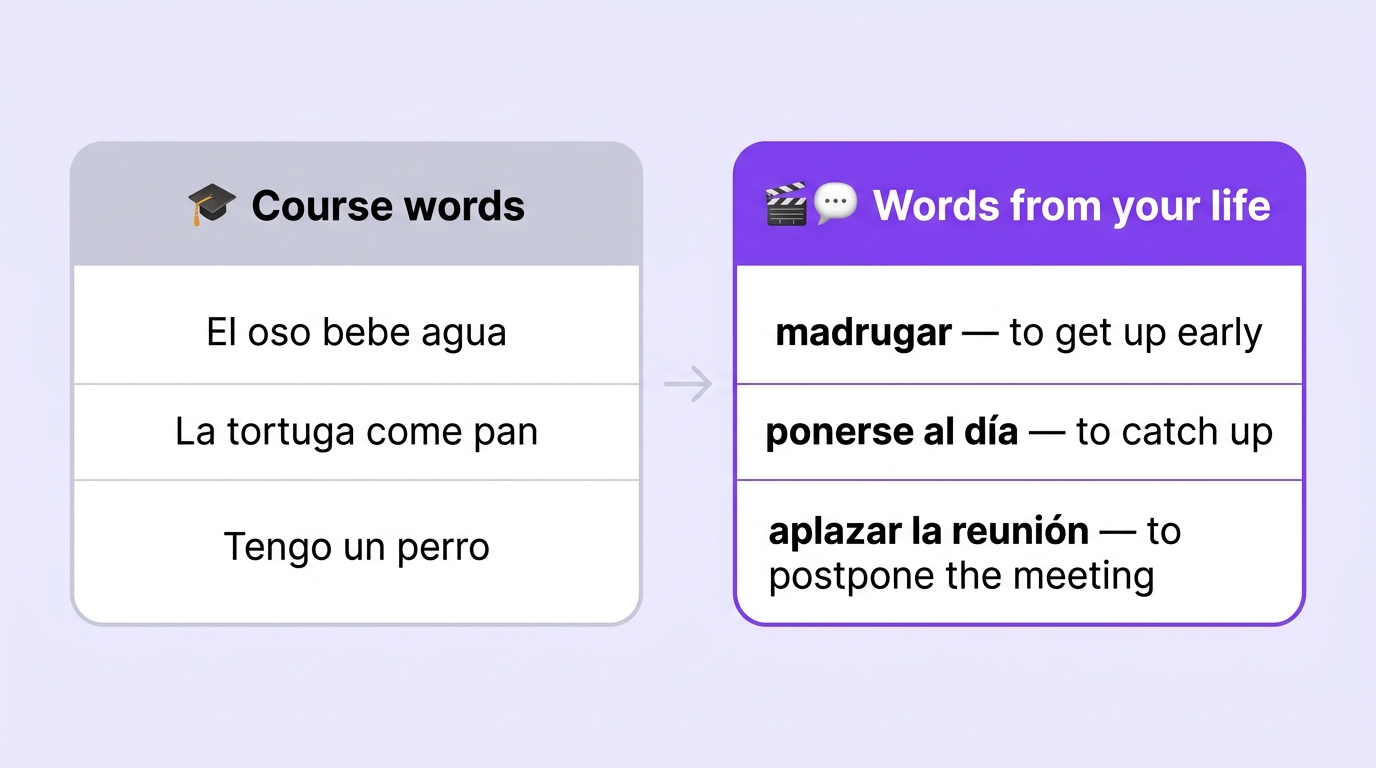
- A limited, someone-else's word set. You learn the vocabulary the course chose — often sentences like El oso bebe agua ("the bear drinks water") that you'll never actually say. Your own words — from your show, your job, your chats — aren't in there.
- Recognition instead of production. Most exercises are pick-an-option or build-a-sentence from ready blocks. That trains recognition, but conversation needs production — pulling a word out of your head to fit your own thought.
- Words out of your context. A word tied to someone else's sentence sticks worse. Vocabulary lands best when it comes from things you actually care about and encounter.
- No way to catch a word from real life. You hear a great word in a movie — and there's no way to instantly save it into your own review set.
- Review is hidden. Spaced repetition — the core of long-term word memory — is barely controllable in Duolingo and tuned to finishing lessons, not to your word list.
Duolingo vs what vocabulary actually needs
| What matters for vocabulary | Duolingo | What you actually need |
|---|---|---|
| Source of words | A fixed course | Your words from real life (shows, books, work) |
| Skill trained | Mostly recognition | Production: say or write it yourself |
| Context | Someone else's sentences | The context where you met the word |
| Review | Tied to course lessons | Spaced repetition on your own list |
| Role | Start and habit | Systematic growth of active vocabulary |
What to add to Duolingo so your vocabulary actually grows
You don't have to quit Duolingo — just add the three things that genuinely build vocabulary:
- Spaced repetition on your own words. Not grinding someone else's lessons, but bringing your words back exactly when you're about to forget them. How that works and how to set it up: how to memorize Spanish words effectively.
- Words from real content. Catch vocabulary from shows, songs and books — it hooks onto a scene and an emotion and surfaces when you need it.
- Production practice. Say words out loud and complete your own sentences instead of only picking from options — that's how a word reaches your speech. More on this: how to learn Spanish words so you can actually speak.
How VibeLing fills the gap
That gap is exactly what VibeLing is built for — an app for learning foreign words that complements courses like Duolingo where they lack depth on vocabulary:
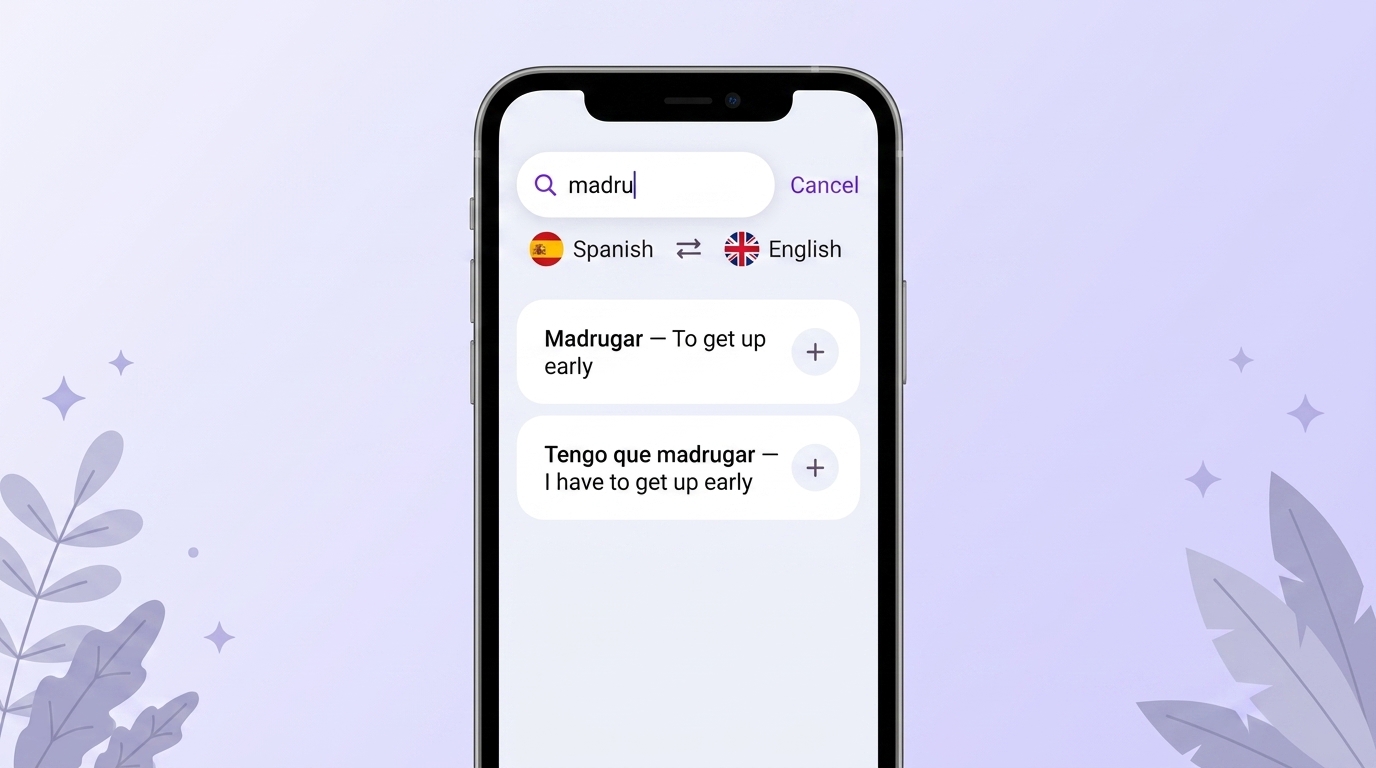
- Save any word or phrase from real life — straight from a movie, a book or a conversation, together with its context, not from someone else's list.
- Learn the phrase, not the bare word — with translation, pronunciation and examples, so a ready-to-speak chunk settles in your head.
- Train production — fill the missing word into a sentence, say the translation out loud. That's the skill that switches on in conversation.
- Review your own words on a schedule — short daily sessions keep your active vocabulary from slipping away.
So here's the verdict: Duolingo is enough to get started and stick with it, but to build a big, working vocabulary you should add a system for your words. Keep Duolingo for the habit, and grow your vocabulary where the words are yours, from real life, and reach your speech. Download VibeLing, save your first real word from a show — and say it out loud right now.
And to turn reading into practice — start your own word list in VibeLing.