How to Learn Spanish Words So You Actually Use Them When You Speak
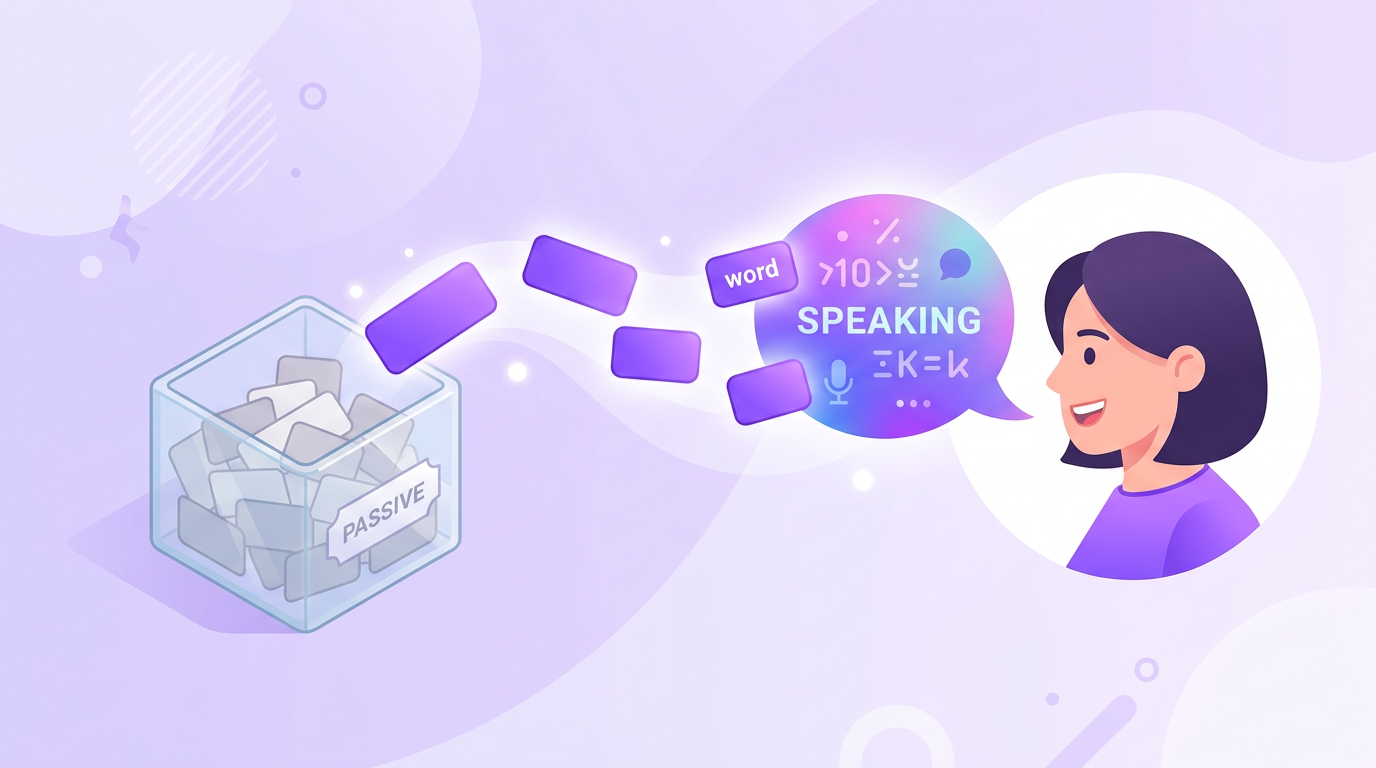
Sound familiar? You've drilled hundreds of Spanish words in an app, you recognize them in text and speech, but the moment a real conversation starts, your mind goes blank. The word you "definitely learned" finally surfaces half an hour after you needed it. The problem is almost never the size of your vocabulary. It's the type: you're stockpiling words you can recognize but can't retrieve.
The good news: this is fixable. Not by learning another thousand words, but by changing the way you learn them. Let's break down how active vocabulary differs from passive — and exactly what to do so your words make it into speech.
Passive and active vocabulary are not the same thing
Everyone learning a language has two vocabularies. Your passive vocabulary is the words you understand when you meet them. Your active vocabulary is the words you actually produce when speaking and writing. Passive is usually 3–5 times bigger than active, and that's normal even in your native language. But when the gap is huge, you understand everything and say almost nothing.
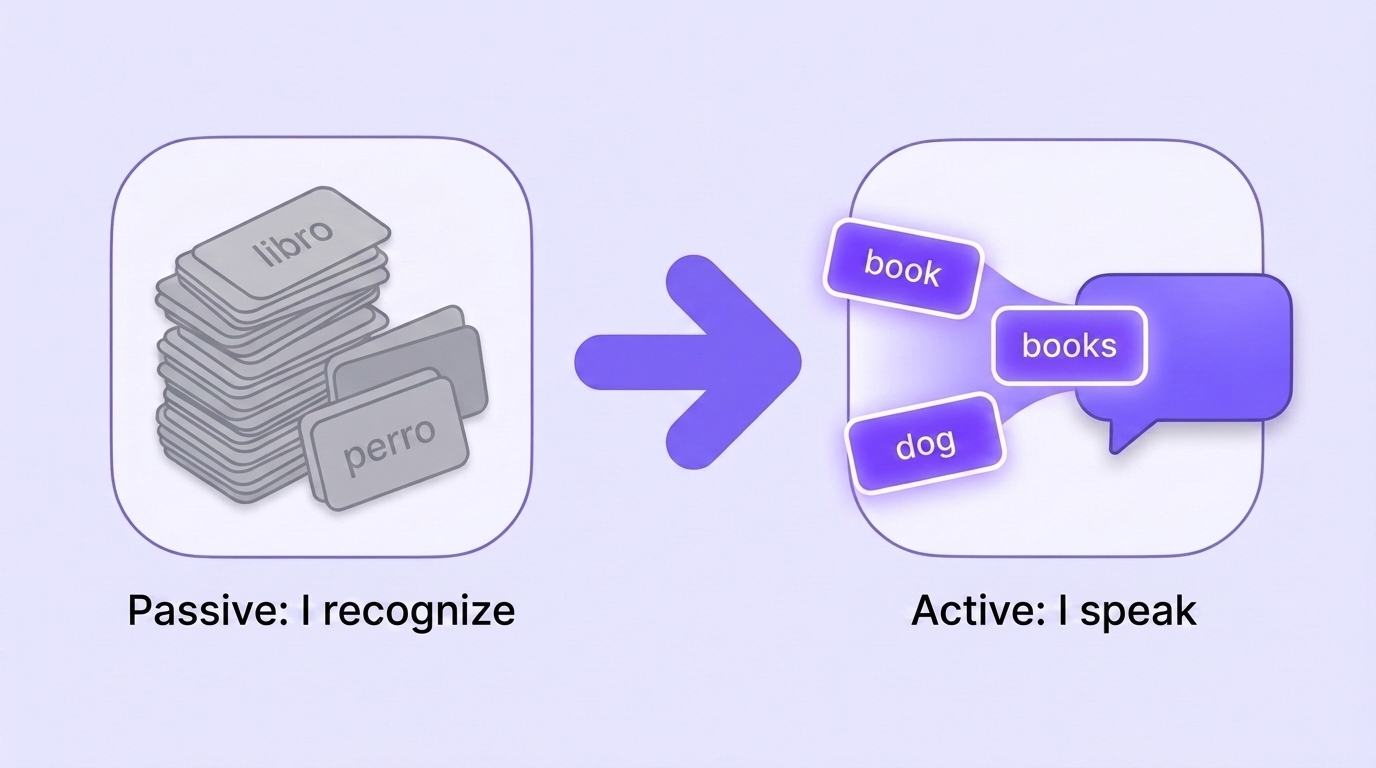
The big mistake is assuming a word moves from passive to active on its own if you just repeat it enough times. It doesn't. Recognition and production are two different skills, and they're trained differently. Recognition is when you're shown a word and recall its meaning. Production is when you have a thought and have to pull up the word for it. In conversation, only the second one works.
Why words get stuck in passive
There are three common habits that keep words from ever reaching your speech:
- Learning a word in isolation. A flashcard that says "sonrojarse — to blush" tells you nothing about how the word lives in a sentence. In speech you don't need a word–translation pair, you need a ready-made chunk you can drop in.
- Training recognition only. If you always see the Spanish word and recall the English one, you're building exactly the passive side. For active you need the reverse: from meaning to word.
- Never saying or writing the word yourself. Until a word has left your mouth or your fingertips, your brain doesn't count it as "working."
Below are four rules that hit precisely those weak spots.
Rule 1. Learn words inside phrases, not one by one
Words travel in packs. A native says tomar una decisión (make a decision), not hacer una decisión; lluvia fuerte (heavy rain), not lluvia pesada. These fixed pairings are called collocations, and they're what make speech fluent: you pull up not a single word but a whole ready block.
echar de menos → Te echo de menos. (I miss you.)
estar agobiado → Estoy un poco agobiado con el trabajo esta semana. (I'm a bit overwhelmed with work this week.)
darse cuenta → No me di cuenta de la hora. (I didn't realize what time it was.)
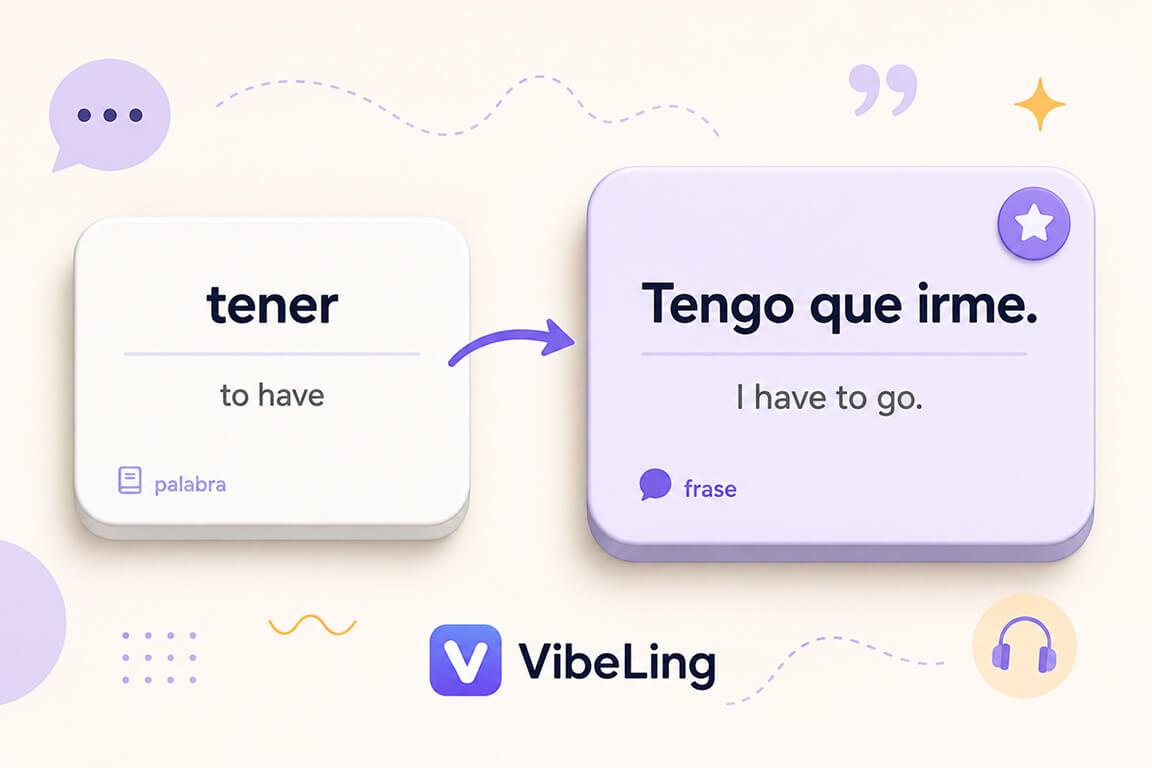
Don't learn "agobiado = overwhelmed"; learn a whole phrase you could say about yourself tomorrow. We've got a separate deep-dive on this — why you should learn phrases, not isolated words. One learned phrase gives you not a single word but a ready-made construction plus the grammar wrapped around it.
Rule 2. Take words from real context
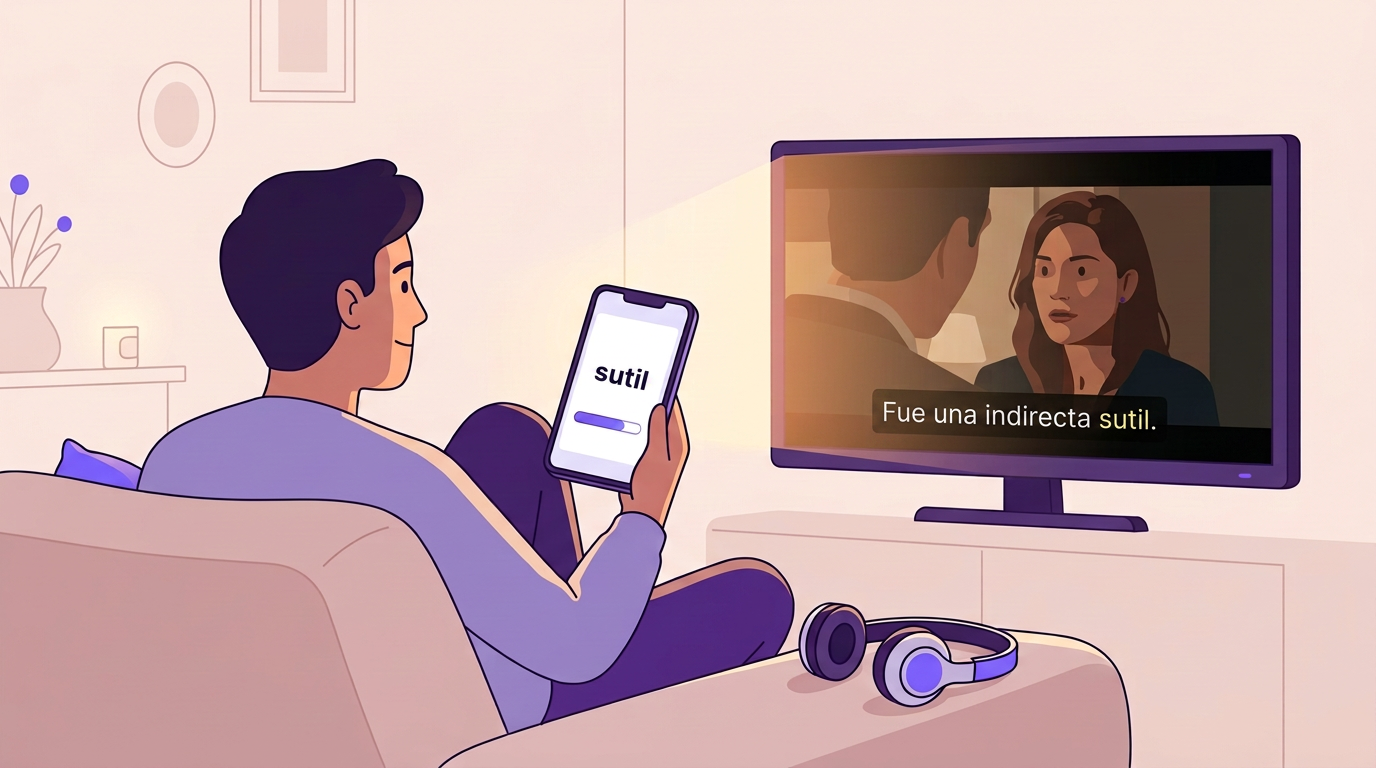
Words you meet "in the wild" — in a series, a song, a chat — stick better than artificial lists. They come with a scene, an emotion, and a situation they're tied to. When that situation comes up in conversation, the word surfaces along with it.
So instead of cramming someone else's topic lists, fish out words from what you're already watching and reading. We described how to turn this into a system in the article on how to learn Spanish with movies and TV shows. The rule is simple: hear an unfamiliar word in an interesting moment — save it right away together with the phrase it appeared in.
Rule 3. Say it out loud and build on it — switch on production
This is the most underrated step. For a word to become active, you have to produce it yourself — out loud or in writing. Not "recognize it in an exercise," but pull it out of your head to serve your own thought.
Three simple ways to train production:
- Say it out loud. Speak the new word in your own sentence about your own life. Not "solicitar — to apply," but "Voy a solicitar este trabajo la próxima semana" (I'm going to apply for this job next week).
- Complete the sentence. Give yourself a phrase with a gap and drop in the right word — that trains exactly the skill of retrieving a word to fit a context.
- Retell the meaning in your own words. Take a thought in English and express it in Spanish using new words.
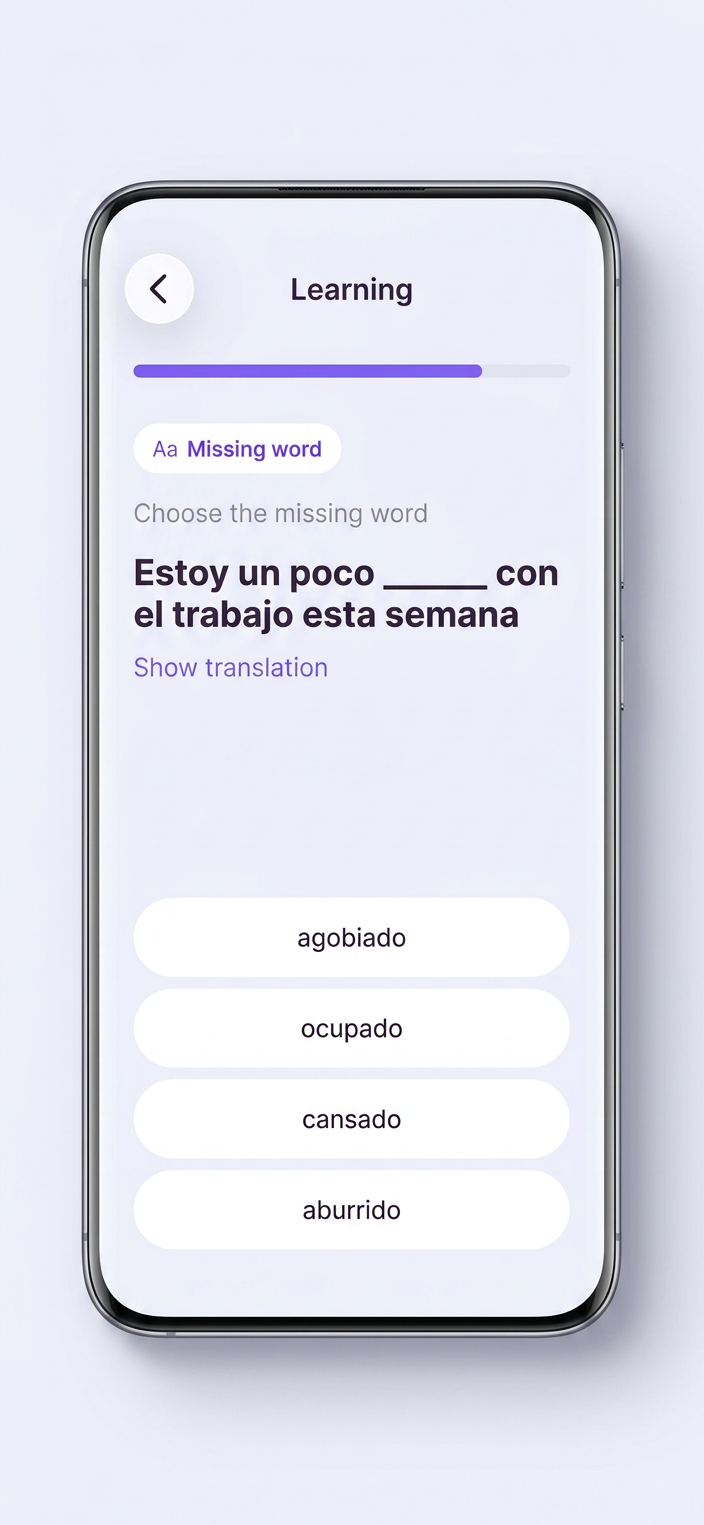
Even five of these mini-reps a day do more than a hundred passive reviews. Your brain remembers what was hard to retrieve, not what was easy to recognize.
Rule 4. Review on a schedule so active doesn't leak back
Active vocabulary is a perishable skill. A word you confidently dropped into speech yesterday will, a week later without review, slide back into passive and then vanish entirely. Spaced repetition saves it: the system shows you the word right as you're about to forget it, and every successful recall stretches the interval.
The key nuance — you have to review for production, not just for recognition. For more on how word memory works and how to set up your reviews, see the piece on how to memorize Spanish words effectively.
Passive habit vs active habit: a comparison
| What you do | Passive (recognition) | Active (speech) |
|---|---|---|
| Unit of learning | Word + translation | A whole phrase |
| Direction | Spanish → English | Meaning → Spanish |
| Action | Read it, recognized it | Said / wrote it yourself |
| Source of words | A ready-made list | Real context from life |
| Result | "I understand but stay silent" | The word shows up in conversation |
How to pull it all into one system with VibeLing
Keeping all four rules in your head and manually drilling words for production is exhausting. That's exactly what VibeLing is built for: it turns "I understand but stay silent" into a working active vocabulary.
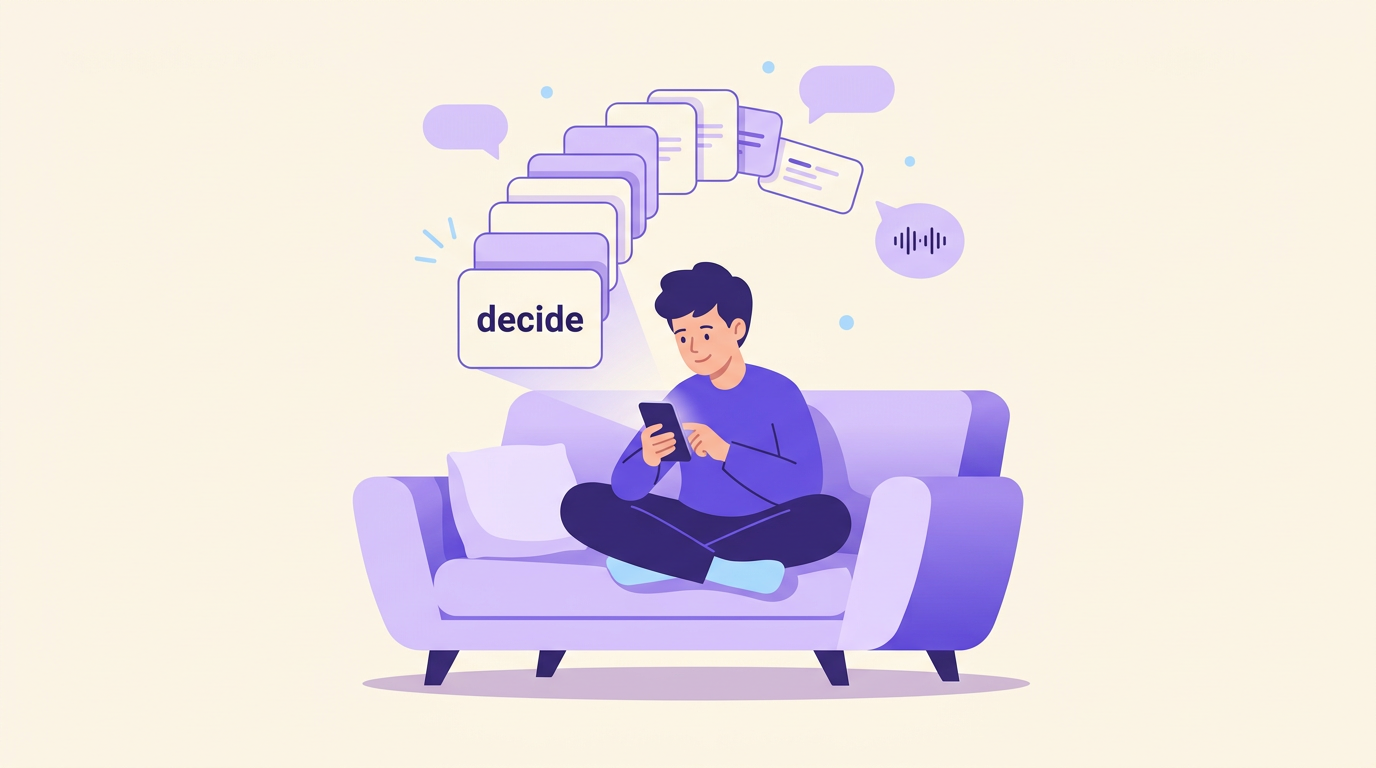
- You save a word or phrase from real life — straight from a series, a book, or a conversation, together with the context it appeared in. Not an abstract list, but your own personal words.
- You learn a phrase, not a bare word — with translation, transcription, and pronunciation, so a speech-ready block settles in your head.
- You train production, not just recognition — VibeLing gives you exercises where you fill the missing word into a sentence and say the translation out loud. That's exactly the skill that kicks in during a conversation.
- You review on a schedule — short daily sessions bring words back right when you're starting to forget them, and stop your active vocabulary from leaking back into passive.
The result is a closed loop: catch a word in real life → learn it inside a phrase → say it and build on it yourself → review it on time. That's how words make it into speech instead of sitting as dead weight in your passive store.
If you're tired of understanding everything and going silent in conversation — try VibeLing and start turning your vocabulary into active speech today. Download the app, save your first real word from a series or a chat — and say it out loud right now.
And to turn reading into practice — try VibeLing.