Learn Spanish Vocabulary with Podcasts
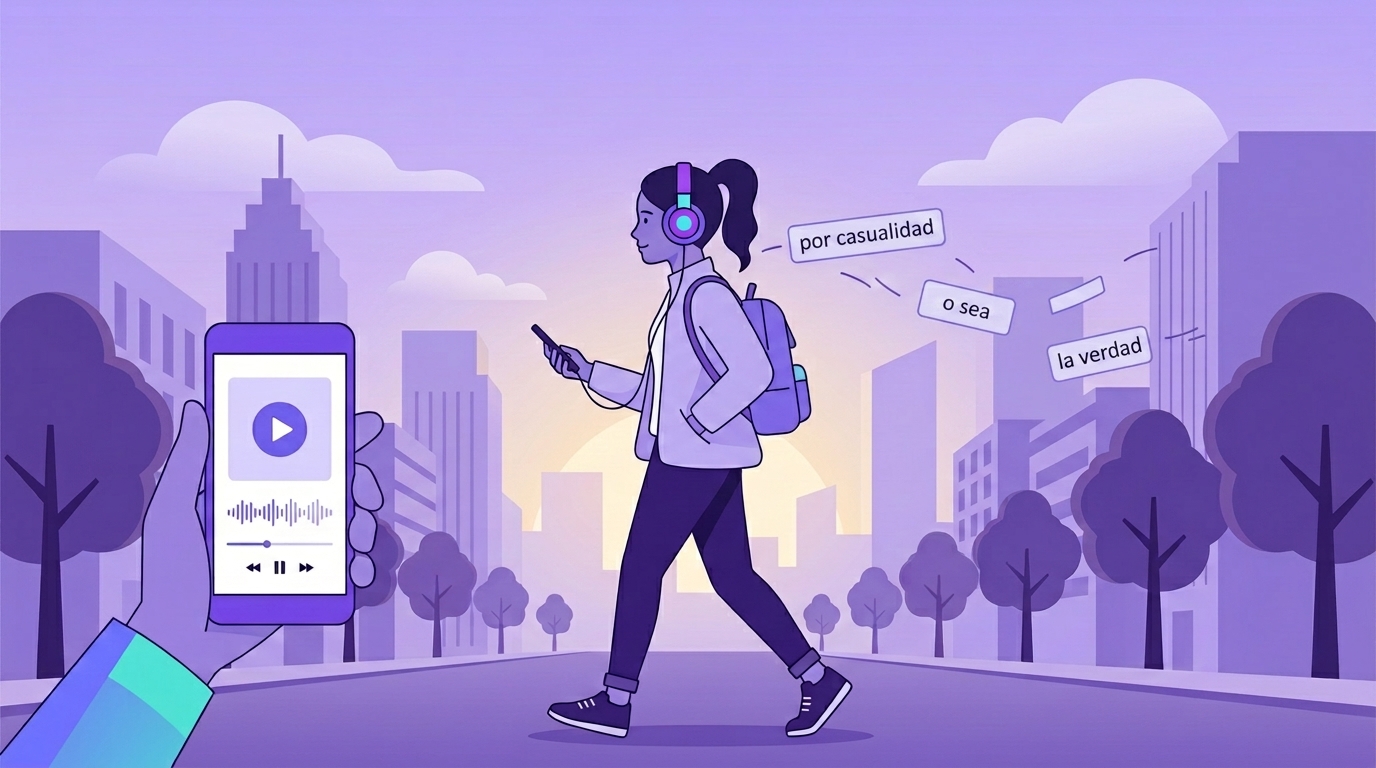
Everyone's day has time that simply evaporates: the commute, the checkout line, the dishes, walking the dog. Reading in those moments is awkward, watching videos even more so. Podcasts are the one learning format that slips into that time without friction. And for building Spanish vocabulary they work surprisingly well — if you listen the right way.
What podcasts give you that a textbook can't
Real speech at real speed. In textbook audio, narrators speak slowly and over-enunciate; nobody talks like that in life. Podcasts give you natural pace, contractions, filler words — exactly the Spanish you'll hear from an actual person in Madrid or Mexico City.
Conversational vocabulary that textbooks skip. O sea, pues, es que, la verdad, bueno — the connectors that make up half of spoken Spanish. You won't learn them from a coursebook, but in podcasts they come up every minute.
Natural repetition. Every host has favorite words and turns of phrase, and they resurface episode after episode. A word you noticed this week will come back on its own next week — that's spaced repetition, except free.
Pronunciation included. A word learned from a screen is easy to recognize in text and miss completely by ear. A word from a podcast arrives with its sound attached.
How to pick a podcast for your level
The golden rule: you should understand roughly 70–80% without straining. If you understand everything, it's too easy — no new words in it for you. If you only catch isolated words, your brain checks out after five minutes and the benefit is zero.
| Level | What to listen to | Where to start |
|---|---|---|
| Beginner | Podcasts for learners: slow speech, short episodes, words explained in English | Coffee Break Spanish, Duolingo Spanish Podcast |
| Intermediate | Learner podcasts with natural but clear speech and transcripts | Notes in Spanish, Españolistos |
| Advanced | Regular podcasts made for native speakers — on your interests: tech, sports, storytelling | Radio Ambulante, or any popular Spanish-language show on a topic you already know well in English |
At the advanced level, topic beats "usefulness": a podcast about something you genuinely care about is one you'll play without willpower. And a familiar topic gives you context that makes unknown words easy to guess.
The big mistake — background listening
The most common scenario: you press play, go about your business, and ten minutes later catch yourself thinking about something else entirely. The pleasant murmur of Spanish in the background gives you the feeling of studying — with none of the progress. Background listening reinforces what you already know and adds almost nothing new: an unfamiliar word flies past and leaves no trace.
That doesn't make background play useless — for getting your ear used to the sound of Spanish, it's fine. But vocabulary only grows from active work, and the active version is simple.
The method: listen → notice → save → review
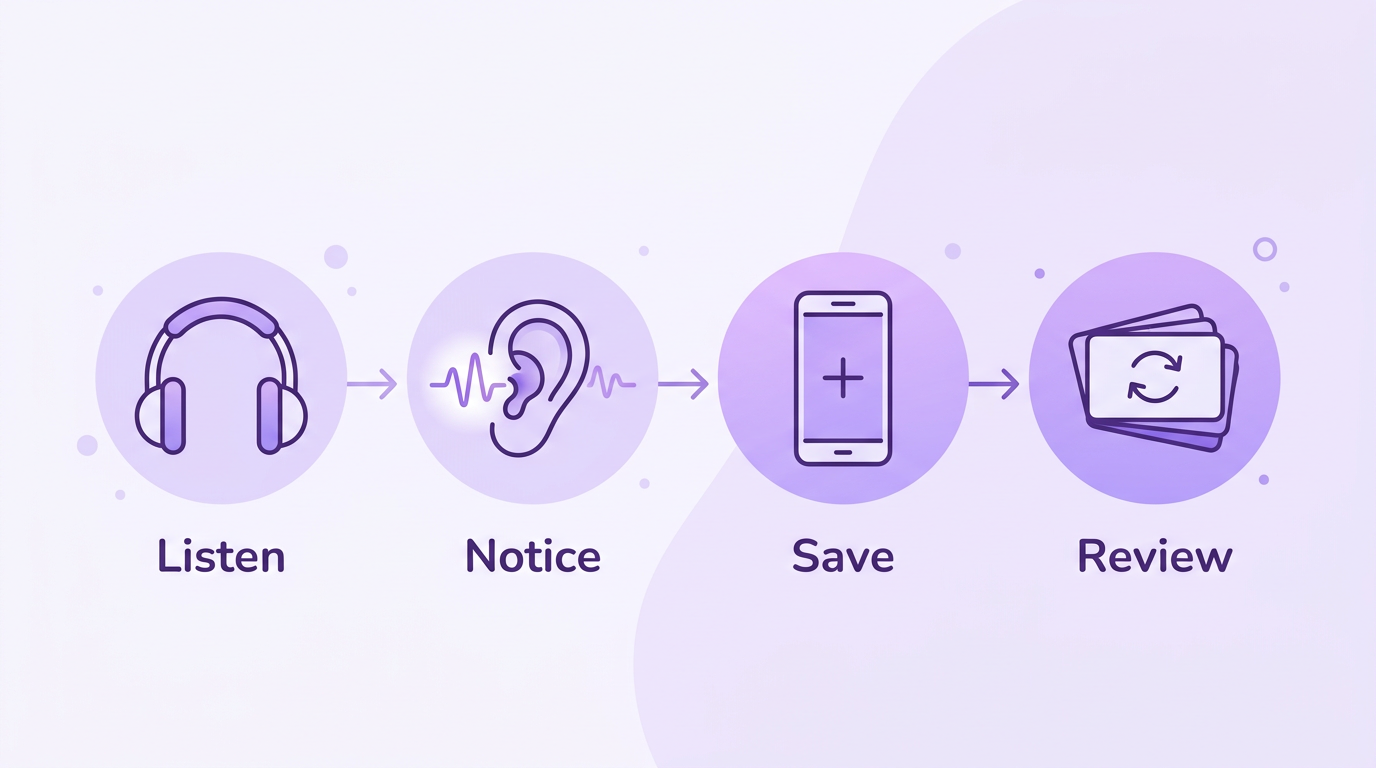
Listen with the transcript within reach. Most learner podcasts publish transcripts, and many regular shows do too. Don't read along with the whole episode — listen, and glance at the transcript when something slips past you.
Notice — but not everything. From a half-hour episode you could write down thirty unknown words — and learn none of them. The working quota is 3–5 words or phrases per episode. Take the ones you've met before or clearly need yourself.
Save immediately. Heard an unfamiliar word — pause, save it, keep going. You won't recall it later: an unknown word heard once survives in memory for seconds.
Repeat the episode. A second listen of the same episode a couple of days later pays off surprisingly well: the words you saved now pop out of the stream, and that's the best proof they're actually learned. It also helps to repeat individual phrases out loud after the host — pronunciation improves through your mouth, not your ears.
Where to save words so you actually come back to them
Notebooks and phone notes fail in the same spot: everything goes in, nothing comes back out. A word list you never revisit is just a wasted pause in your podcast.
So save words where review is built in. In VibeLing it looks like this: you hear "me enteré por casualidad" in an episode — pause, type por casualidad into the search. The app shows the translation, examples, a picture and audio — and you can double-check you heard the phrase right. From there it sits in your personal dictionary, and short training sessions bring it back at the right intervals until it settles into memory for good.
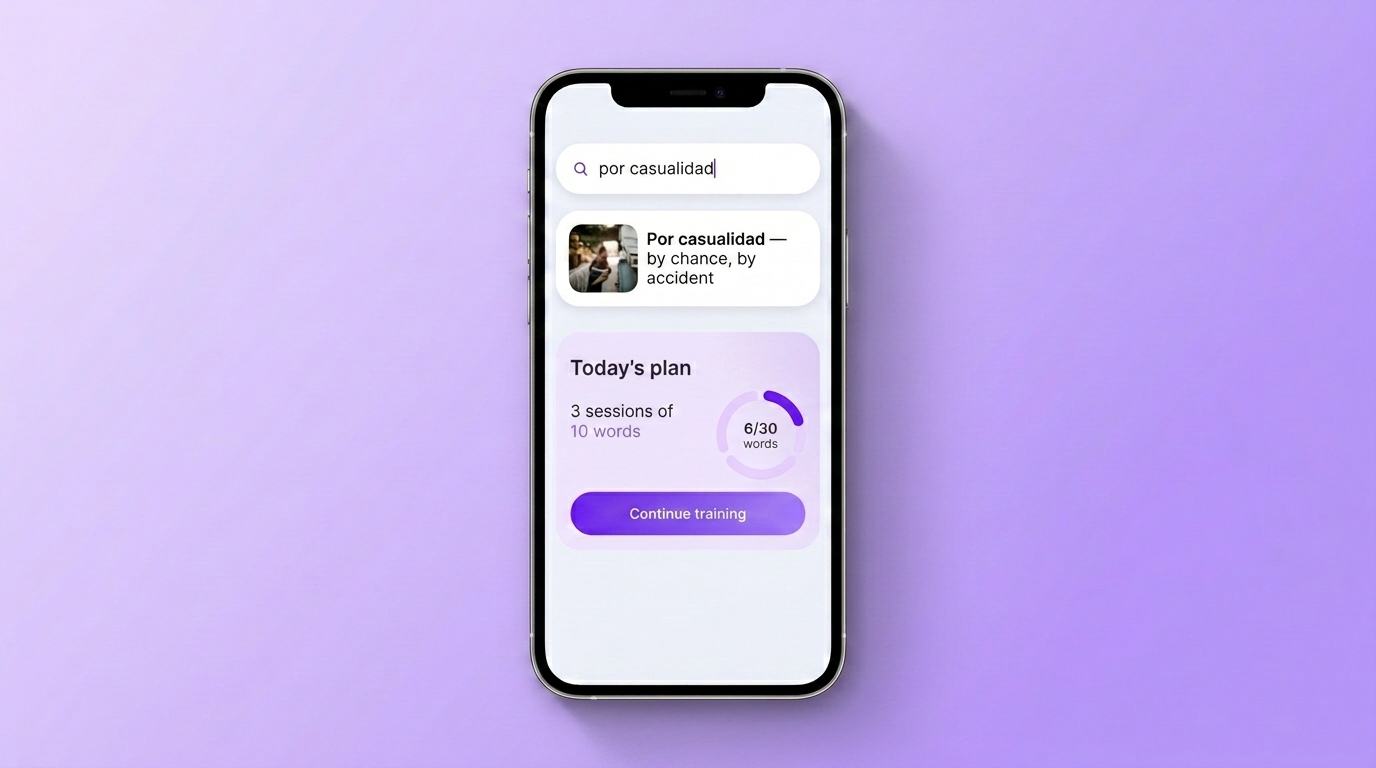
The same approach — notice, save, review — works with any content: we've walked through it with YouTube videos and movies and TV shows. Podcasts simply cover the part of your day that screens can't reach.
Your first-week plan
- Pick one podcast for your level from the table above. One, not five.
- Tie it to a specific time slot: the commute, a walk, the gym.
- Save 3–5 words or phrases from each episode — pause and save on the spot.
- Two or three days later, replay the episode and check whether you recognize your saved words in the stream.
- Train what you've saved for 10 minutes a day so the words don't stay stuck in a list forever.
A month of this routine gives you 60–100 living words, each one heard in real speech and recognizable by ear. To make sure they stick, give VibeLing a try — save words right from the podcast pause, and let the app handle the review schedule.