How to Learn Spanish Vocabulary from Songs
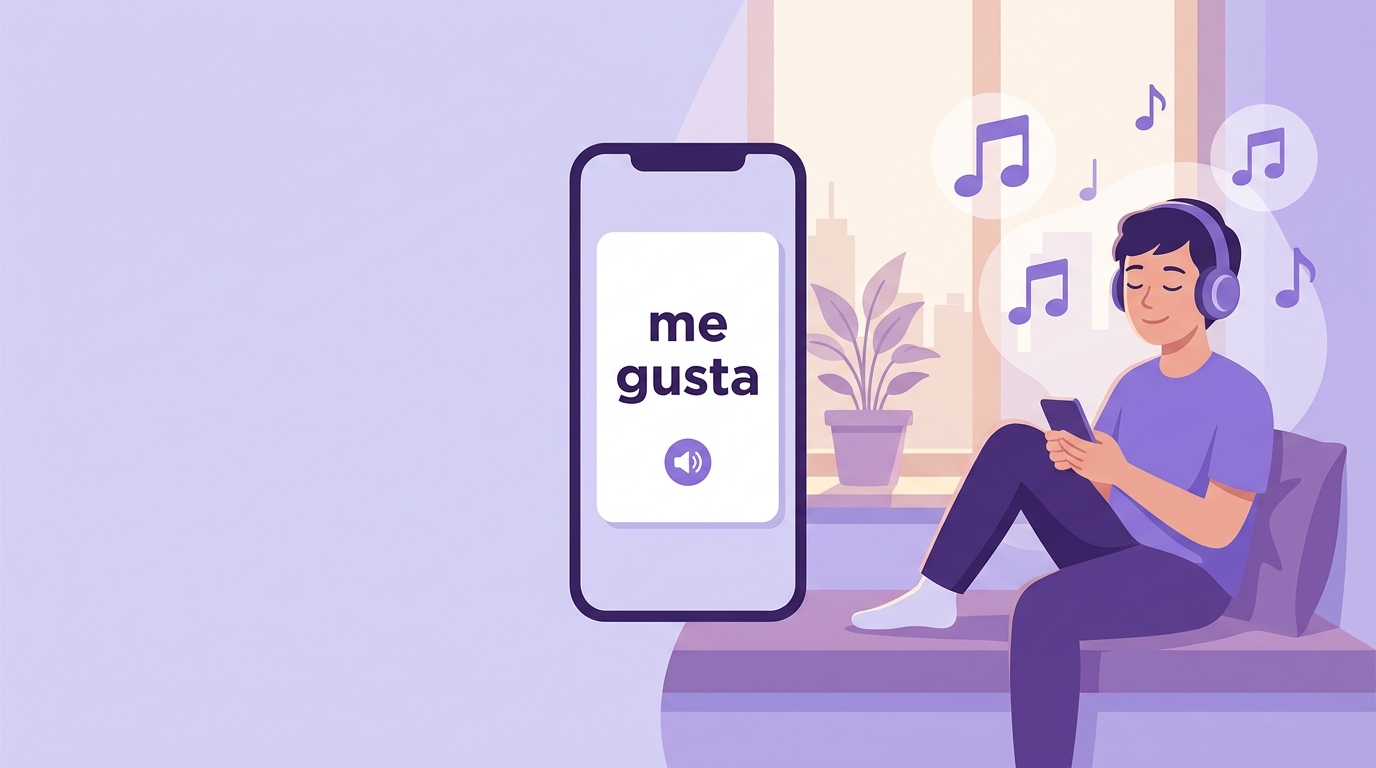
A chorus can loop in your head for a week without you making any effort to keep it there. Now try to recall what the second verse of that same song actually says. Usually it turns out half the lines never resolved into words at all. You listen to music for years and your vocabulary barely moves.
The problem isn't the songs. Listening on its own doesn't turn into words you can use. What's missing is a small routine around the track — it takes about twenty minutes and pulls 5–8 expressions out of one song that actually stay with you.
Why songs stick better than textbook dialogues
A song gives you something plain text can't: melody, rhythm and rhyme. Those are extra hooks for your memory — recall the tune and the words come along with it. On top of that, the chorus repeats three or four times per track, so review is built into the song for free.
The second reason is purely practical. You listen to a song willingly and repeatedly because you like it. No audio course will ever get thirty plays out of you.
But the method has a hard limit, and it's worth knowing up front. Passive listening builds recognition: you hear it, you understand it. For a word to surface when you are the one speaking, you have to pull it out of memory rather than merely identify it. So what follows isn't about listening more — it's about what you do with a song after the music stops.
Which songs actually work
Picking the track is half the job. A good study song looks like this:
- Clear vocals. If you can't make out the words even with the lyrics in front of you, the song is wrong for this — your level has nothing to do with it.
- Moderate word density. Ballads, pop, Latin folk, singer-songwriter tracks: few words, repeated often, with pauses between lines.
- Everyday vocabulary. Songs about relationships, work, the city, the road hand you words you'll actually use in conversation.
What to save for later: fast reggaetón and Spanish rap (word density like an audiobook at double speed), heavy regional slang, and older tracks full of dated turns of phrase. One more thing — don't queue up a forty-track playlist. One song for a week gives you more than forty songs in an evening.
Four passes through one song
The scheme is simple: each pass adds a layer of understanding instead of starting over.
| Pass | What you do | Why |
|---|---|---|
| 1. By ear | Listen with no lyrics, note what you caught | An honest check of your listening — skip it and you're just reading with your eyes |
| 2. With lyrics | Read along with the audio, don't translate yet | Links what you hear to what's written, catches swallowed endings |
| 3. Breakdown | Write out 5–8 words and expressions with meanings | Turns the song into concrete material you can review |
| 4. Singing along | Sing with the artist | Trains pronunciation and speech rhythm |
The first two passes take three or four minutes each, the breakdown around ten minutes, and singing along can stretch across the whole week in your headphones on the way to work.
What to write down, and what to skip
The most common mistake in pass three is collecting beautiful rare words. Songs are full of abstract vocabulary like alma, eternidad, anhelo: it sounds striking, but you'll almost never say it. Verbs and set phrases are far more valuable — ordinary speech is built out of those.
Here's what a good haul from well-known songs looks like:
| Line | Expression | Meaning |
|---|---|---|
| Voy a reír, voy a bailar | voy a + infinitive | I'm going to (do something) |
| Me gustas tú | me gusta / me gustas | I like it / I like you (literally: it pleases me) |
| Hasta que te conocí | hasta que | until |
| Poco a poco | poco a poco | little by little, gradually |
All four will come in handy in a message or a conversation within the week. The selection rule comes down to one question: could I drop this expression into a sentence of my own? If not, skip it, however pretty the word is.
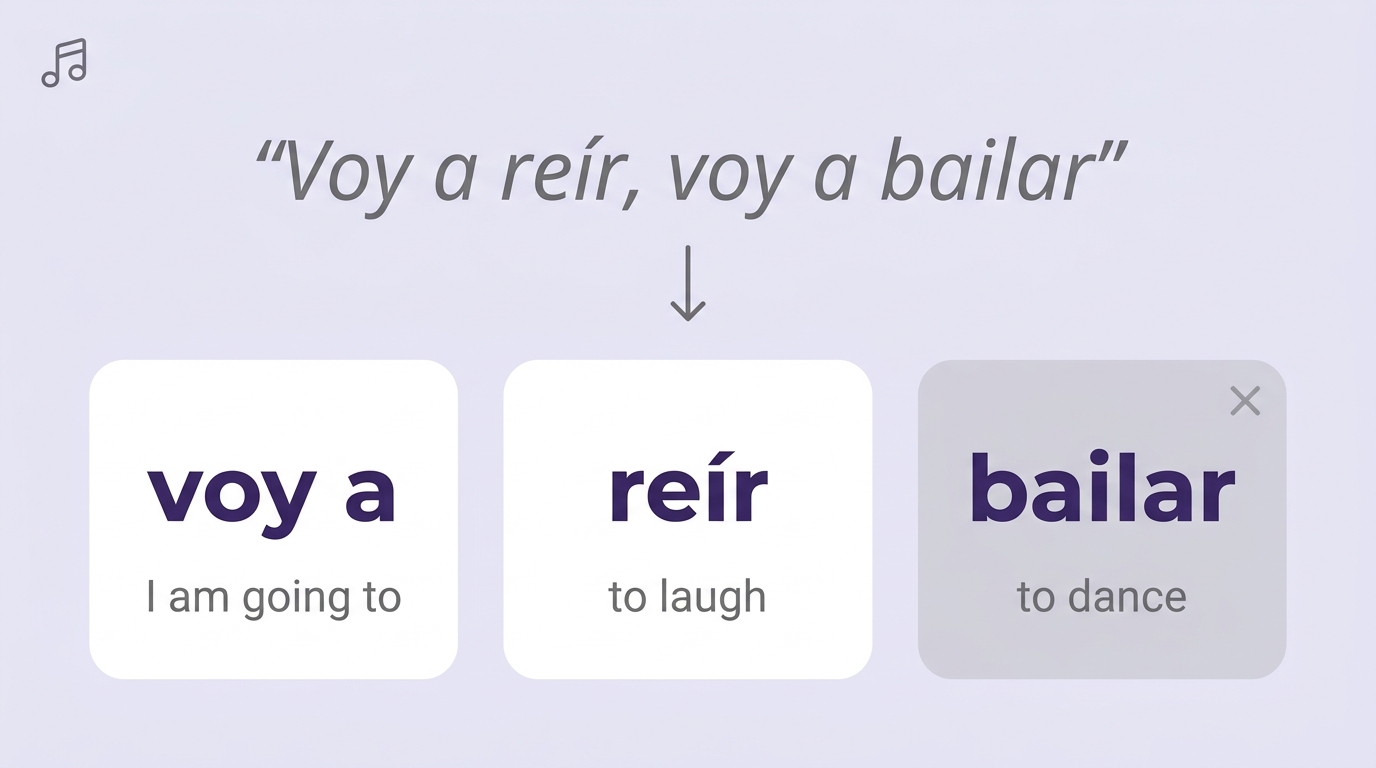
Write the expression down whole, along with a fragment of the line. On its own voy means very little, while voy a bailar — from a song you've heard twenty times — comes back to you with the melody attached. This isn't specific to music: the whole expression is almost always more useful than a single word pulled out of it.
The traps of song Spanish
Lyrics are written to fit a rhythm and a rhyme, so the language in them sometimes departs from normal Spanish. You need to understand these things — you don't need to copy them.
- Swallowed consonants. In Caribbean and Andalusian singing the final -s and -d often vanish: está becomes something like ehtá, cansado becomes cansao. What you hear isn't always what's written, which is exactly why pass two with the lyrics is non-negotiable.
- Diminutives everywhere. despacito (slowly), poquito (a little bit), ahorita (right now). They're normal in speech, but the -ito ending carries a warmth that doesn't fit every context.
- Regional forms. A song from Spain will use vosotros; one from Latin America won't, and in Argentina you'll meet vos instead of tú. All are correct — just not in the same place.
- Word order bent for the rhyme. A line may put the adjective, the verb or the pronoun somewhere no one would put it in a normal sentence.
How not to lose what you wrote down
Two weeks from now, expressions pulled from a song will fade exactly like words from any other source, unless you come back to them. The only thing that works here is regular review at growing intervals: today, in a day, in three, in a week. The mechanism behind that is covered in detail in the article on spaced repetition.
Keeping that schedule in your head or a notebook isn't realistic, so it's easier to hand it to an app. In VibeLing you add voy a bailar right after the breakdown, get the translation, an example sentence and audio, and from there the app brings the expression back for review at the right moment. It's worth giving each song its own collection — then the words stay tied to the track instead of dissolving into one long list.
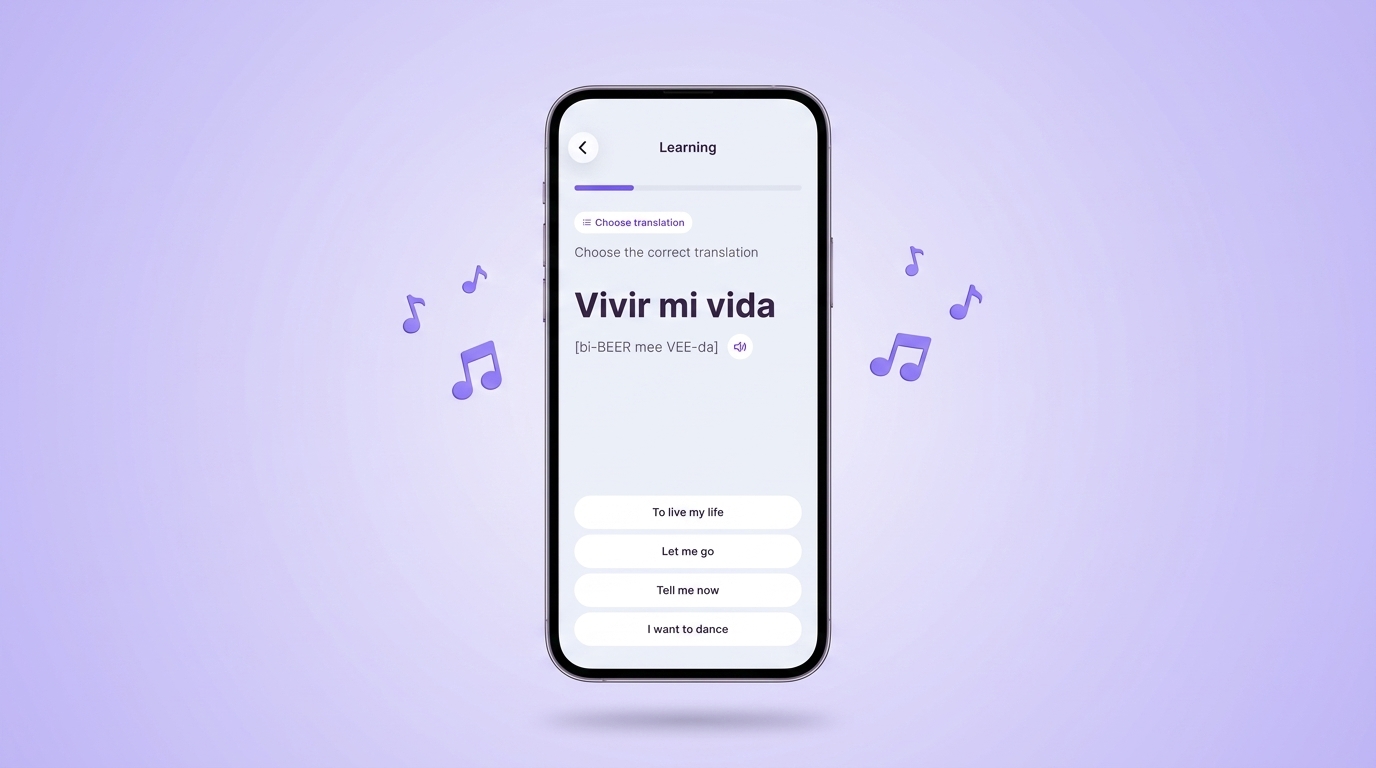
The pronunciation exercise deserves a separate mention: the app shows the meaning and asks you to say the word out loud. For song vocabulary that fits especially well — you've already heard a native speaker sing it, so all that's left is to say it yourself.
Sing along, even if you can't sing
Plenty of people skip the fourth pass, and it gives you something no amount of reading will. When you sing along, you physically reproduce someone else's rhythm and someone else's links between words. In Spanish, neighbouring vowels run together: voy a comes out as a single sound. Producing that at normal speed is hard on its own, but it happens by itself under music, because the melody sets your pace.
Karaoke versions and lyric videos beat a plain recording here: the text in front of you keeps you on track, and the artist's voice doesn't drown out your own.
A week with one song
So that none of this stays theoretical, here's a working schedule. It costs 10–15 minutes a day.
- Monday. Passes one and two, the breakdown, 5–8 expressions added to the app.
- Tuesday to Thursday. The song in the background on your commute, plus a short review session.
- Friday. Sing along with the lyrics in front of you.
- Weekend. Listen with no lyrics and check how much you understand now. The difference from Monday is usually obvious.
Over a month that's four songs and 20–30 living expressions. Not a huge number, but these are expressions you recognise by ear and can pronounce, rather than a line in a notebook.
Where to start today
Open a song you've had on repeat for the past few weeks anyway. Find the lyrics, run the first three steps and write out at least five expressions. Twenty minutes. If music works for you as a source of language, films and TV shows are worth a try too — the principle is the same, there's just more material.
And so that your haul doesn't sit dead in a notes app, start your own Spanish word collection in VibeLing: add words while you're still breaking the song down, and let the app make sure you come back to them in time.