How to Learn Spanish Words from Reading
Reading in Spanish has a reputation as something for advanced learners: first I'll build my vocabulary, then I'll pick up a book. In practice it works the other way around — books are one of the most reliable ways to grow your vocabulary. A word from a book arrives with a story attached: who said it, what was happening, how the scene ended. Your memory has something to hold on to, unlike a line in a study list.
The real problem is different: most attempts to read with a dictionary die somewhere in chapter two. Below is how to choose a book you will actually finish, which words to write down and which to skip without guilt, and what to do with the words you collect so they are still with you a week later.
Why books build vocabulary so well
Frequent words repeat constantly in running text. If a word is in the top three or four thousand by frequency, you will meet it dozens of times in an average novel — in different forms, with different prepositions, in different situations. The book drills the vocabulary with you, simply through the amount of text.
The second thing books give you is collocations. On a flashcard from a textbook, tomar is just "to take." In a real text you see tomar una decisión, tomar en cuenta, tomarse el tiempo — ready-made chunks that your own speech is later built from. You cannot learn that from isolated words.
The biggest mistake: a book that is too hard
Comfortable reading depends on the share of words you already know. Reading researchers usually put the threshold at about 98%: when roughly one word in fifty is unfamiliar, the text flows, and you can guess many new meanings from context. When every tenth word is unknown, reading turns into decoding, and the book goes back on the shelf. There is more on how vocabulary size relates to comprehension in our article on how many words you need to speak Spanish.
A quick test: open a random page and count the unfamiliar words. Five to seven per page is fine. Noticeably more — pick an easier book. This is not about ambition; it is about whether you will finish it.
What usually works:
- Graded readers. Publishers release classics and modern stories rewritten for a specific level — from a few hundred words up to three or four thousand. These are proper stories with controlled vocabulary, not children's books.
- Books you have already read in English. A familiar plot quietly suggests the meaning of unfamiliar words.
- Detective novels and genre fiction. Short sentences, lots of dialogue, fast action — noticeably easier to read than nineteenth-century classics.
Which words to write down — and which to skip
The second way to kill your reading habit is writing down every unknown word. You end up spending half an hour per page and filling a notebook you never want to open again. Unknown words in a book are not equally valuable, and most of them can be skipped with no consequences.
A word is worth writing down when it:
- blocks your understanding of the scene — the passage makes no sense without it. That one you look up right away;
- has already appeared two or three times — if it keeps coming back, it is frequent, and frequent words pay off fastest;
- is something you would want to say yourself — you read it and realized this was the word you had been missing.
Skip the rest without guilt. A rare word from a harbor scene will do you no harm unlooked-up: if it really matters, it will come back. A good target is five to ten words per reading session, no more.
Save the phrase, not the lonely word
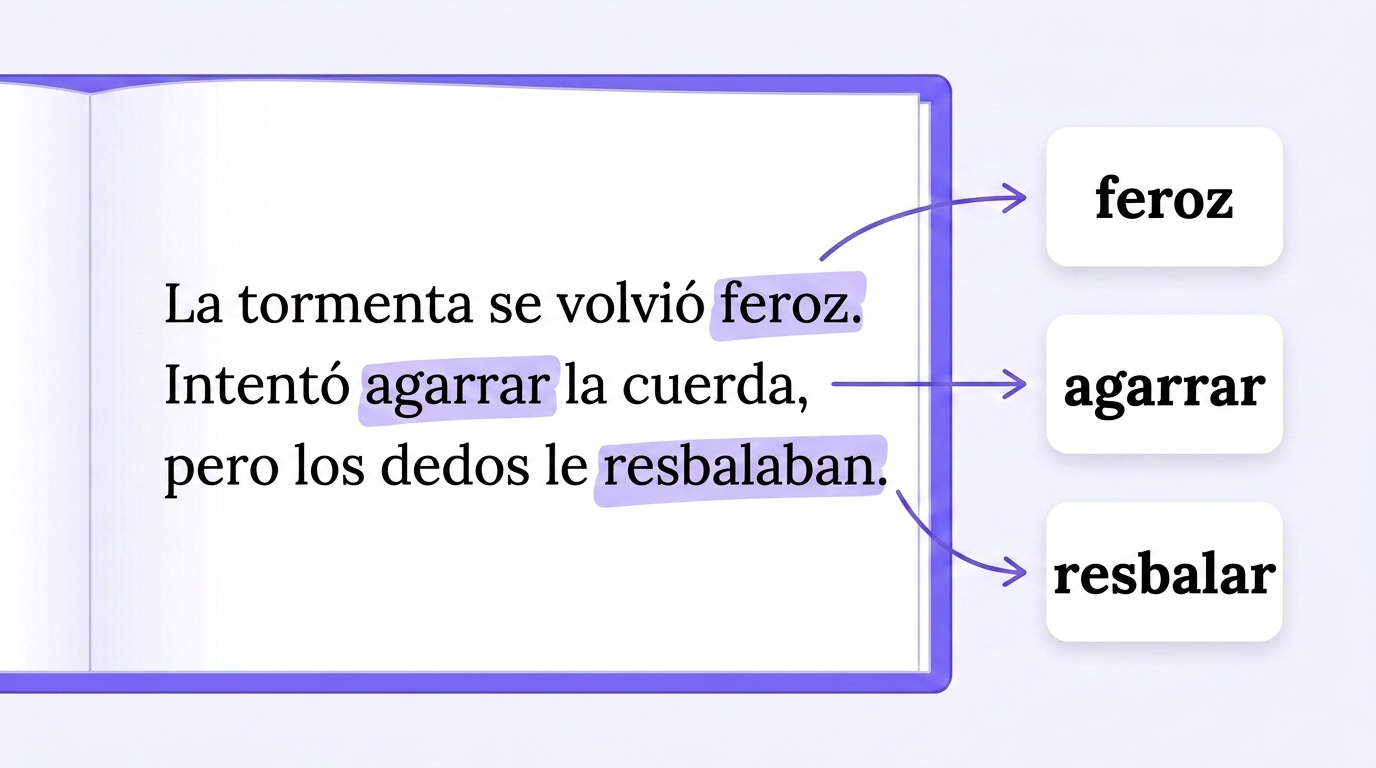
A word written in a column — "agarrar — to grab" — will mean nothing to you a week later. Save it together with the piece of the sentence where you met it:
Intentó agarrar la cuerda, pero los dedos le resbalaban.
The context brings the scene back, and the meaning with it. You also remember how the word behaves in a sentence: which preposition it takes, which words usually stand next to it.
What to do with the words after reading
Writing words down does almost nothing by itself. If you never come back to the list, in a couple of weeks it is no different from the words you simply skipped. For a word to stay, you need to review it several times at growing intervals — on day one, a day later, then a few days after that. We covered how this mechanism works in our article on spaced repetition.
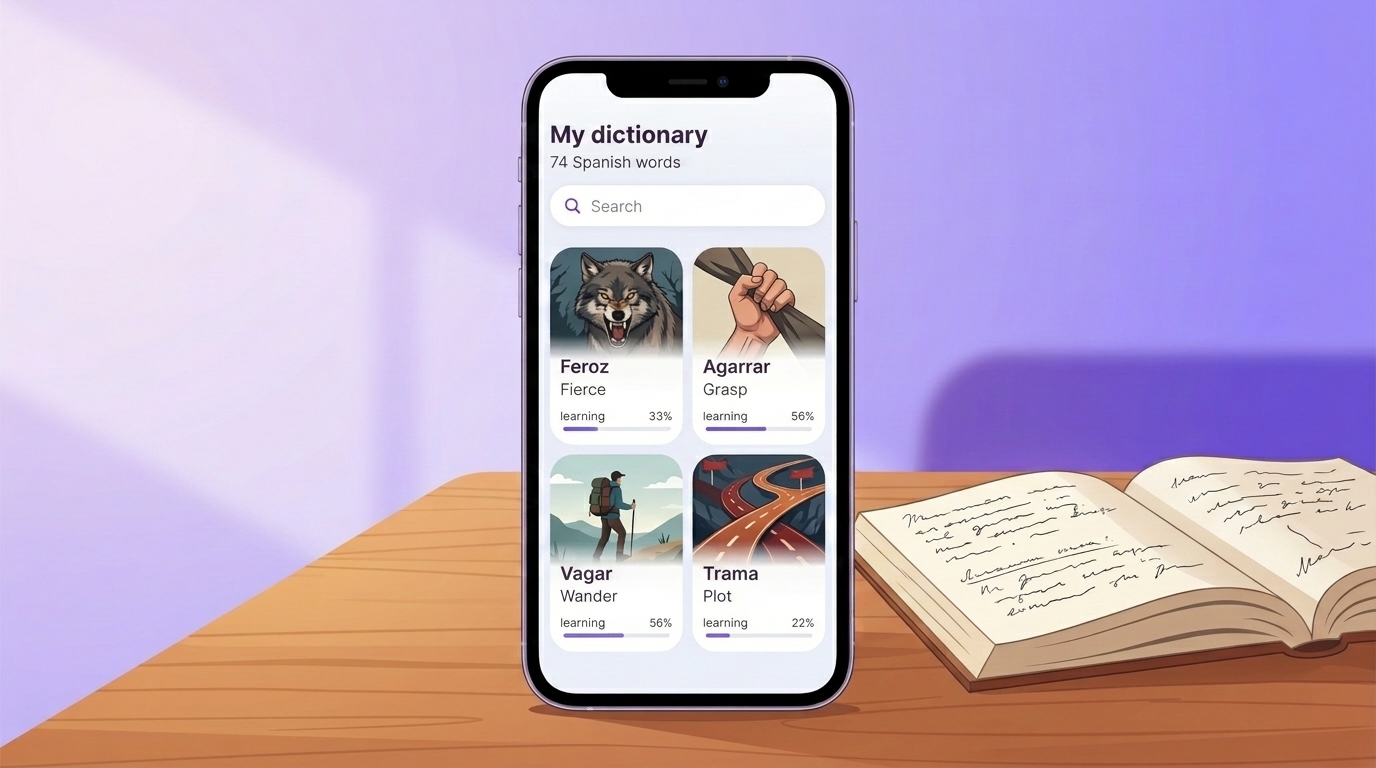
Keeping that schedule by hand in a notebook is a chore, so it is easier to hand this part to an app. In VibeLing it looks like this: you meet resbalar in a book — you type it into the app and get the translation, real example sentences, and audio. The word lands in your personal dictionary, and VibeLing then brings it back in short training sessions exactly when it is time to review. You can create a separate collection for each book — it is satisfying to see how many words one novel has given you.
How much to read for it to work
Consistency matters more than volume here. Fifteen to twenty minutes a day beats three hours once every two weeks — both for the habit and for the number of encounters with new words. A month of that adds up to a few hundred pages and one or two hundred carefully chosen words.
Where to start
- Pick a book by the "no more than five to seven unknown words per page" rule — a graded reader or something you have already read in English.
- Read 15–20 minutes a day. Open the dictionary only for words that block the scene.
- Write down 5–10 words per session — together with the phrase they appeared in.
- Add them to an app and review for a couple of minutes a day.
You will collect your first hundred words from books faster than you expect. To make sure they do not get lost, start a personal dictionary in VibeLing: add words right as you read, and let the app take care of the review schedule.