Why You Should Learn Spanish Phrases, Not Just Individual Words
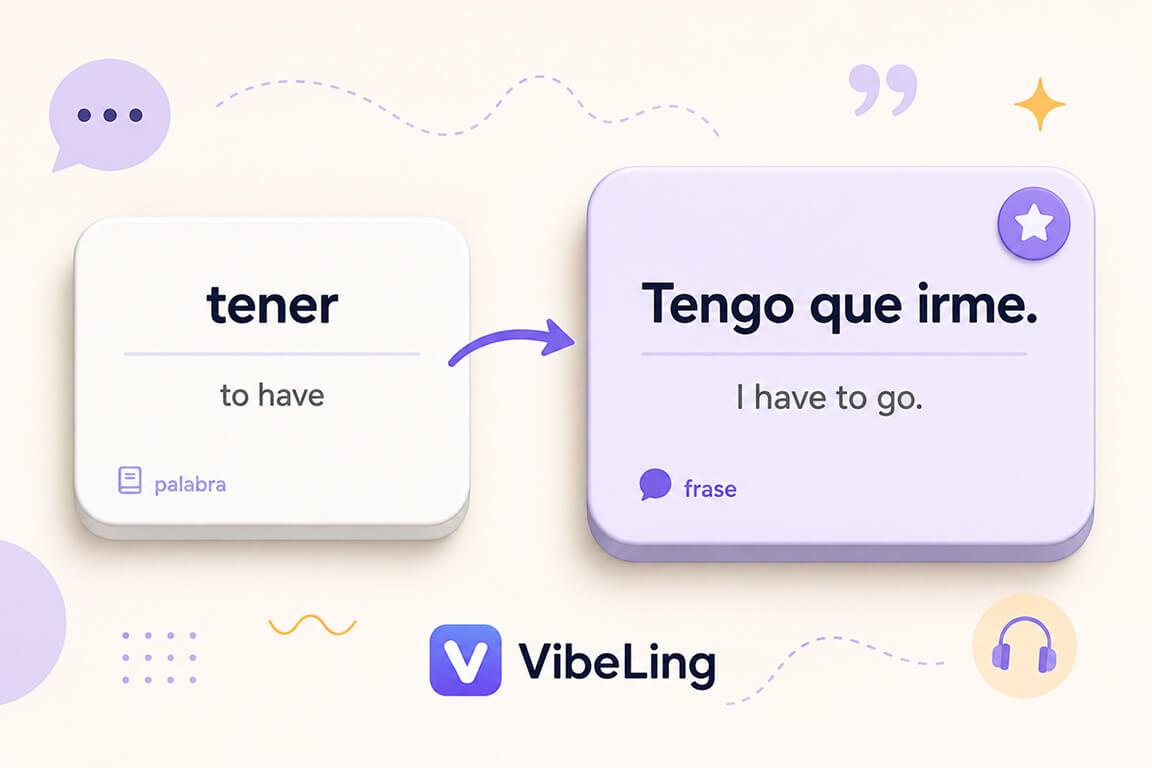
Many people start learning Spanish by memorizing word lists:
tener — to have
hacer — to do / to make
sentido — meaning / sense
igual — equal / same
At first, this feels logical. The more words you know, the better you should be able to speak.
But in real life, it often does not work that way.
You can know hundreds or even thousands of Spanish words and still freeze when you need to say something simple. You may recognize words while reading, understand short videos, and still struggle to produce a natural sentence in a conversation.
One reason is simple: real Spanish is not built only from isolated words.
It is built from phrases, expressions, and ready-made patterns:
¿Qué quieres decir?
No tengo ni idea.
Tiene sentido.
Me da igual.
¿En serio?
No pasa nada.
Déjame pensar.
These phrases are much more useful than separate words because they are already connected to meaning, grammar, and real situations.
In this article, we’ll look at why learning full Spanish phrases can help you speak faster, remember vocabulary better, and sound more natural.
How I came to this idea
A few years ago, I was actively learning English.
My goal was practical: I wanted to move abroad, work in an international company, and stop feeling like a person who “knows the language” but freezes every time a real conversation starts.
I worked with a native-speaking teacher. Our lessons were not classic grammar lessons where we spent the whole hour analyzing one tense. We mostly talked.
At the same time, I watched TV shows in English. Usually Silicon Valley or Breaking Bad. Before each lesson, I had to retell the previous episode in my own words: what happened, what the characters said, why someone got angry, what I understood, and what confused me.
My teacher kept giving me one piece of advice:
Don’t write down only separate words. Write down full phrases and try to use them later in conversation.
At first, I thought this was strange.
If I did not know the word mean, why not just write:
mean — to signify / to intend
Why should I write the whole phrase?
What do you mean?
I didn’t mean it.
That means a lot.
I thought: I’ll learn the word first, and then I’ll build sentences with it myself.
Later I realized that this was exactly the problem.
The same idea applies perfectly to Spanish.
We do not speak in separate words
When we learn a language, we often imagine speech as a collection of separate words:
tener
hacer
decir
pensar
saber
It feels like we first need to collect enough “bricks” and then build sentences from them.
But real speech does not work only this way.
We constantly use ready-made language chunks:
No sé.
¿Qué quieres decir?
Déjame pensar.
Para ser sincero.
No tengo ni idea.
Tiene sentido.
Hasta luego.
Technically, these phrases consist of individual words. But the brain often does not build them from scratch every time.
It retrieves them as whole units.
Think about reading.
You do not read the word “computer” letter by letter:
c
o
m
p
u
t
e
r
You see the whole word.
Something similar happens with common phrases.
When you know the Spanish phrase no sé, you do not mentally assemble:
no
sé
You simply retrieve:
No sé.
This is one reason fluent speech feels fast.
Fluent speakers are not applying grammar rules from zero every second. They already have many ready-made patterns stored in memory.
What linguistics says about this
In linguistics, such patterns are often called formulaic sequences. You can also think of them as chunks, fixed expressions, or semi-fixed phrases.
They can be short:
No sé.
Hasta luego.
Claro.
No pasa nada.
Or longer:
No tengo ni idea.
¿A qué te refieres?
Eso no tiene sentido.
Si te soy sincero.
Research on formulaic language shows that ready-made multi-word units play a major role in natural language use. Erman and Warren estimated that such prefabricated expressions make up a large part of spoken and written English — over half of the material in their dataset. Their study is based on English, but the broader point is relevant to language learning in general: natural speech contains many repeated patterns, not only new sentences invented from scratch.
There is also evidence that formulaic sequences are processed faster. Conklin and Schmitt found that both native and non-native speakers read formulaic phrases more quickly than comparable non-formulaic phrases.
This helps explain why phrases are so useful for learners.
It is easier for the brain to retrieve a familiar chunk than to build a sentence word by word under pressure.
This idea is also connected to the Lexical Approach in language teaching. In this approach, language is not seen only as “grammar plus individual words”, but as a system of lexical units: words, collocations, chunks, and fixed phrases. British Council describes the lexical approach as teaching language through lexical units, including chunks and fixed phrases.
Why an individual word often does not help you speak
Let’s take the Spanish verb tener.
In a dictionary, it usually means:
tener — to have
Useful, of course.
But now look at real Spanish phrases:
Tengo frío.
Tengo hambre.
Tengo que irme.
Tengo ganas de verte.
No tengo ni idea.
If you translate word by word, some of them may feel strange.
Tengo frío is literally “I have cold”, but in English you say:
I’m cold.
Tengo hambre is literally “I have hunger”, but naturally:
I’m hungry.
Tengo que irme means:
I have to go.
Tengo ganas de verte means something like:
I feel like seeing you.
I want to see you.
No tengo ni idea means:
I have no idea.
If you only learn:
tener — to have
you know the word, but you still may not know how to use it naturally.
But if you learn the full phrases, you immediately get useful speech patterns.
This is the main difference.
A word gives you a translation.
A phrase gives you a way to say something.
Phrases give words context
An isolated word often floats in your memory without a clear place to use it.
For example:
sentido — sense / meaning
This word is useful, but by itself it does not tell you much.
Now look at phrases:
Tiene sentido.
No tiene sentido.
¿Tiene sentido para ti?
Now the word becomes alive.
You understand not only what it means, but also how it works in real speech.
The same with igual.
You can learn:
igual — same / equal
But in real conversations, these phrases are much more useful:
Me da igual.
Igual tienes razón.
Es igual.
Depending on the context, me da igual may mean:
I don’t care.
It does not matter to me.
Either way is fine.
That is something a simple word translation cannot fully explain.
Phrases give vocabulary context, grammar, tone, and usage.
Phrases help you speak faster
In a real conversation, you do not have time to build perfect sentences.
Someone asks you a question, and you need to answer quickly.
Even if your answer is not perfect, you need something to start with.
Ready-made phrases help a lot here.
If you need a second to think:
Déjame pensar.
If you do not know:
No tengo ni idea.
If you agree:
Tiene sentido.
If you are surprised:
¿En serio?
If something is not a problem:
No pasa nada.
If you want to clarify:
¿Qué quieres decir?
Each phrase is a small bridge in a conversation.
It helps you avoid freezing.
The more bridges you have, the easier it becomes to speak.
Phrases help you learn grammar naturally
Phrases are not only good for vocabulary. They also help you absorb grammar.
For example, Spanish learners often struggle with constructions like:
tengo que + infinitive
You can study the rule.
But you can also learn useful phrases:
Tengo que irme.
Tengo que trabajar.
Tengo que pensarlo.
Tengo que llamar a mi amigo.
After seeing and using these phrases several times, your brain starts noticing the pattern.
The same happens with:
voy a + infinitive
For example:
Voy a intentarlo.
Voy a verlo.
Voy a preguntarle.
Voy a prepararlo.
This does not mean grammar is useless.
Grammar is useful.
But grammar becomes much easier to use when it is attached to real phrases, not only abstract rules.
Why movies, series, podcasts, and real conversations are so useful
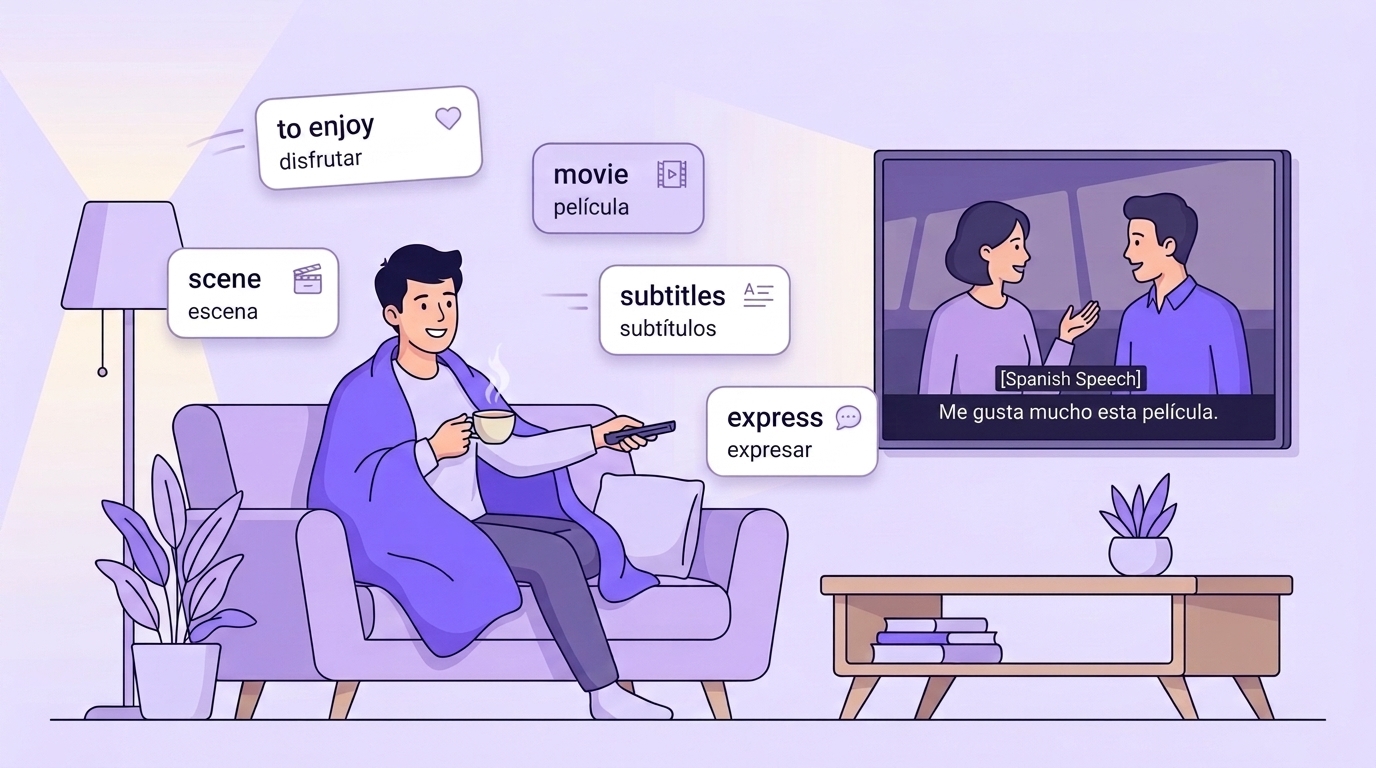
Movies, TV shows, podcasts, YouTube videos, songs, and real conversations are useful because they show language in context.
A dictionary may show you:
pasar — to pass / to happen
dar — to give
tener — to have
hacer — to do / to make
But in real Spanish, you hear:
¿Qué pasa?
No pasa nada.
Me da igual.
Tengo que irme.
¿Qué haces?
And this is where the language becomes real.
¿Qué pasa? is not something you should translate as “What passes?”
It means:
What’s happening?
What’s wrong?
What’s up?
No pasa nada literally looks like “nothing happens”, but naturally it can mean:
It’s okay.
No worries.
Don’t worry about it.
Me da igual is not simply “it gives me equal”.
It means something like:
I don’t mind.
It does not matter to me.
If you learn only separate words, you can easily miss these meanings.
Because meaning often lives not inside one word, but inside the phrase.
Which Spanish phrases should you save?
You do not need to save every phrase you see.
A good phrase to learn is a phrase you can imagine yourself using.
Before adding a phrase to your vocabulary system, ask yourself:
Can I imagine a situation where I would say this?
If yes, save it.
Good examples:
No tengo ni idea.
Tiene sentido.
No pasa nada.
Déjame pensar.
Voy a intentarlo.
Tengo que irme.
¿En serio?
Me da igual.
Lo siento.
Hasta luego.
These are not rare “beautiful expressions” for a vocabulary list.
They are practical phrases you can use in messages, travel, lessons, work calls, or everyday conversations.
Examples: word vs phrase
| Individual word | Better as a phrase |
|---|---|
| tener — to have | Tengo que irme. |
| sentido — sense | Tiene sentido. |
| idea — idea | No tengo ni idea. |
| serio — serious | ¿En serio? |
| pasar — to happen / to pass | No pasa nada. |
| igual — same / equal | Me da igual. |
| pensar — to think | Déjame pensar. |
| intentar — to try | Voy a intentarlo. |
This way, you do not only learn a translation.
You learn a ready-to-use expression.
How to learn Spanish phrases effectively
Here is a simple approach.
1. Take phrases from real context
Use movies, series, podcasts, songs, books, YouTube videos, messages, or real conversations.
The more real the context, the easier it is to remember.
2. Save the whole phrase
Do not save only:
sentido — sense
Save:
Tiene sentido.
Do not save only:
pasar — to happen
Save:
No pasa nada.
3. Add a natural translation
Sometimes literal translation is not enough.
For example:
No pasa nada.
Literally, it looks like “nothing happens”. But in many situations, a better translation is:
No worries.
It’s okay.
4. Add your own example
The closer the example is to your life, the easier it is to remember.
For example:
No pasa nada, podemos hacerlo mañana.
No worries, we can do it tomorrow.
5. Review with spaced repetition
Saving a phrase once is not enough.
To remember it long-term, you need to review it at the right time. Spaced repetition helps you repeat phrases before you forget them and gradually move them into long-term memory.
6. Try to use the phrase in real speech
Even if it feels a bit artificial at first.
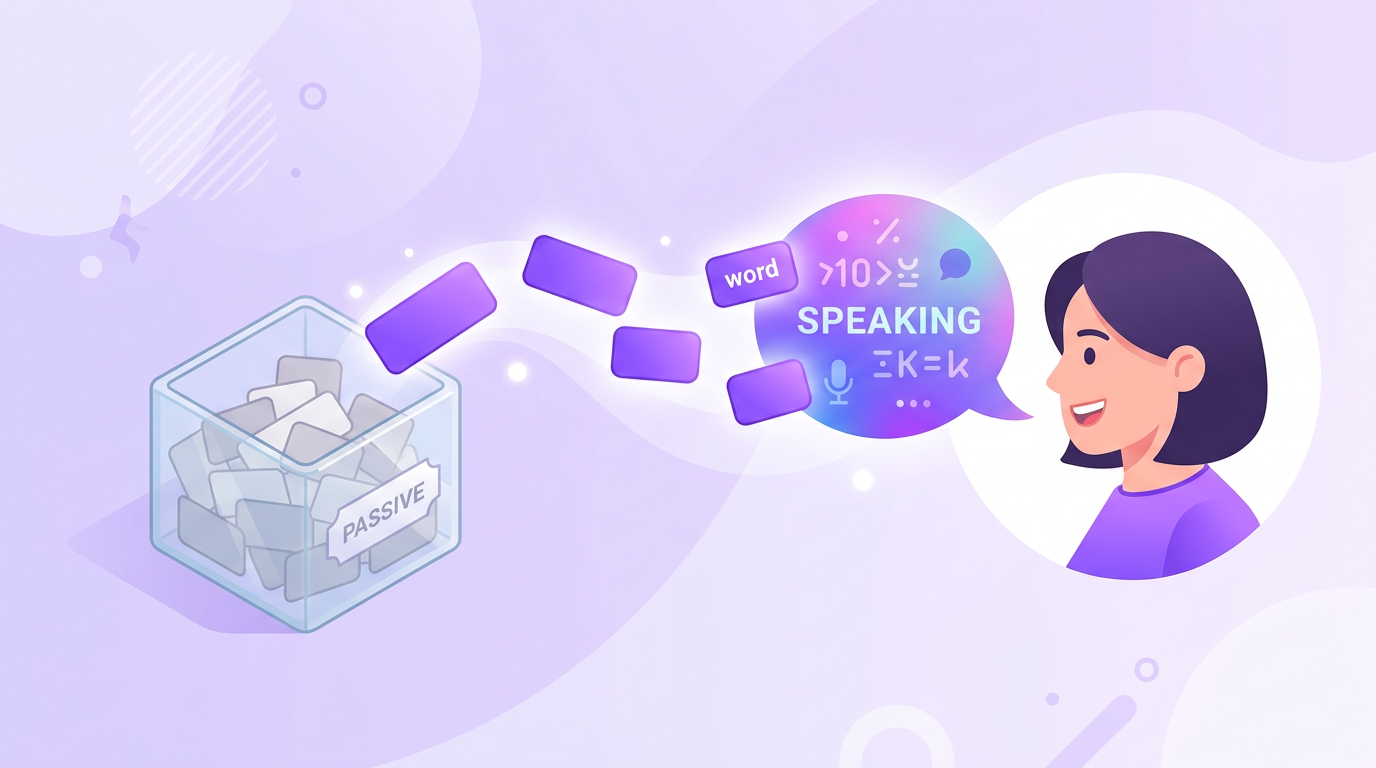
The goal is to move phrases from passive recognition to active use.
How to learn Spanish phrases in VibeLing
This is one of the reasons we built VibeLing.
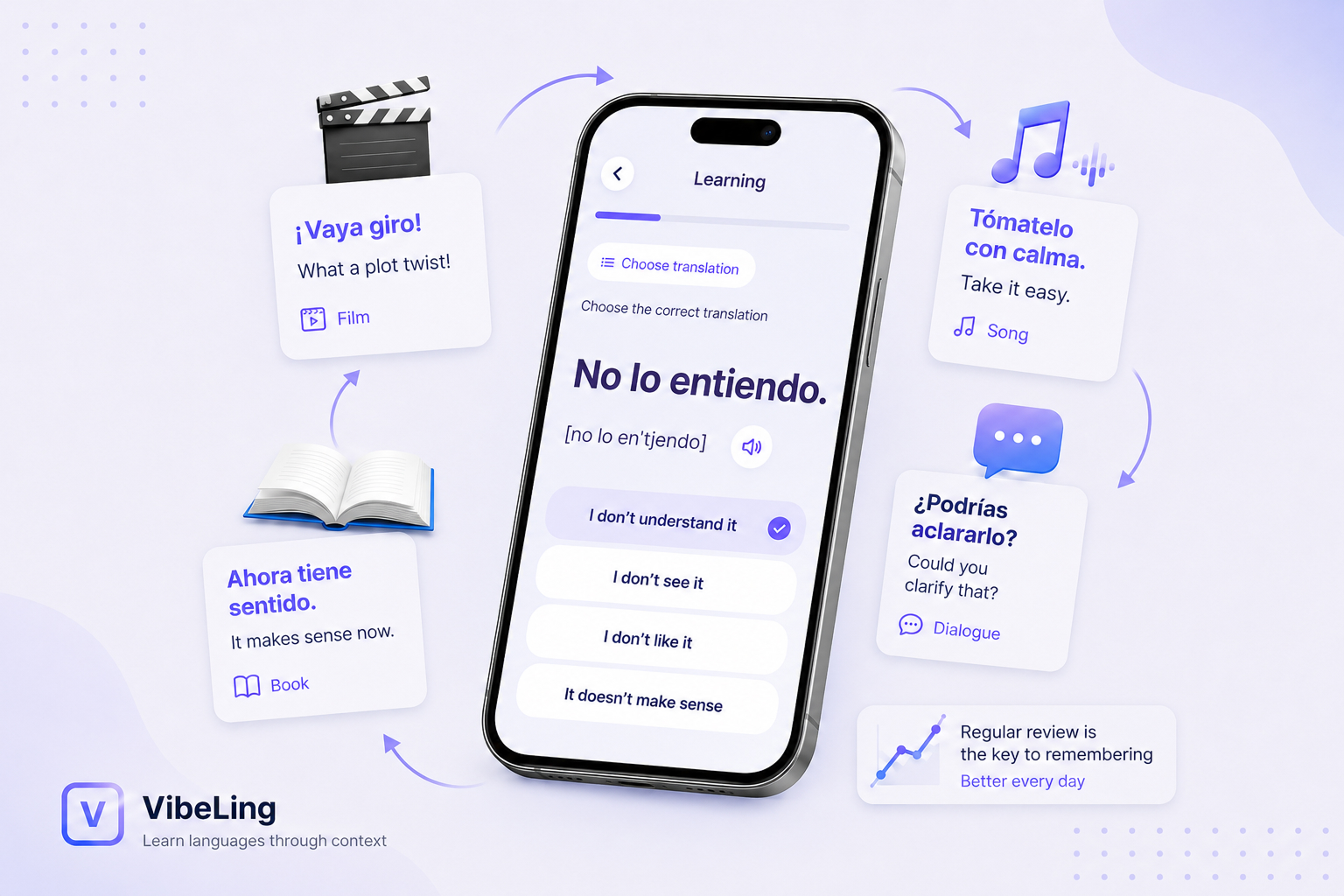
In VibeLing, you can add not only individual words, but also full Spanish phrases and sentences.
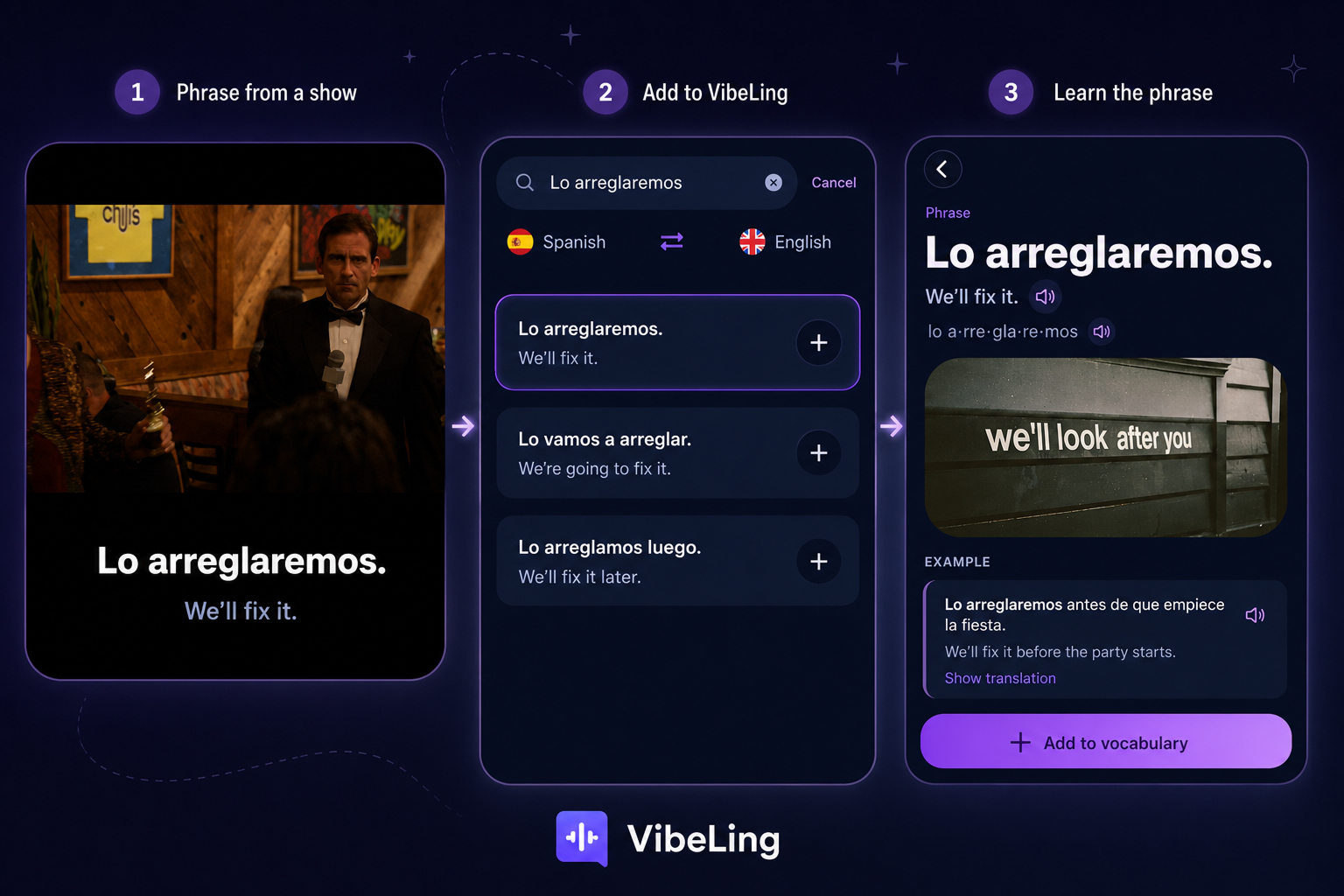
For example, you hear:
No pasa nada.
Or:
Tengo que irme.
Or:
¿Qué quieres decir?
You add the phrase to VibeLing, and the app helps turn it into a useful learning card with translation, explanation, examples, pronunciation, and associations.
Then the phrase goes into spaced repetition.
You do not need to manually decide what to review today. VibeLing shows you the words and phrases that are scheduled for practice.
The main idea is simple: learn Spanish not as a list of isolated words, but as a collection of real phrases you can actually use.
The app is available here — iOS or Android.
Should you stop learning individual words?
No.
Individual words are still useful. Sometimes you just need to save a word quickly and understand it later.
But if your goal is to speak, write, and understand real Spanish, try to save words inside phrases as often as possible.
Not only:
tener — to have
But:
Tengo frío.
Tengo que irme.
No tengo ni idea.
Not only:
sentido — sense
But:
Tiene sentido.
No tiene sentido.
This gives every word context.
And context makes words easier to remember and easier to use.
Summary
If you learn only isolated Spanish words, you may build a large vocabulary and still struggle to speak.
Real conversation requires more than words.
It requires ready-made patterns:
No tengo ni idea.
Déjame pensar.
Tiene sentido.
¿Qué quieres decir?
No pasa nada.
These phrases help you speak faster, understand real Spanish better, and stop translating every word in your head.
A good rule is simple:
When you find a useful phrase, save it as a whole phrase.
Especially if you can imagine yourself saying it.
Spanish is not just a dictionary.
It is a collection of situations where you already know what to say.
FAQ
Is it better to learn Spanish words or phrases?
Both are useful, but phrases are often more practical for speaking. Individual words help you expand vocabulary, while phrases show you how those words are used in real conversations.
Why are Spanish phrases easier to remember?
Phrases have context. They connect vocabulary with meaning, grammar, tone, and real situations. This gives your memory more “hooks” than a single isolated word.
Can I learn Spanish from movies and TV shows?
Yes. Movies and TV shows are great sources of natural Spanish phrases, expressions, and intonation. The key is not to save everything, but to choose phrases you can imagine using yourself.
What Spanish phrases should beginners learn first?
Start with practical phrases like No tengo ni idea, No pasa nada, Tiene sentido, Déjame pensar, Tengo que irme, ¿En serio?, and ¿Qué quieres decir?.
How often should I review Spanish phrases?
It is best to review phrases with spaced repetition. This means reviewing them more often at first and less often later, as they become stronger in memory.
Can I add full Spanish sentences to VibeLing?
Yes. In VibeLing, you can add individual words, phrases, or full sentences. The app helps create translations, explanations, examples, and spaced repetition practice.
Worth reading next: How to Learn Spanish With Movies and TV Shows: A Step-by-Step Method That Actually Works and How to Learn Spanish Words So You Actually Use Them When You Speak. And to turn reading into practice — build your personal vocabulary in the app.