How to Learn Spanish With Movies and TV Shows: A Step-by-Step Method That Actually Works
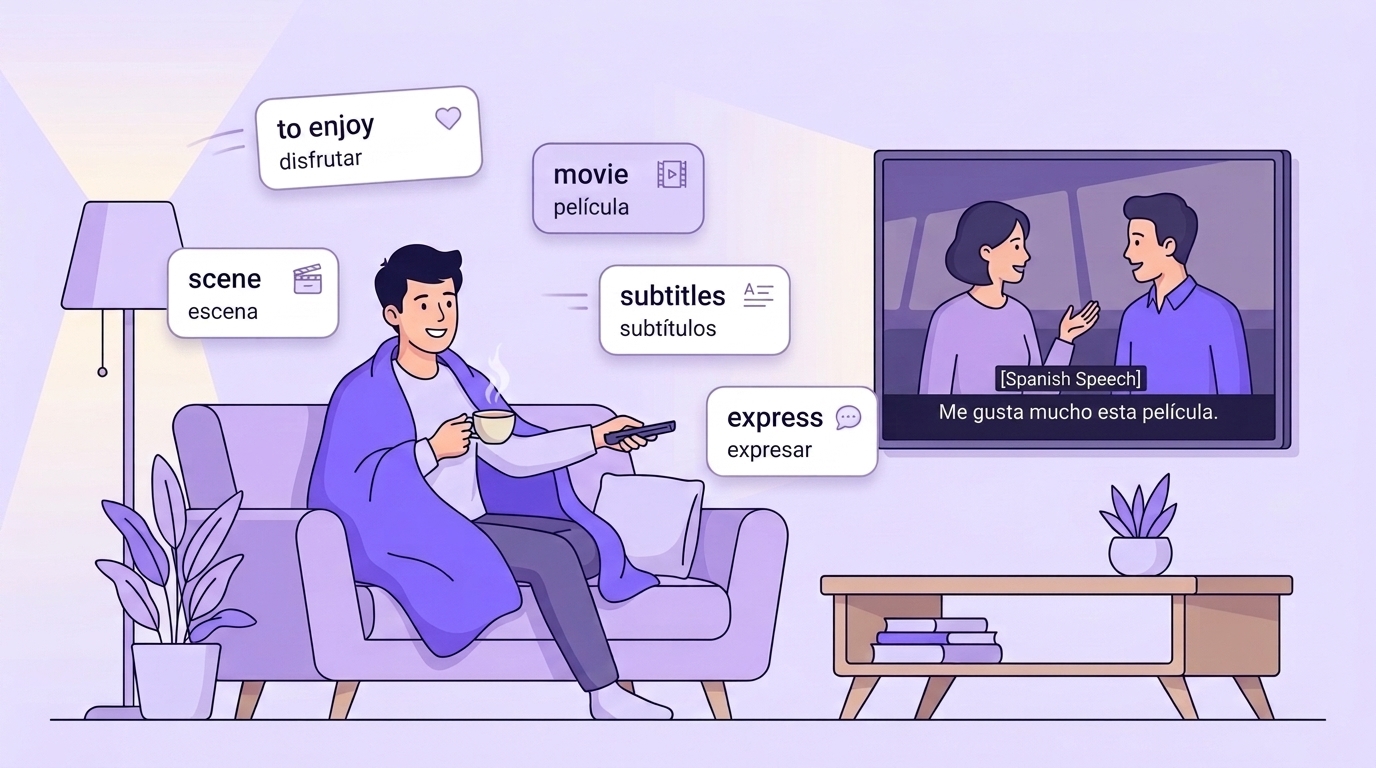
"Just watch shows in the original and you'll start speaking." Anyone who has ever taken on Spanish has heard this advice. It sounds perfect: instead of boring textbooks, your favorite series — "Money Heist," "Élite," or "Narcos" — and the language supposedly "soaks in" on its own. In practice, though, people rewatch the tenth season with English dubbing and honestly don't understand why their vocabulary is stuck.
The problem isn't the method — it's how it's used. Movies and series really are one of the most powerful sources of living language: real phrases, intonation, slang, cultural context. But for it to work, you have to watch actively, not as background noise. This article lays out a step-by-step method that turns your evening show into a genuine Spanish workout.
Why "just watching" doesn't work
When you watch a film with English dubbing or English subtitles, your brain takes the path of least resistance: it reads the translation and completely ignores the Spanish audio. You enjoy the plot, but the language passes you by.
Even watching in the original, without working the material the effect is weak. An unfamiliar word flashes by — you guess the meaning from context — and a minute later you've forgotten it forever. For a word to stick in memory, you have to do something with it: notice it, save it, break it down, and review it. These four steps are exactly what separate "background watching" from learning.
Passive watching develops listening comprehension at best. Actively working the material also builds your vocabulary and your ability to speak.
Step 1. Pick content that matches your level
The most common mistake is starting with something over your head. If you understand less than half without subtitles, "La Casa de Papel" at full speed will be torture. Use your level as a guide:
| Level | What to watch | Why it fits |
|---|---|---|
| Beginner (A1–A2) | Cartoons, kids' shows, "Extr@ en español", "Destinos" | Simple vocabulary, clear speech, lots of repetition |
| Pre-Intermediate (A2–B1) | Sitcoms: "Aquí no hay quien viva", "Los Serrano" | Everyday dialogue, short scenes, living phrases |
| Intermediate (B1–B2) | "Money Heist" (La Casa de Papel), "Élite", "Valeria" | Varied vocabulary, natural speaking pace |
| Advanced (B2–C1) | "Narcos", talk shows, Spanish stand-up comedy | Complex syntax, accents, idioms, humor |
The main criterion: the content should be interesting and roughly 70–80% understandable to you. Then the remaining 20–30% is exactly the growth zone where you learn new things without losing the thread of the plot.
Step 2. Set up subtitles the right way
Subtitles are your main tool, but you have to use them wisely. There's a clear hierarchy by effectiveness:
- English subtitles — almost useless for the language. Your eyes stay glued to the translation and your brain switches off the Spanish audio. Only good for simply watching the film.
- Spanish subtitles — the gold standard. You hear the phrase and see how it's spelled at the same time. That "sound + text" pairing is exactly what you need to memorize.
- No subtitles — expert level for training your listening, once your level already allows it.
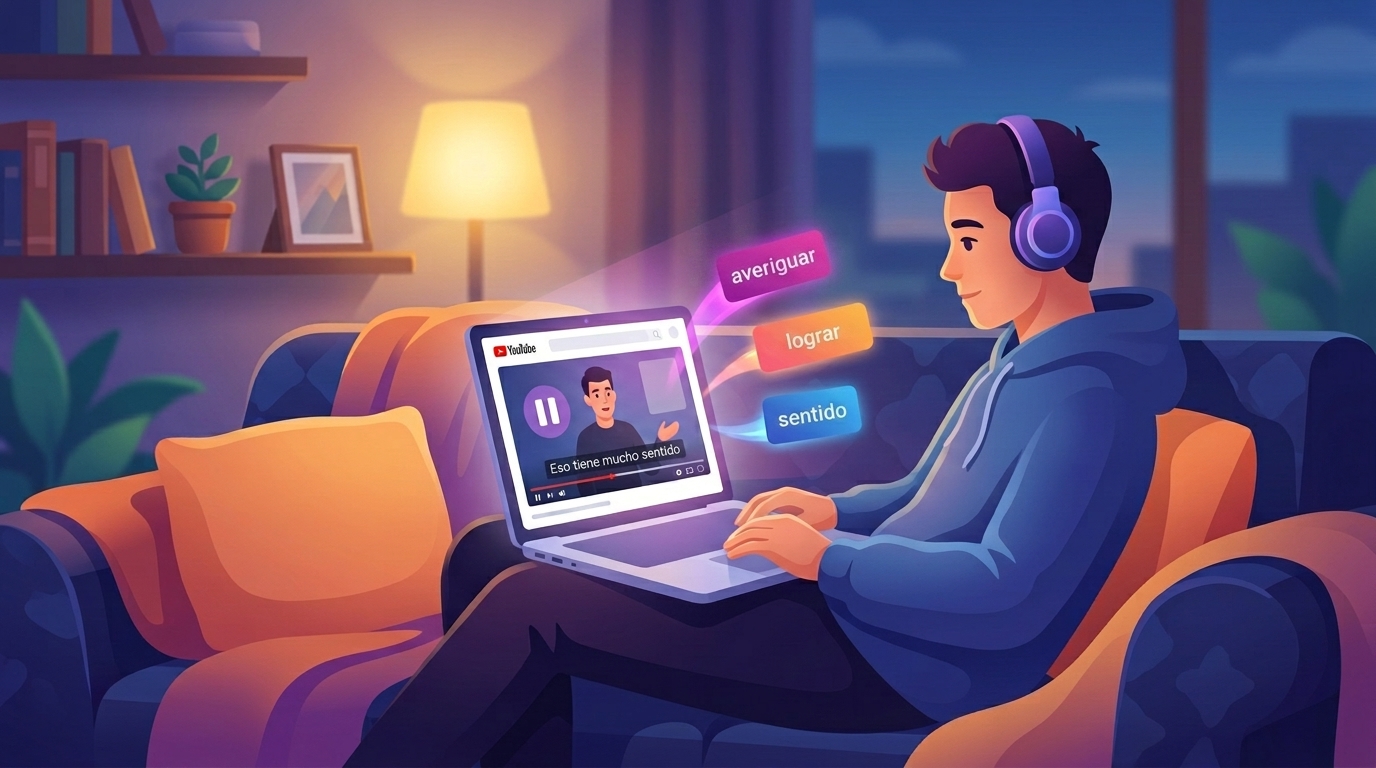
The optimal strategy: watch with Spanish subtitles. You'll see the unfamiliar word written out — which means you can find it, check it, and save it.
Step 3. Watch actively: the "pause — phrase — card" method
Here's the trick that turns watching into training. Don't try to parse every word — that kills the fun. A selective approach works:
- Watch the scene as usual.
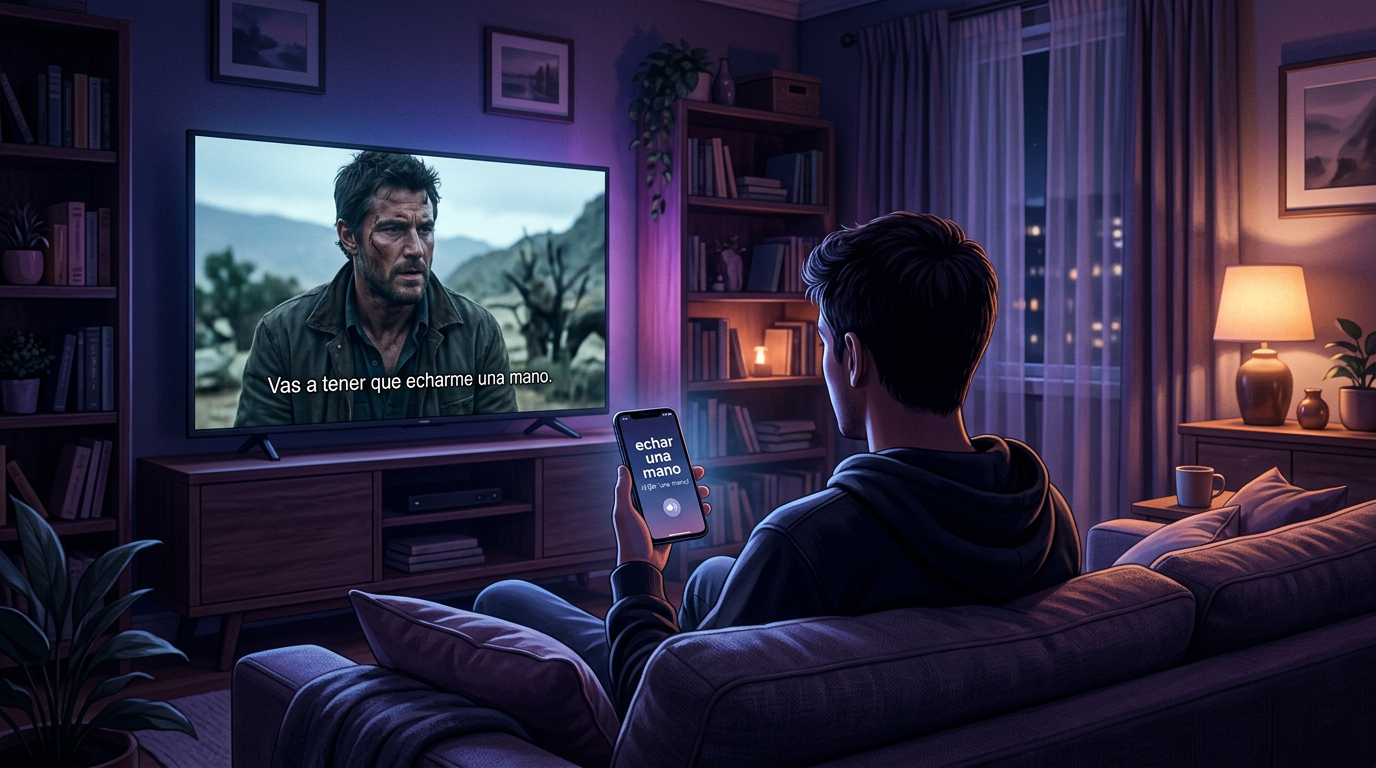
- You heard a living phrase or an unfamiliar word that grabbed you and will surely come in handy when speaking — hit pause.
- Save that word or phrase right away, before you forget it and lose the context.
- Keep watching. Per episode, catching 5–10 genuinely useful expressions is plenty.
The key word here is "right away." The most valuable thing in movies isn't isolated words — it's ready-made phrases from real speech: what native speakers actually say. Those are what you want to catch.
Which phrases to catch first
Don't pause on rare, complicated words — pause on living, conversational expressions you'll be able to use yourself as soon as tomorrow:
| Phrase from the show | Translation | When it's useful |
|---|---|---|
| No pasa nada | It's no big deal / No worries | Reassuring someone, playing down a problem |
| Es broma | I'm just kidding | After a joke, so you don't offend |
| Depende de ti | It's up to you | Leaving the choice to the other person |
| Dame un segundo | Give me a second | Asking for a pause |
| No me lo puedo creer | I can't believe it | Expressing surprise |
| Tiene sentido | That makes sense | Agreeing, showing you got the point |
Notice: you won't learn a single one of these phrases from a textbook word list. They live in dialogue — where the language is real.
Step 4. Where to save phrases so you don't lose them
A notebook or your phone's notes app seems like the obvious solution, but it has a fatal flaw: you jot it down and never look at it again. Words pile up as dead weight, nobody prompts you with the translation, there's no pronunciation and no review. A week later you won't even remember what the word you wrote down meant.
It's far more convenient to catch phrases on the go in an app like VibeLing. It's built around exactly this scenario: "you saw a word or phrase from real life — you saved it in one tap." On the home screen there's a "Word or phrase from life" field: you paste in the expression from the show and it lands in your personal dictionary.
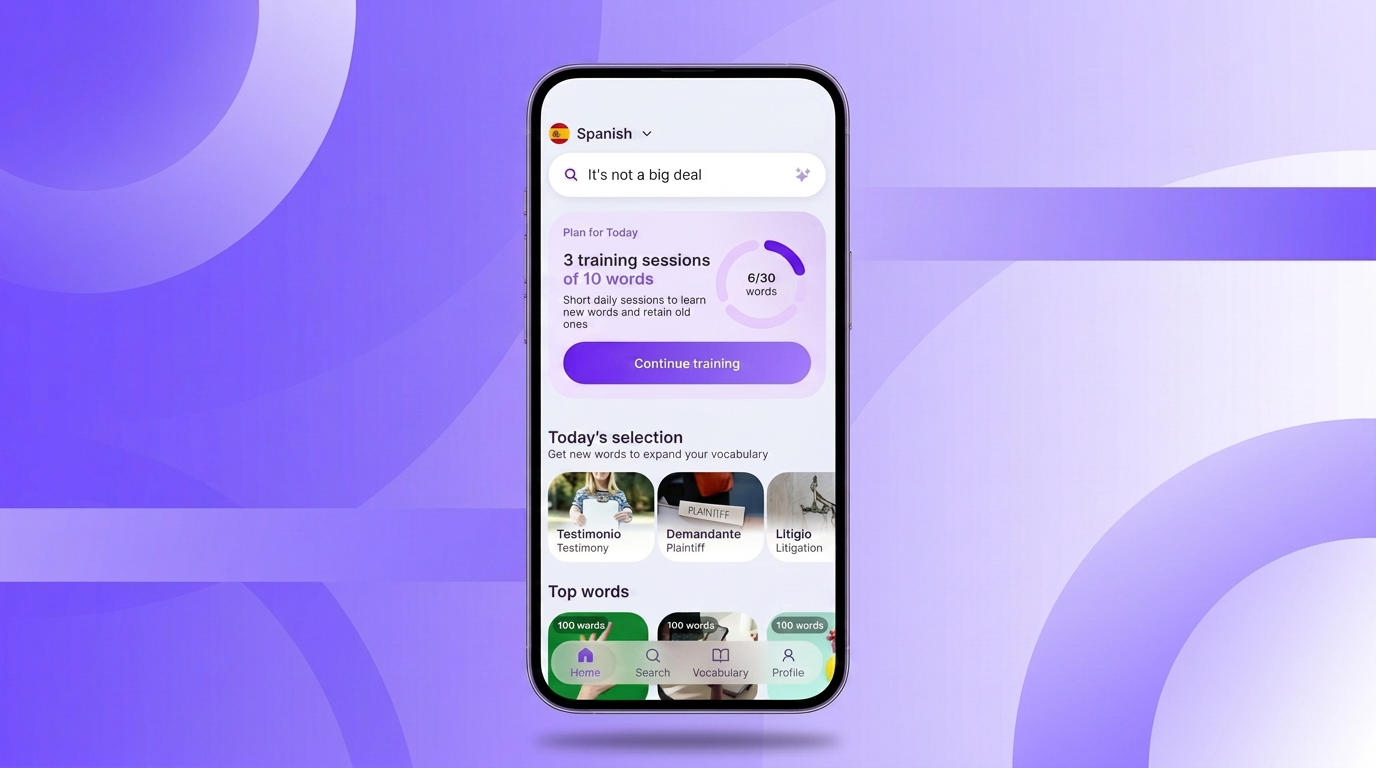
No more "create a card, add the translation, find an example by hand" — the app takes that routine off your hands. And it builds a daily plan of short training sessions so you learn new things without forgetting the old ones.
Step 5. Break the phrase down: translation, example, pronunciation
Saving isn't enough — you have to "live" the word. Ideally, for each expression you want to see its exact translation, the transcription, a living usage example, and hear how it sounds. That's exactly what VibeLing shows automatically for every saved word or phrase.
For example, you caught the phrase no pasa nada in a show. On the card you immediately see the transcription, a short definition in simple words, and a usage example like "Tranquilo, no pasa nada," with a button right there to hear the pronunciation. That way the expression is memorized not in isolation but together with its context — exactly the way the brain likes to memorize a language.
Step 6. Review with a spaced repetition system
Here's the main secret almost everyone who "learns from series" forgets. Even a perfectly analyzed word vanishes from memory within a couple of days if you don't review it. Our brain is built to forget everything it doesn't use — this is described by the famous "forgetting curve."
The antidote is spaced repetition: the word is shown to you at the exact moment you're about to forget it. Frequently at first, then less and less often, until it settles into long-term memory for good.
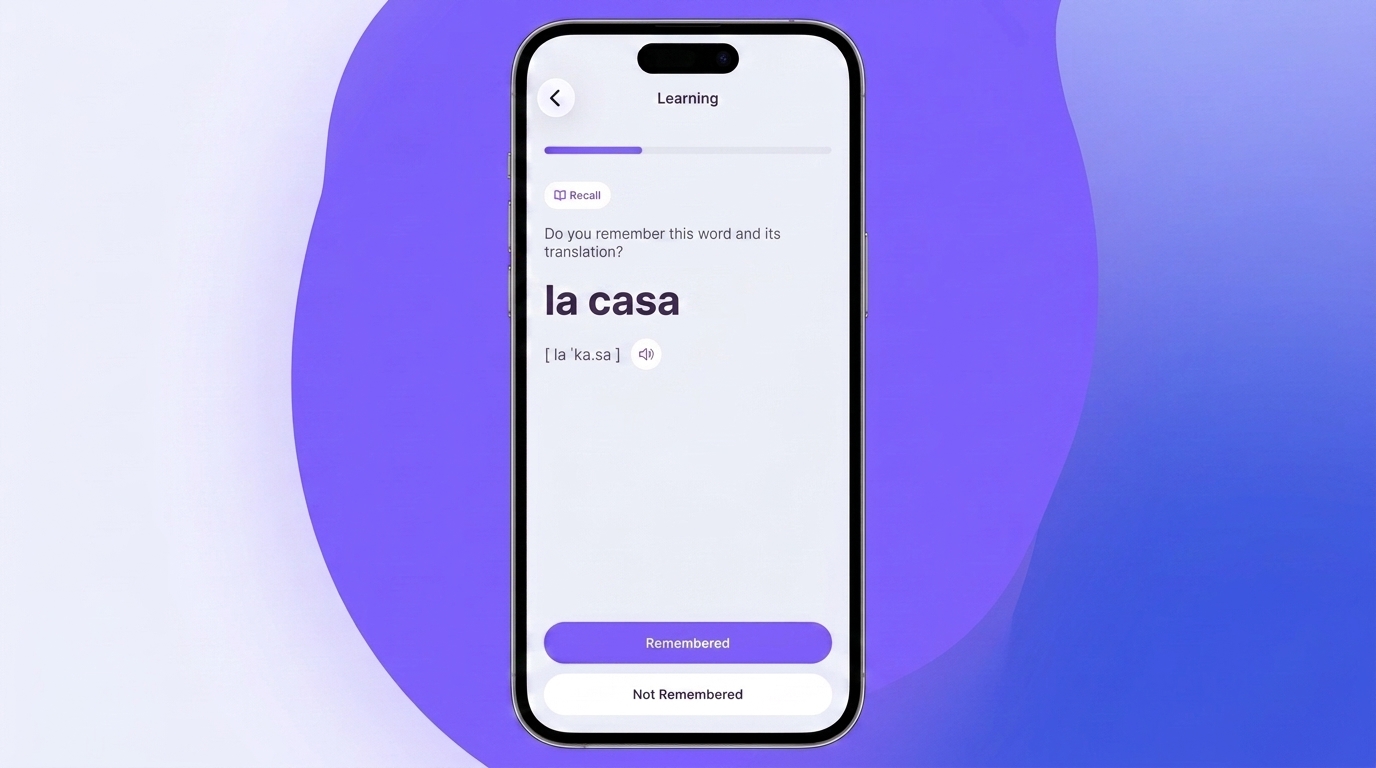
Building such a schedule by hand is impossible. That's why in VibeLing reviews run automatically: the app brings back the words from your shows at the right moment and in different formats — recall the translation, choose the missing word, spell it out letter by letter, say it out loud. Each session is 10 words and a few minutes that easily fit into a commute or a queue.
A 30-day mini-plan
So the method doesn't stay theory, here's a routine that's realistic to keep up:
- Every day: one episode (20–40 minutes) with Spanish subtitles.
- While watching: catch and save 5–10 living phrases.
- After the episode (5 minutes): do a short review session.
- Once a week: rewatch your favorite scene without subtitles — to check how much you already understand by ear.
Over a month that's 150–300 new living expressions — and, more importantly, the habit of learning for pleasure rather than by force.
Common mistakes that ruin the method
- English subtitles "just in case." The brain always picks the easier language. Spanish only.
- Trying to understand every word. It's exhausting and kills your motivation. Catch the essentials, get the rest from context.
- Writing down rare, bookish words. Learn what's actually said in dialogue, not what sounds "clever."
- Not reviewing. Without spaced repetition, even analyzed phrases are gone within a week. This is the most critical point.
Conclusion
Movies and series aren't a "magic pill" that learns the language for you — they're an excellent source of living material you have to work with. The formula is simple: watch with Spanish subtitles, catch living phrases, save them right away, break them down with translation and pronunciation, and review them with a system. Then every evening in front of the screen genuinely moves you forward.
All the technical routine — saving, translating, examples, pronunciation, and the review schedule — is best handed off to an app. Try VibeLing: save phrases from your favorite shows in one tap and turn watching into real progress. Download the app and start learning Spanish with what you already love to watch.
Worth reading next: Why You Should Learn Spanish Phrases, Not Just Individual Words and Learn Spanish Vocabulary in Just 10 Minutes a Day. And to turn reading into practice — try VibeLing.