How to Memorize Spanish Words Effectively: A Complete Guide
Many people learn Spanish vocabulary in the same way: they write down a translation in a notes app, keep a list in a notebook, or save words in a spreadsheet. At first, it feels useful. You see a word, understand it, write it down — and it seems like you’ve learned it.
But a few days later, most of those words are gone. And when you actually need a word in a conversation, it suddenly doesn’t come to mind.
The problem usually isn’t your memory. More often, it’s the way you learn words: without context, without repetition, and without actively trying to recall them.
In this guide, we’ll look at how to memorize Spanish words more effectively — not just to recognize them when reading, but to actually remember and use them when speaking, writing, watching movies, or listening to native speakers. We’ll also show how VibeLing can make this process easier.
Why Spanish words are easy to forget
The most common mistake is learning isolated words as simple translations.
For example:
hacer — to do / to make.
But in real Spanish, this word appears in many different phrases:
hacer una pregunta — to ask a question
hacer ejercicio — to exercise
hacer frío — to be cold
hacer sentido — to make sense
If you only learn “hacer = to do / to make”, you still don’t really understand how the word works in real speech. That’s why it’s often much more effective to learn not just single words, but full phrases and short expressions.
The second problem is lack of repetition. You can see a word, understand it, and even save it somewhere. But if you don’t come back to it later, your brain quickly decides that this information is not important.
The third problem is passive recognition. When you see a word in a text, it may feel familiar. But in a real conversation, you need to recall it yourself. That’s much harder.
So effective vocabulary learning is built on three things:
learning words in context;
repeating them over time;
testing yourself instead of just rereading translations.
Learn phrases, not just words
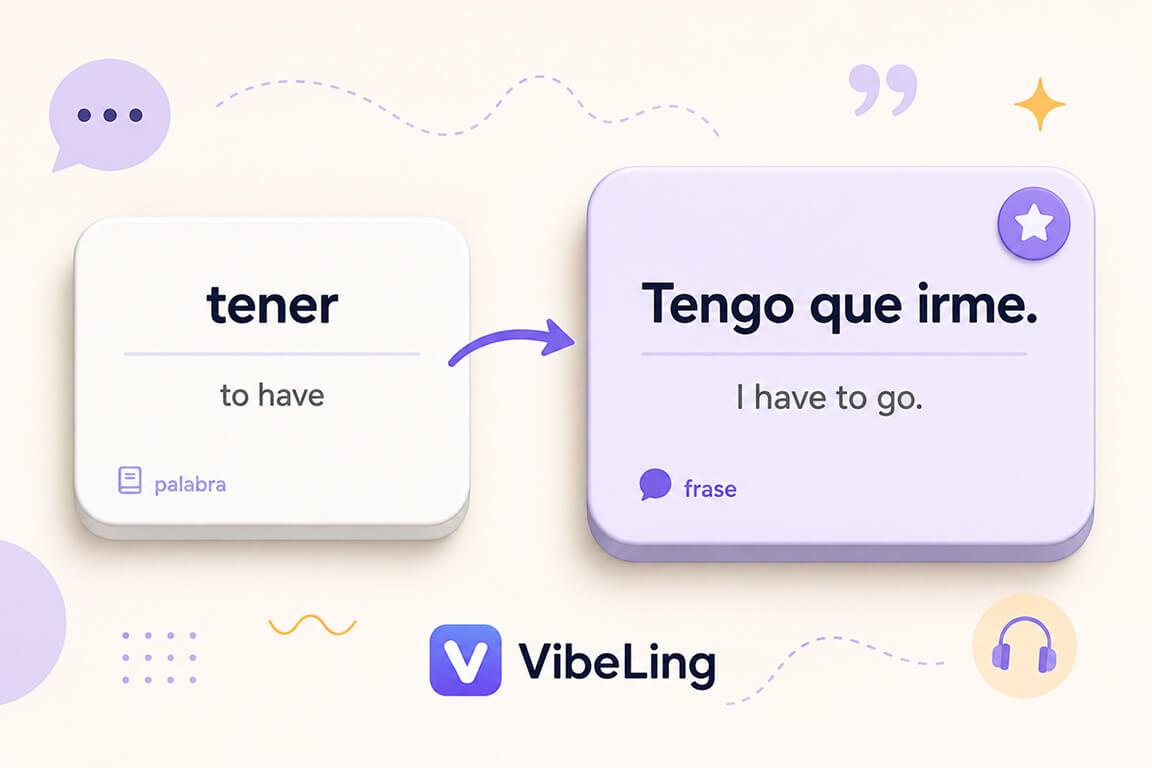
The easiest way to remember Spanish words better is to save them together with a phrase.
For example, you can learn:
raro — strange / weird.
But it’s much better to learn it like this:
Eso es raro. — That’s strange.
Fue un momento muy raro. — It was a very weird moment.
A phrase gives you context right away: when to use the word, what other words it appears with, and how it sounds in natural Spanish.
This is especially useful for everyday expressions. For example, it’s better to learn tener ganas de not just as “to feel like”, but in a real sentence:
Tengo ganas de viajar.
I feel like traveling.
Now the expression is not just an abstract translation. It becomes a ready-to-use piece of language.
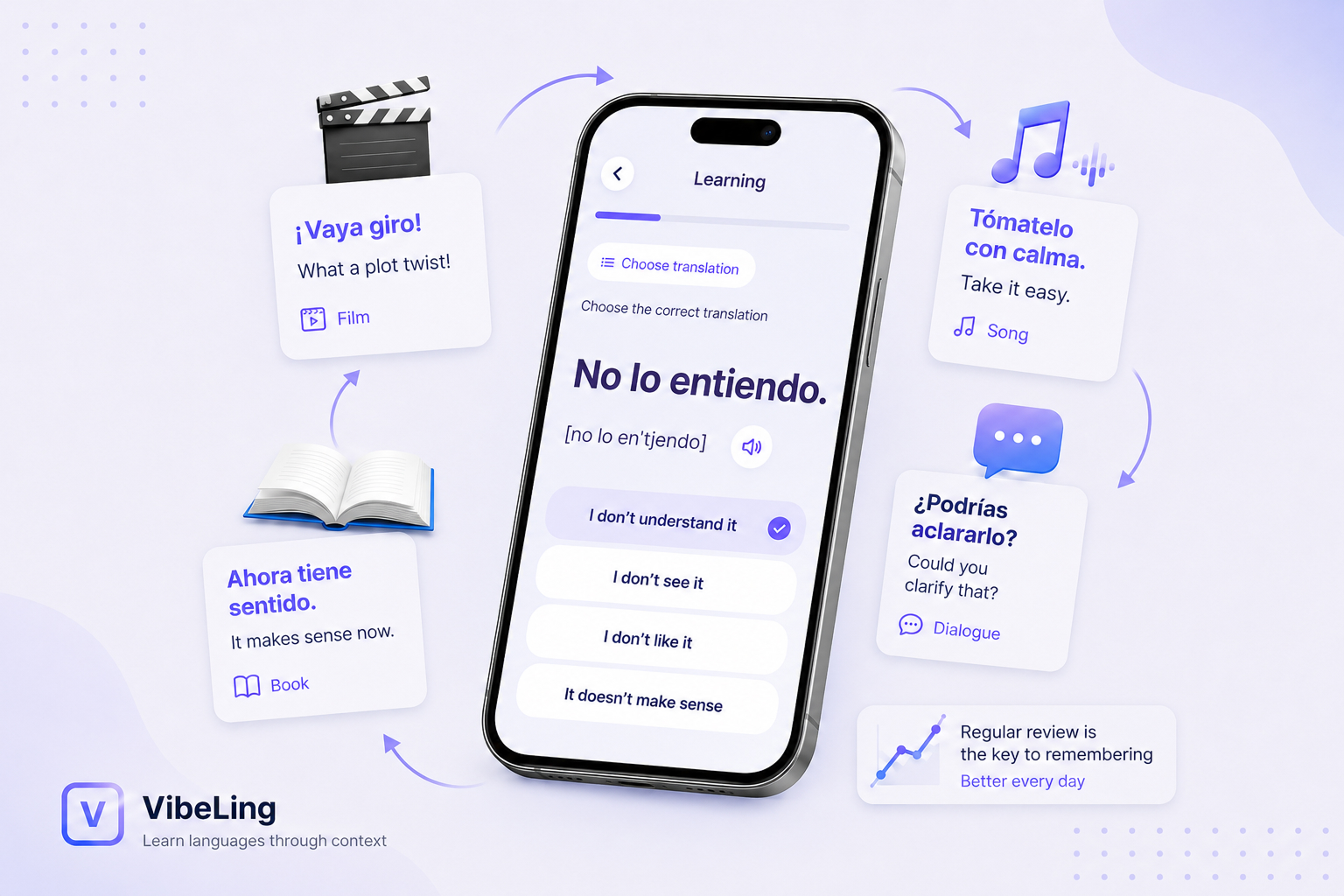
That’s the main idea behind VibeLing: instead of learning random word lists, you save Spanish words and phrases that you actually meet in real life — in movies, series, songs, books, articles, podcasts, or conversations.
How to learn Spanish words properly
A good learning system looks like this:
You find a useful phrase → save it → understand its meaning → repeat it later → try to use it yourself.
Let’s break this down.
1. Take words from real content
You don’t have to start with huge lists like “1000 most common Spanish words”. Those lists can be useful, but they often get boring because the words are disconnected from your life.
It’s usually better to take words from content you already enjoy:
movies and TV series;
YouTube videos;
songs;
books;
articles;
podcasts;
work or study materials;
real conversations and chats.
For example, you’re watching a Spanish series and hear:
No lo entiendo.
I don’t understand it.
You could save only the word entender. But it’s much more useful to save the whole phrase, because this is how it appears in real speech.
2. Don’t save every unknown word
Another common mistake is adding every unfamiliar word to your vocabulary list. After a while, the list becomes huge — and you no longer want to open it.
It’s better to save words and phrases that are actually useful:
the word appears often;
the phrase sounds natural;
you want to use it yourself;
it relates to your work, studies, travel, hobbies, or interests;
you’ve already seen or heard it several times.
A good vocabulary system is not a place where everything gets dumped. It’s your personal collection of words and phrases you really want to remember.
3. Add an example
A word without an example is easier to forget. That’s why it’s useful to save at least one sentence with each word.
Not very useful:
depender — to depend.
Better:
Depende de la situación.
It depends on the situation.
Even better:
Todo depende de lo que quieras hacer.
It all depends on what you want to do.
No quiero depender de nadie.
I don’t want to depend on anyone.
This helps you feel how the word works instead of just memorizing a translation.
4. Repeat words over time
Saving a word once is not enough. To actually remember it, you need to come back to it later.
The best approach is not random repetition, but spaced repetition. At first, you repeat a word more often. If you remember it easily, the interval becomes longer. If you forget it, the word comes back sooner.
This way, you don’t waste too much time on words you already know, and you review difficult words more often.
5. Test yourself actively
Reading through a vocabulary list is not the same as learning. When you simply look at a translation, your brain stays mostly passive.
It’s much more useful to try to recall the answer yourself:
see a Spanish word and remember the meaning;
see an English translation and remember the Spanish phrase;
choose the correct answer;
listen to the word;
recall the full phrase.
This active recall is what helps move words from passive recognition to real memory.
How VibeLing helps you learn Spanish words
You can build this system manually with notes, spreadsheets, or classic flashcards. But manual systems often become annoying pretty quickly.
You have to look up translations, write examples, save phrases, plan reviews, and remember to come back to old words. At some point, your vocabulary list can turn into a graveyard of saved words: everything is there, but you rarely return to it.
VibeLing is designed to make this process easier.
In the app, you can add Spanish words and phrases from real life: from movies, TV shows, songs, books, articles, podcasts, or any other source. Then VibeLing helps you with translations, examples, pronunciation, and practice.
Instead of this manual process:
found a word → opened a translator → wrote down the translation → searched for an example → forgot to review it later
you get a simpler flow:
found a phrase → added it to VibeLing → got translation and examples → reviewed it in practice
The key idea is that you’re not learning someone else’s random list. You’re building your own vocabulary from things you actually saw, heard, or wanted to remember.
For example, you hear this phrase in a movie:
No pasa nada.
It’s okay. / No worries. / It’s not a big deal.
You can save it in VibeLing, check the meaning, and review it later in a practice session. This way, the phrase doesn’t disappear after the scene — it gradually becomes part of your active vocabulary.
Example: how to learn one phrase properly
Let’s take this phrase:
No estoy seguro de eso.
I’m not sure about that.
A weak approach would be to save only the word seguro with the translation “sure” or “safe”.
A better approach is to save the whole phrase:
No estoy seguro de eso.
Then look at similar examples:
¿Estás seguro?
Are you sure?
Estoy bastante seguro.
I’m pretty sure.
No estoy seguro de qué hacer.
I’m not sure what to do.
After that, try to make your own sentence:
No estoy seguro de esta idea.
I’m not sure about this idea.
Now you’re not just learning a word. You’re learning a pattern that you can actually use in conversation.
How many Spanish words should you learn per day?
Trying to learn 50 new words every day usually isn’t a good idea. It may feel productive at first, but soon the reviews pile up and motivation drops.
For most learners, 5 to 15 new words or phrases per day is much more realistic.
If you’re just starting, even 5 useful phrases a day is enough. That’s around 150 phrases a month. And if those phrases come from real content and are reviewed regularly, they’ll be much more valuable than a huge list you only opened once.
The important thing is to count not only new words, but also reviews. Repetition is what turns “I’ve seen this before” into “I can actually use this.”
Common mistakes when learning vocabulary
The first mistake is learning words without context. A single translation is usually not enough. Save a sentence or a full phrase instead.
The second mistake is saving too many words. Your vocabulary system should help you, not become an endless list you never want to open.
The third mistake is not reviewing. A saved word is not the same as a learned word.
The fourth mistake is only recognizing words passively. For real conversations, you need active recall.
The fifth mistake is learning words you don’t care about. Words from your favorite series, songs, books, topics, or real situations are often easier to remember because they already have context and emotion attached to them.
Final thoughts
To memorize Spanish words effectively, you don’t need to force yourself through huge vocabulary lists. It’s much better to learn words in context, save full phrases, repeat them over time, and test yourself through active recall.
A simple system looks like this:
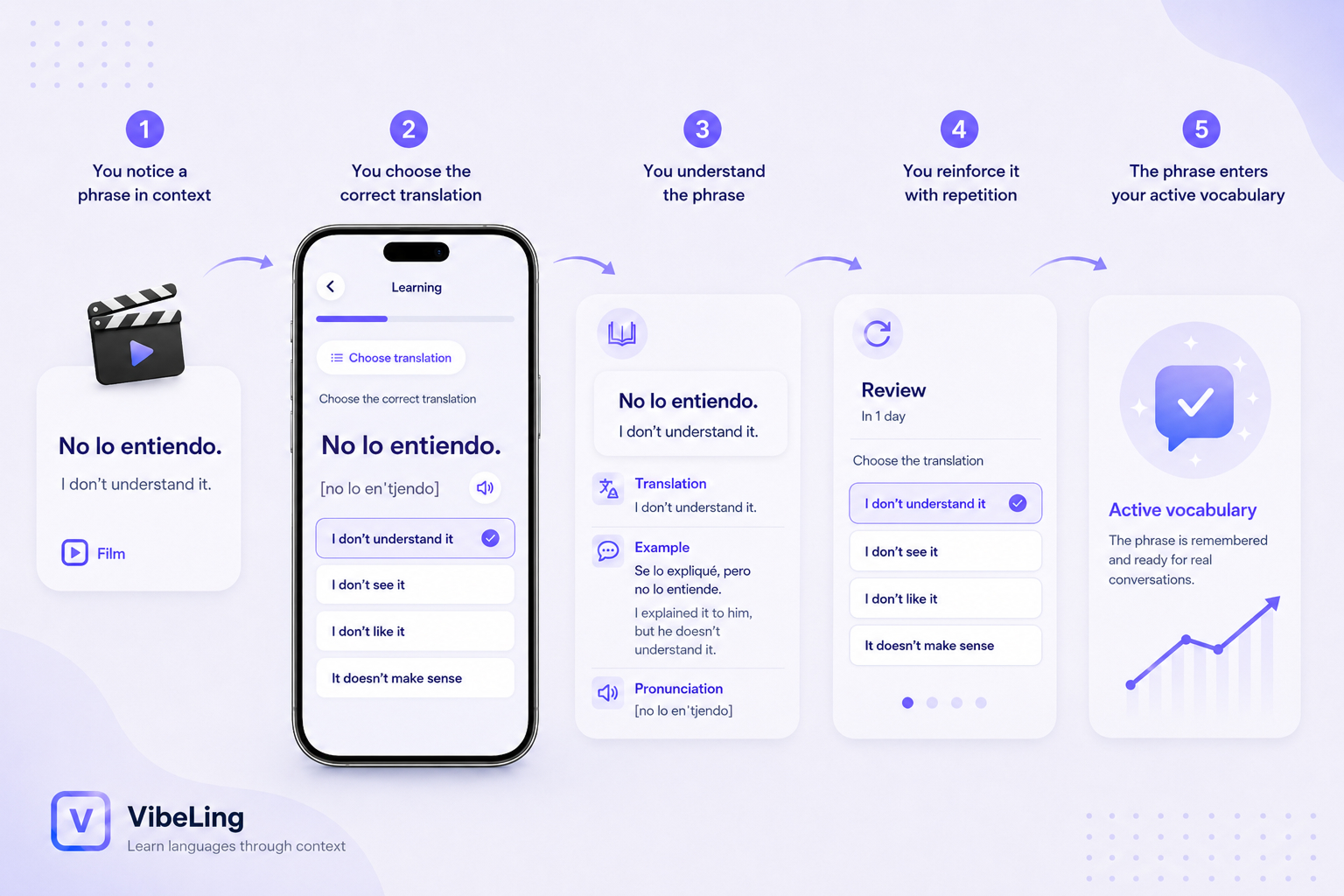
That’s exactly what VibeLing is built for. The app helps you collect Spanish words and phrases from real life, get translations and examples, and review them in practice so they don’t disappear from memory.
If you want to learn Spanish not through dry word lists, but through real phrases from movies, books, songs, articles, and conversations, try VibeLing.
The app is available on iOS and Android.
Worth reading next: How Often Should You Review Spanish Vocabulary? and Why You Should Learn Spanish Phrases, Not Just Individual Words. And to turn reading into practice — build your personal vocabulary in the app.