How Many Words Do You Need to Speak Spanish?
The answers you find online differ by a factor of twenty: some sources promise that 500 words will do, others insist on ten thousand. Neither figure is made up — they just count different things and answer different questions. Here is the number that actually matters if your goal is not passing a test but holding a conversation.
The short answer
To keep an everyday conversation going in Spanish, you need roughly 800–1,000 words you can actively produce, plus another 2,000–3,000 words you simply recognise. The first number decides what you can say. The second decides whether you understand the reply. Below is where those figures come from and why they are so far apart.
Passive and active vocabulary are two different numbers
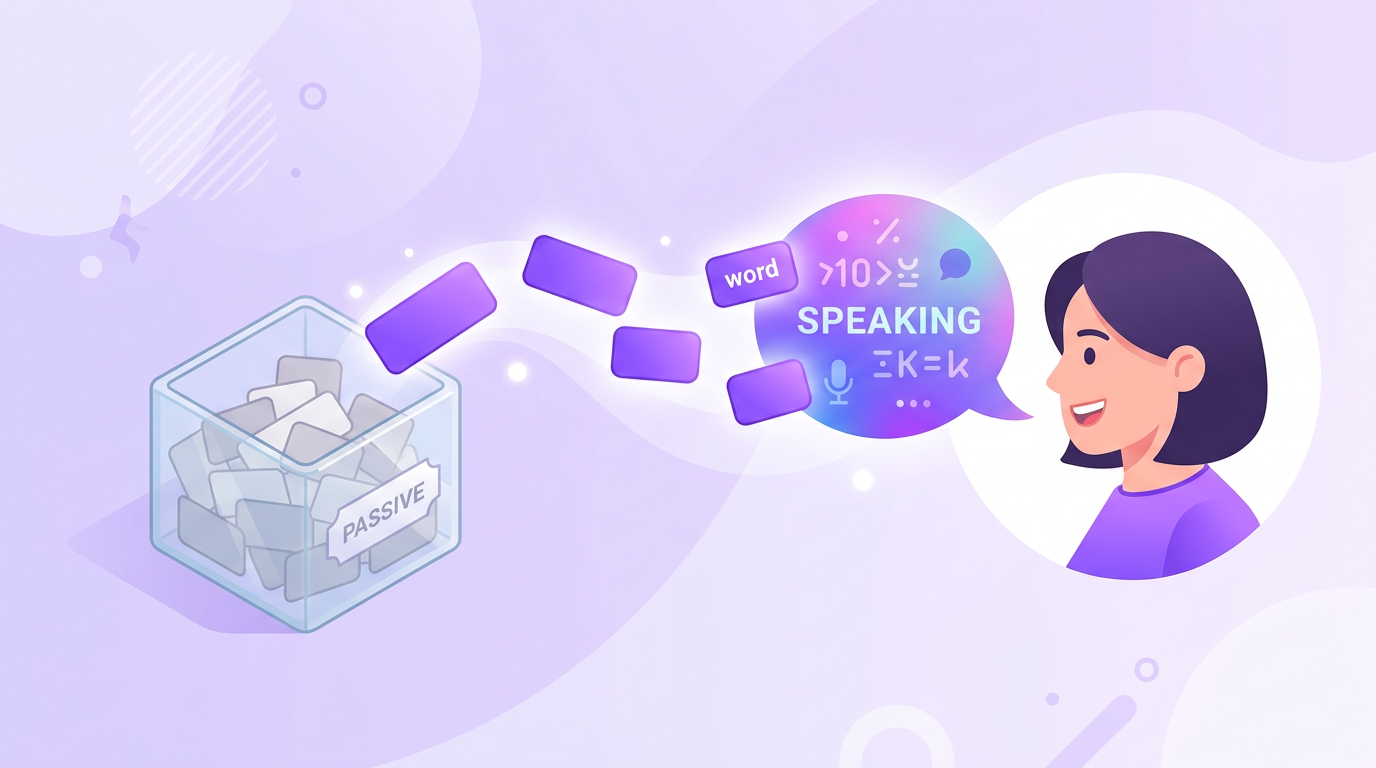
Your passive vocabulary is the set of words you recognise when you see or hear them. Your active vocabulary is what comes to mind when you need to say something. The gap exists in your native language too, but for learners it is enormous: active vocabulary is usually about half the size of passive, and in the early years the difference is even bigger.
It is easy to test. You will probably understand imprescindible in a written sentence. But when you need to say "that's essential", the only thing that surfaces is muy importante. The word is familiar, and it is still absent from your speech.
That is why "how many words do I know" is close to a useless question. What matters is how many of them you can pull out of memory in a second, while the other person waits.
What counts as a word in the first place
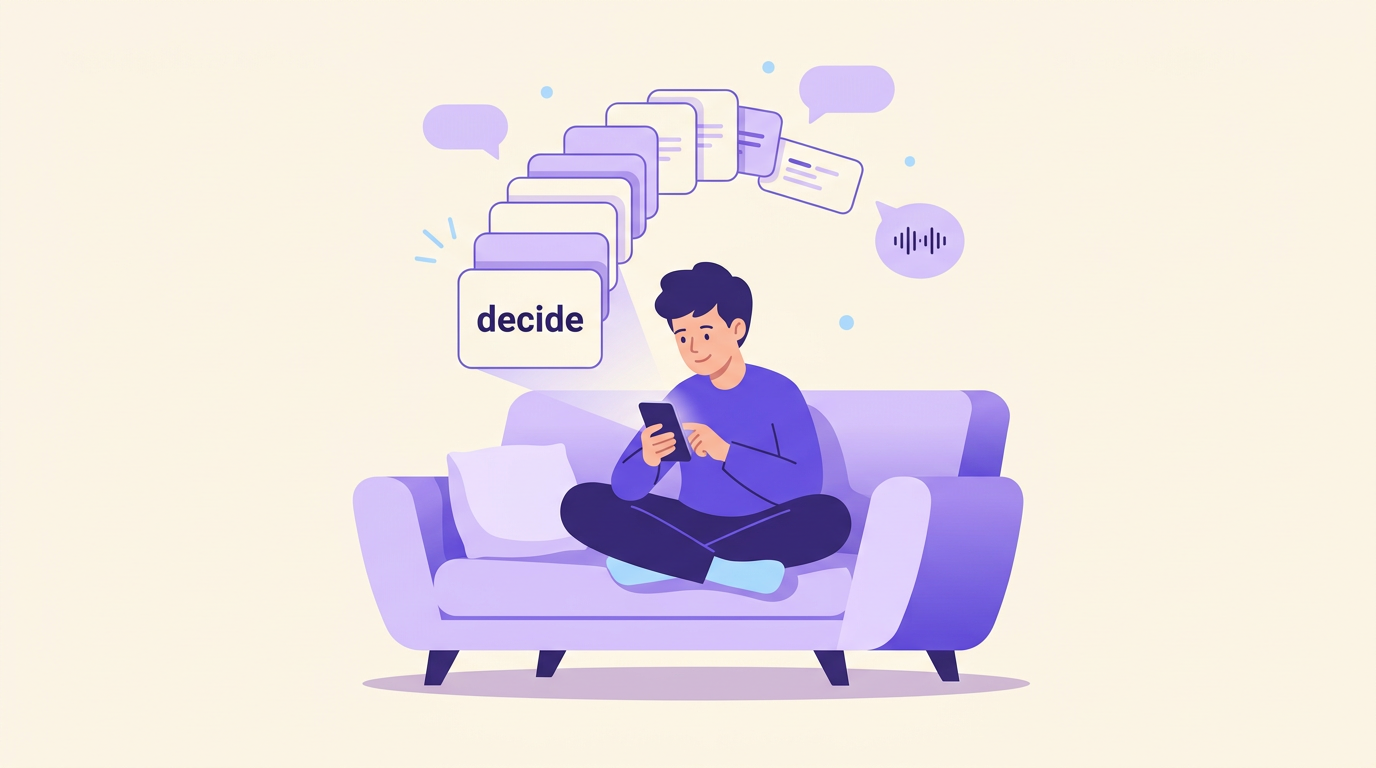
The second reason the numbers vary so much is that researchers count word families, not words. Decidir, decide, decidió, decidiendo, decisión, indeciso all belong to one family: learn the base and you will recognise the rest. So "3,000 words" in a study means something like ten thousand word forms.
Then there are multiword units: darse cuenta, echar de menos, tener ganas de. Their meaning does not assemble from the parts, so for a speaker they are separate items that have to be learned whole and counted alongside ordinary words.
How much speech the first few thousand words cover
Vocabulary is distributed very unevenly. The hundred most frequent words in Spanish (de, la, que, el, en, y, a, los, se…) account for roughly half of all the words in an ordinary text. After that the curve flattens fast: every next thousand adds less than the one before.
Here are approximate figures from corpus frequency research — the best known being Paul Nation's work on English, with similar patterns found in Spanish — for how much of an ordinary conversation you would follow:
| Word families known | Understood in conversation | What that feels like |
|---|---|---|
| 1,000 | ~78% | Every fifth word is unknown, the thread slips away |
| 2,000 | ~90% | You get the topic, you lose the details |
| 3,000 | ~95% | Almost everything lands, the gaps fill in from context |
| 5,000 | ~97% | Comfortable listening, rare stumbles |
| 8,000–9,000 | ~98% of written text | Books and articles without a dictionary |
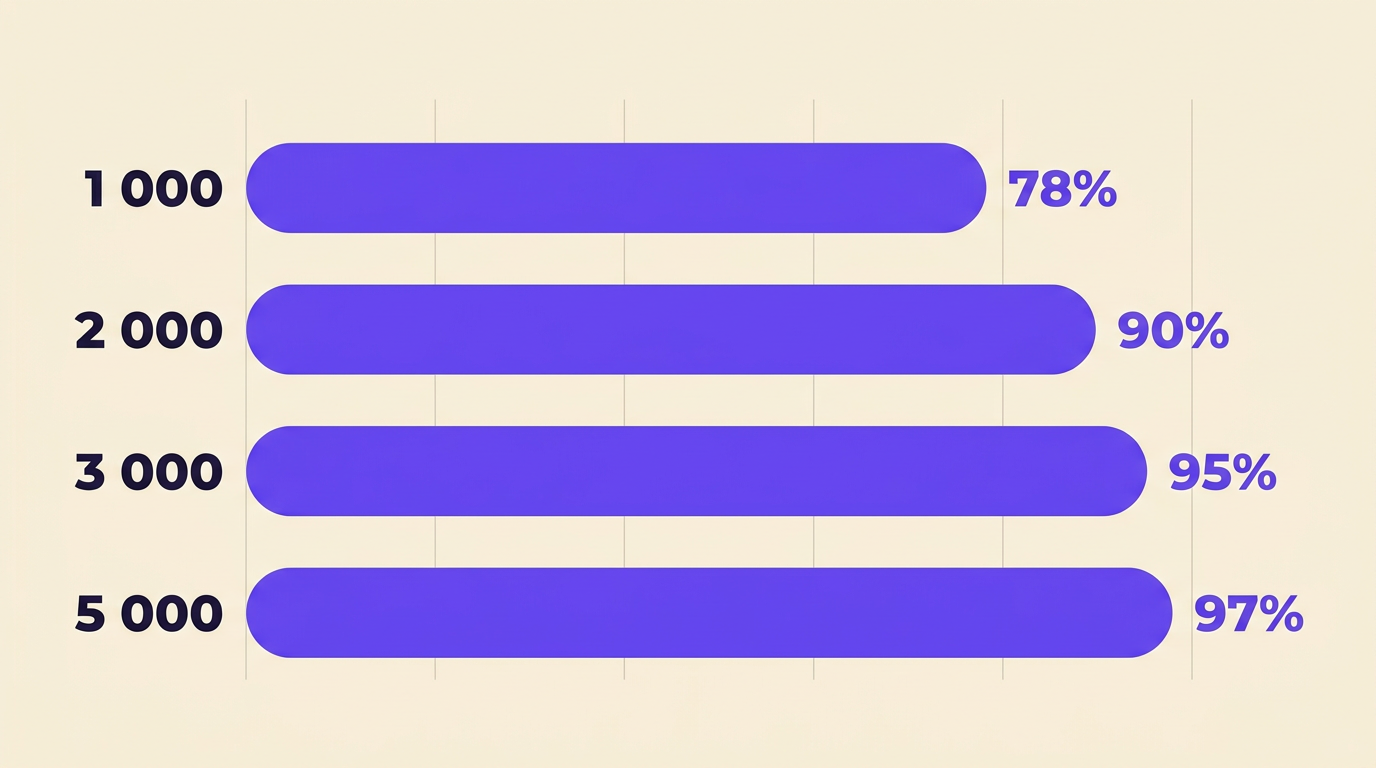
Look at where the jump sits. The distance between 1,000 and 3,000 words is the distance between understanding nothing and understanding almost everything. The next two thousand add a couple of percentage points. The practical conclusion: the first three thousand words are worth far more of your time than anything that comes after them.
Vocabulary size by CEFR level
The official CEFR scale describes what you can do, not how many words you have, so there is no single authoritative table. But studies of learners' vocabulary size at each level converge on similar ranges:
| Level | Passive vocabulary (word families) | What you can handle |
|---|---|---|
| A1 | around 500 | Introduce yourself, order coffee, name things around you |
| A2 | 1,000–1,500 | A short everyday conversation in simple sentences |
| B1 | 2,000–2,750 | Talk about your job, your plans, a problem at the hotel |
| B2 | 3,250–4,000 | An argument, a film discussion, a work call |
| C1 | 5,000–8,000 | Shades of meaning, irony, professional topics |
| C2 | 10,000 and up | Practically no limits |
The numbers are approximate and differ by hundreds of words between studies, so treat them as orders of magnitude. For comparison: an educated adult native speaker typically has 15,000–20,000 word families. You do not need to catch up with them — conversation already works at B2.
Why familiar words don't turn into speech
This is where the trap is. Someone honestly accumulates 4,000 words, recognises them in shows without subtitles, and still gets by on three hundred when talking. The cause is in how those words were learned.
When you look at a Spanish word on a card and recall the English meaning, you are training recognition — a passive skill. In conversation everything runs the other way: the English thought comes first, and you have to retrieve the Spanish word yourself. That is a different action, and it has to be trained separately.
How to move words from passive to active
Four techniques that genuinely change things:
- Review in the reverse direction. Not "Spanish word → meaning", but "English word → Spanish". That is exactly the effort a conversation demands.
- Say it out loud. A word you have spoken comes back noticeably more easily than one you only read silently. It also exposes straight away when you don't know how it sounds.
- Learn the word inside a phrase. Not decisión but tomar una decisión. In speech you pull a ready-made chunk out of memory instead of assembling one.
- Use a new word the same day. One sentence out loud, a message, a line in a journal — it doesn't matter. A word that has been through your own speech behaves differently from one you have only read.
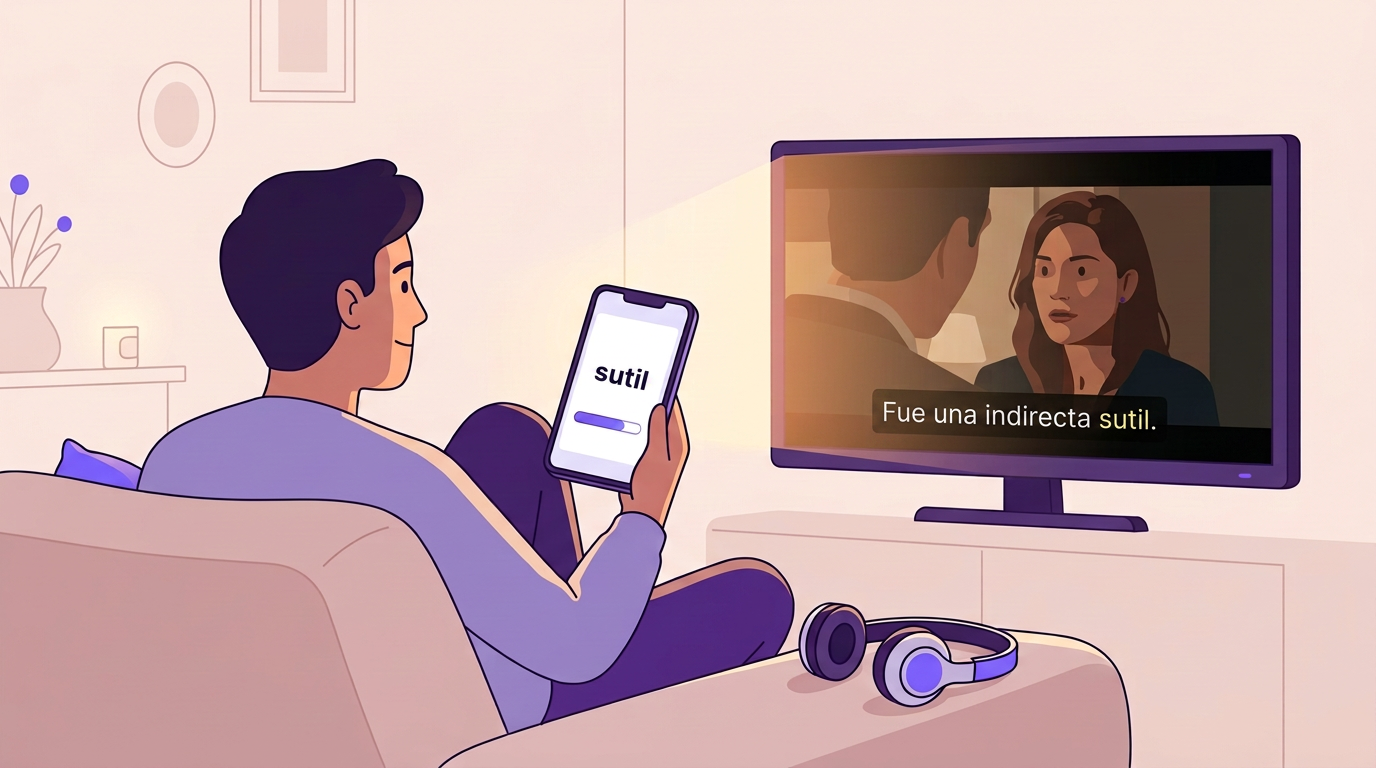
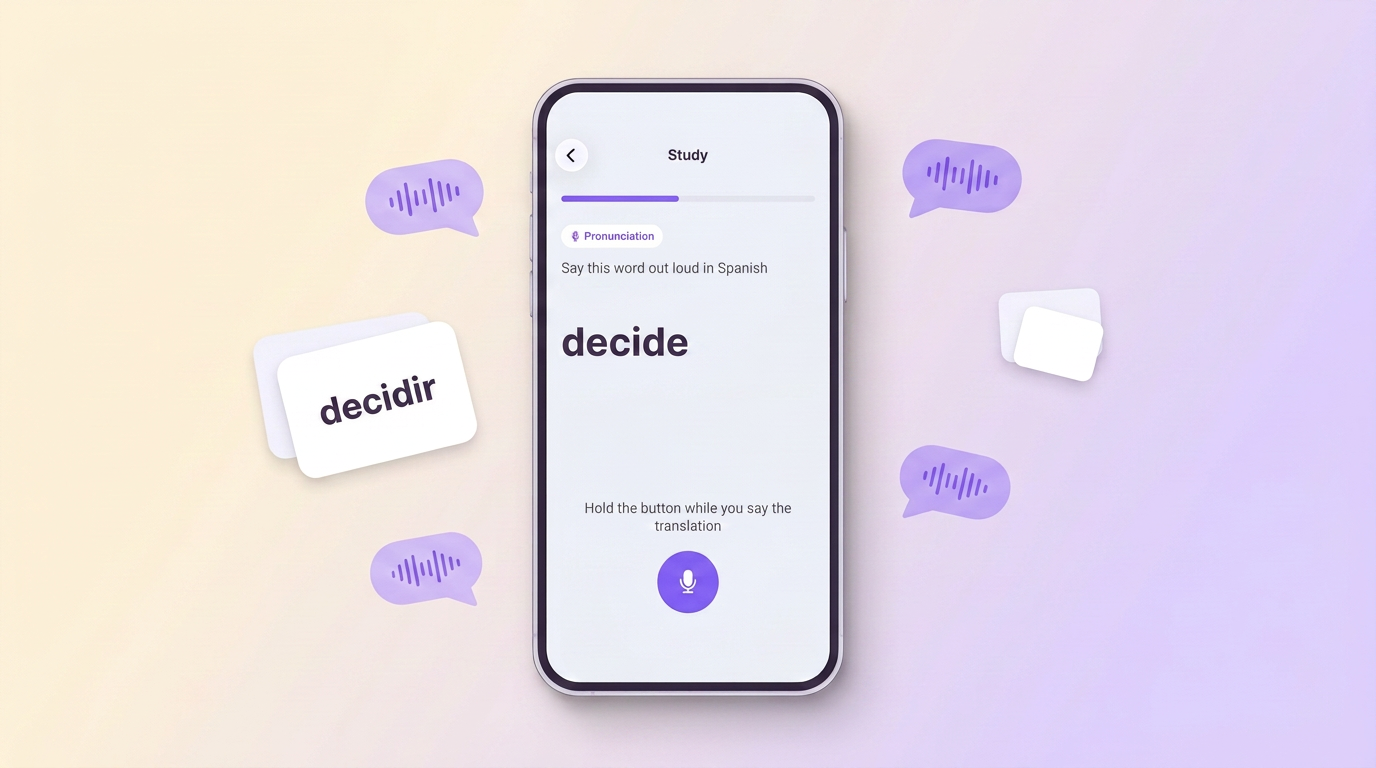
That is exactly the work VibeLing does. A word you saved from a show, an article or a conversation isn't only shown for recognition: the practice includes a screen where the English word is on the display and the Spanish one has to be spoken out loud, into the microphone. Every word also comes with a translation, usage examples and audio, and spaced repetition brings it back exactly when it starts slipping away.
How long this takes
An active thousand words sounds daunting until you break it down by day:
| New words per day | Per month | A thousand words in |
|---|---|---|
| 3 | ~90 | about a year |
| 5 | ~150 | 7–8 months |
| 10 | ~300 | 3–4 months |
The maths is optimistic: some words fall away if they are never reviewed, so real timelines run longer. But the order of magnitude holds — ten minutes a day covers a basic conversational vocabulary in roughly a year. Not five years, which is what most people assume.
One more thing: ten new words a day only makes sense if the old ones keep coming back. Without review you add three hundred words a month and lose almost as many.
What to measure instead of a total
A total word count is a poor metric: you can't measure it precisely and it says nothing about conversation. These are more useful:
- How many times in ten minutes of talking you hit a word you don't have. When five or six drops to one, you have moved up a level, whatever the counter in your app says.
- How often you have to talk your way around something. Saying "la cosa para abrir botellas" instead of abrebotellas is a normal and useful skill, but the less you need it, the more fluent you sound.
- How many words from your own list you have actually said out loud this week. That is your active vocabulary, measured as it changes.
The bottom line
The entry threshold for conversation is lower than people assume: about a thousand active words and two to three thousand you recognise, not ten thousand. And the difference between learners who start speaking and learners who get stuck at understanding is almost never the amount they have studied — it is whether they trained their words in the direction speech actually needs.
If you want to see how many words you have in the active column right now, start building your own Spanish word list in VibeLing: save what you meet in real life, review it from English into Spanish, and say it out loud. In a couple of months a thousand will stop looking like a big number.