How to Stay Motivated While Learning Spanish
Almost everyone who learns Spanish on their own goes through the same cycle. First the excitement: you download an app, start a notebook, practice every day for a week. Then one missed day, then another, then the guilt — and a month later the only thing left of your Spanish is an icon on your phone. Six months pass and the whole thing starts over from yet another "Monday."
This cycle doesn't get broken by willpower. People quit at fairly predictable points, and almost every one of those points can be cushioned in advance. Here is where things usually go wrong and what to do about it.
Why you quit — and it's not laziness
Take apart a typical abandoned Spanish project and you'll almost always find three mistakes made right at the start:
- The goal can't be checked. "Learn Spanish" is not a goal, it's a direction. It has no finish line, so your brain never gets a single "done" checkmark and slowly loses interest.
- The plan is built for the best version of you. An hour a day, six days a week works beautifully for the first ten days — until a work crunch, a cold or a trip shows up.
- Progress is invisible. You study for three weeks and speak roughly the same as before. That feeling of "nothing is changing" is the biggest single producer of abandoned languages.
Each of these mistakes can be fixed separately, and none of them requires heroics.
Set a goal you can actually check
A working goal answers two questions: what exactly will I be able to do, and by when. Compare:
| Vague goal | Checkable goal |
|---|---|
| Learn Spanish | By December, follow my favorite Spanish series without English subtitles |
| Improve my vocabulary | Add 300 words to my personal dictionary in three months and get them to "learned" |
| Start speaking | In a month, talk about my job in Spanish for two minutes without preparation |
A checkable goal does two things. First, it has a finish line you can actually reach. Second, it dictates the content of your practice: to watch a series without subtitles you need words from that series, not a generic "100 B1 words" list from a random collection.
Plan for your worst week, not your best
The "one hour a day" plan doesn't fail because an hour is too much. It fails on the first day when there is no hour. Then the familiar logic kicks in: today is ruined anyway, so I'll start fresh on Monday. Monday quietly turns into next month.
So your baseline plan has to survive the worst-week test: a business trip, a deadline, a sick kid. Usually that's 5–10 minutes a day — one short vocabulary session you can do in a line or on the bus. Everything on top of that is a bonus, not an obligation. We covered how to get the most out of this format in our article on learning Spanish vocabulary in 10 minutes a day.
The point of the minimum plan isn't volume — it keeps the chain from breaking. Ten minutes teaches you very little in a single day, but it keeps you in the game, and over six months that adds up to thousands of repetitions.
A missed day is not a failure
A day without practice is just a day without practice. What turns it into a failure is the conclusion — "I blew it again" — that you draw yourself. There is a simple rule that breaks this logic: never miss twice in a row. One missed day is normal life. Two in a row is the signal to come back, even if only for five minutes.
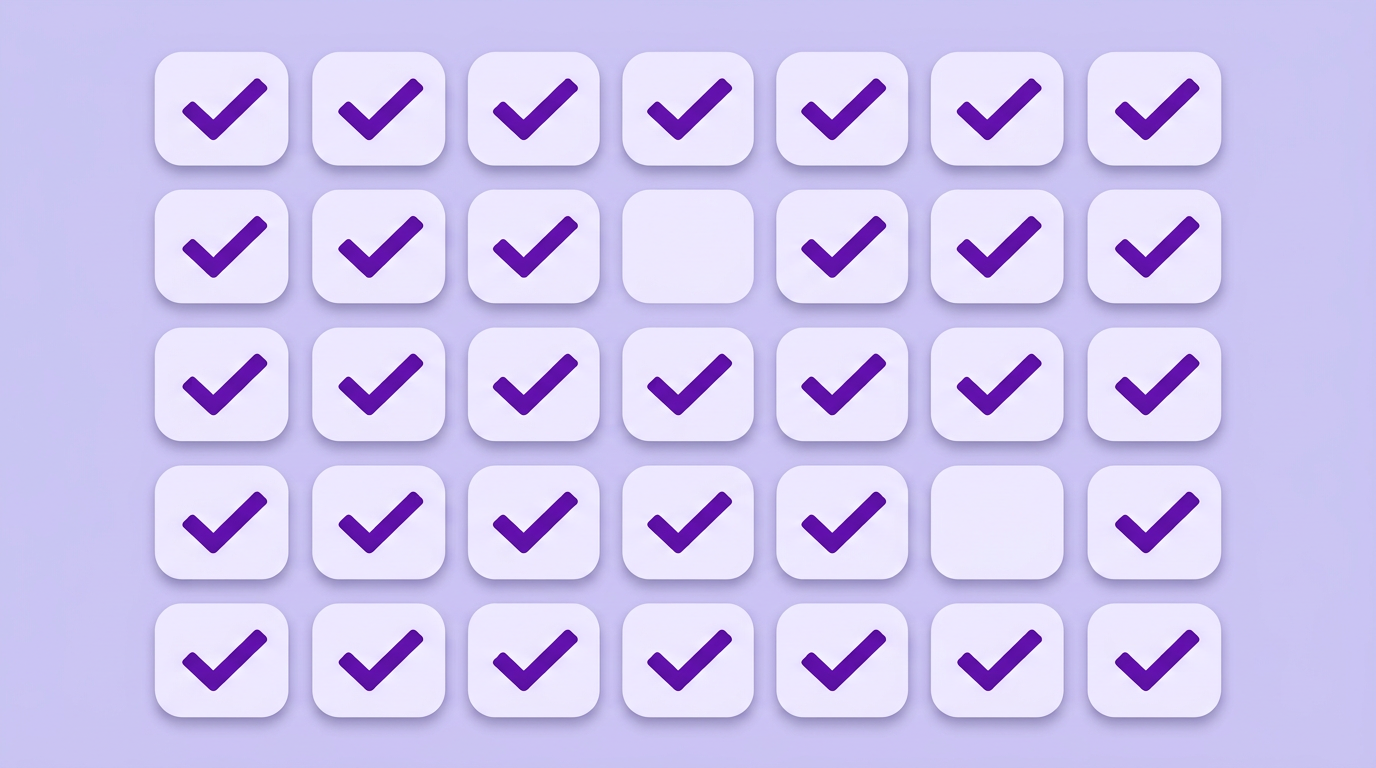
Be careful with streaks — counters of consecutive days. While the streak grows, it motivates. But if the app resets it to zero over one missed day, for some people the desire to continue resets along with it. Count sessions per month instead of perfect days in a row: 20 sessions with four missed days is an excellent month, not a ruined streak.
Make your progress visible
Fluency grows slowly and imperceptibly, so you can't rely on the feeling of "I speak better now" — it won't show up for a long time. You need a counter that changes every week. The simplest one is the size of your dictionary: how many words you've added and how many of them you've brought to "learned."
In VibeLing this is visible right on the dictionary screen: every word has a "learning" bar that fills up with each review, and the total count of your words sits at the top. Opening your dictionary and seeing that 80 words appeared there in a month, half of them already mastered, is far more convincing than any vague feeling.
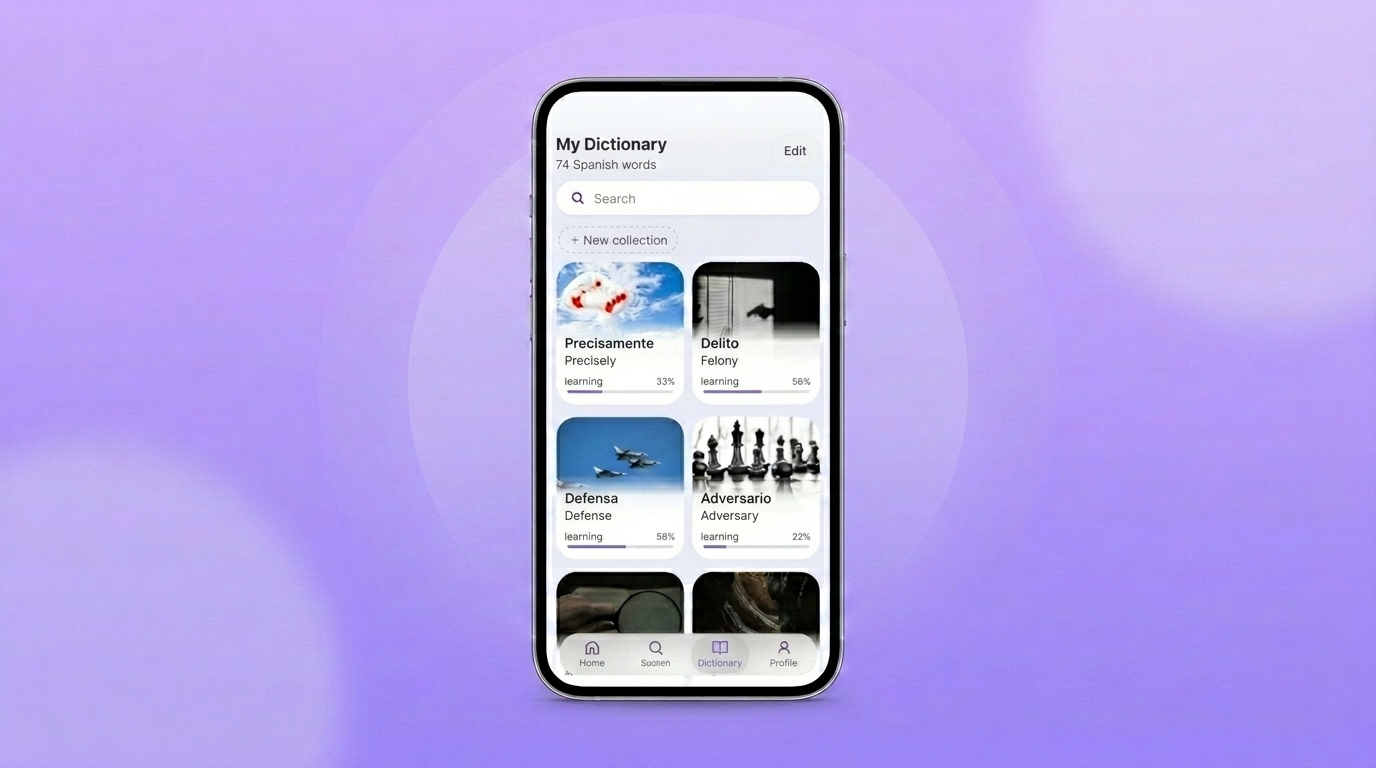
Once a month, give yourself a small checkup: rewatch an episode that felt hard a month ago, reread the phrases you saved, record the same two-minute talk about yourself. The difference between "then" and "now" is the strongest fuel available.
Learn the words that come to you
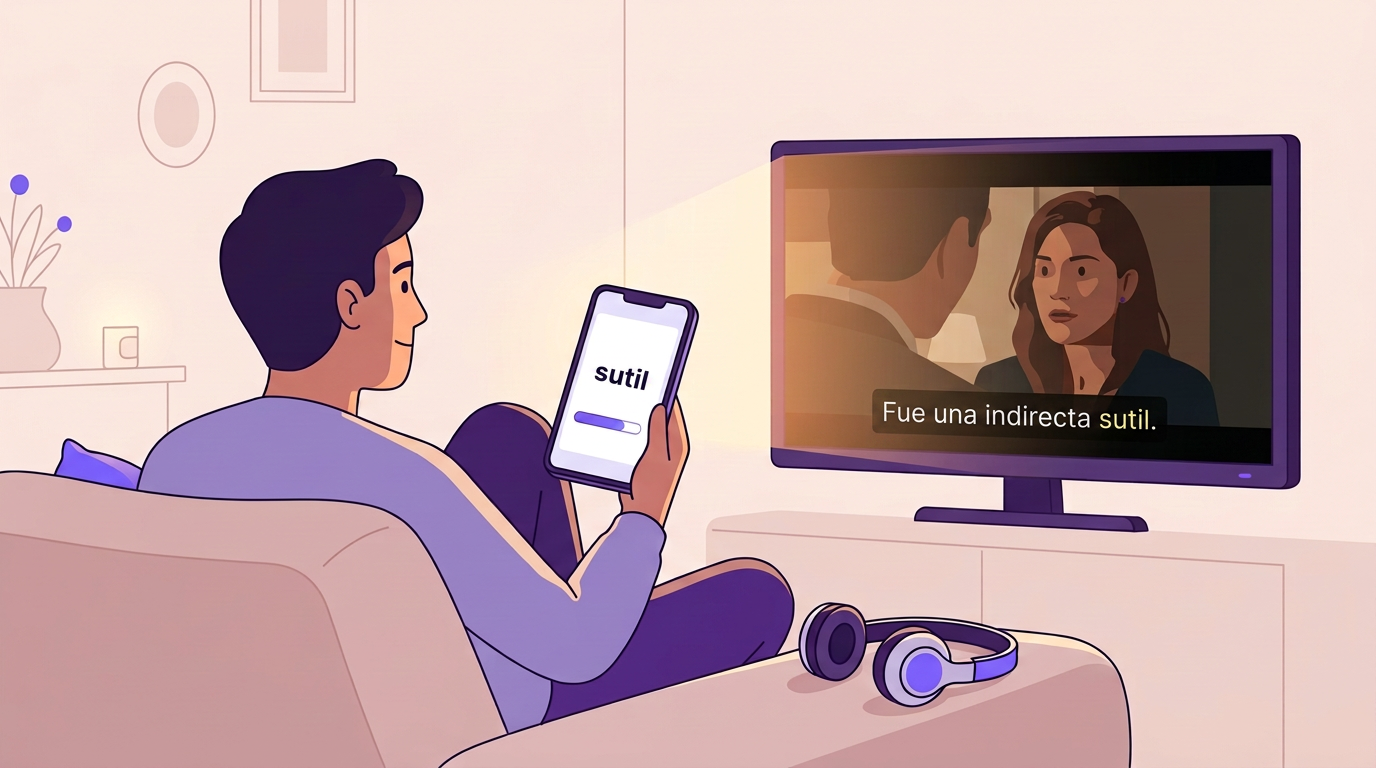
Discipline is a limited resource; interest lasts longer. Lists of "the most essential words" get abandoned quickly because the words in them belong to no one: they aren't connected to your job, your shows or your plans. The word madrugada, heard from a character of your favorite series in an important scene, sticks in a completely different way than the same word sitting at number 47 in someone else's list.
That's why the most durable source of words is your own life: series, songs, work emails, posts, games. When you meet an unfamiliar word, save it right away. In VibeLing it takes a few seconds: you type the word, the app pulls up the translation, examples and pronunciation, and then spaced repetition takes over — the word shows up in your practice exactly when you're about to forget it. You no longer have to decide "what should I study today": the review queue builds itself, which removes one more excuse to skip. We wrote more about how these short sessions grow into a lasting routine in our article on building a daily Spanish vocabulary habit.
Where to start today
Here is the whole plan in short:
- Set a goal with a finish line and a deadline — one you can actually check.
- Pick a minimum that survives your worst week: 5–10 minutes a day.
- Agree with yourself on the "never miss twice in a row" rule.
- Choose one progress counter — for example, the number of learned words — and look at it once a week.
- Collect words from your own life, not from other people's lists.
None of these steps requires motivation — that's the whole point. Motivation gets you started; after that, a system and convenient tools should do the work. If you want your words saved in one tap, reviewed automatically and adding up to visible progress, start your personal dictionary in VibeLing — and may you simply never need another "Monday."