How to Build a Daily Spanish Vocabulary Habit That Sticks

The app is installed, the first three days go great, and by day nine you have forgotten about it. A week later you open it, see the counter back at zero, and close it again. The story is so common it barely deserves discussion — and it is almost never about laziness.
Daily vocabulary practice does not run on motivation. It runs on a few boring settings: what moment of the day you practise, how long it takes, and what happens on the day everything goes wrong. Let's go through those settings one by one.
Why the habit breaks in week two
The first days run on novelty: a new app, new words, visible progress. Novelty runs out around day ten, which is normal and has nothing to do with willpower. After that the session has to rest on something else, and if that something else was never built, everything falls apart.
It usually falls apart for three reasons:
- There is no specific moment. "I'll practise every day" is not a plan. The day fills up, the spare minute never arrives on its own, and words get pushed to the evening — by which point there is nothing left in the tank.
- The serving is too big. Twenty new words per session looks reasonable on Monday and impossible on Thursday. As soon as a session requires being in the mood, you start avoiding it.
- One miss feels like failure. You skip a day, the counter resets, it stings, and you don't open the app for a week. Streak mechanics are useful in themselves, but they are exactly what finishes off anyone who had one bad day.
Attach words to something that already happens every day
The most reliable way not to forget about a session is to stop relying on memory at all. Instead of a time ("9 a.m."), pick an event that happens without exception: the coffee is poured, you sit down on the train, you brush your teeth, you put the kettle on, you wait for the car to warm up. The session starts right after that event.
The sentence comes out like this: "after I pour my coffee, I open the app and work through my words." The event is already built into the day, it needs no slot in your schedule — and everything attached to it moves in for free.
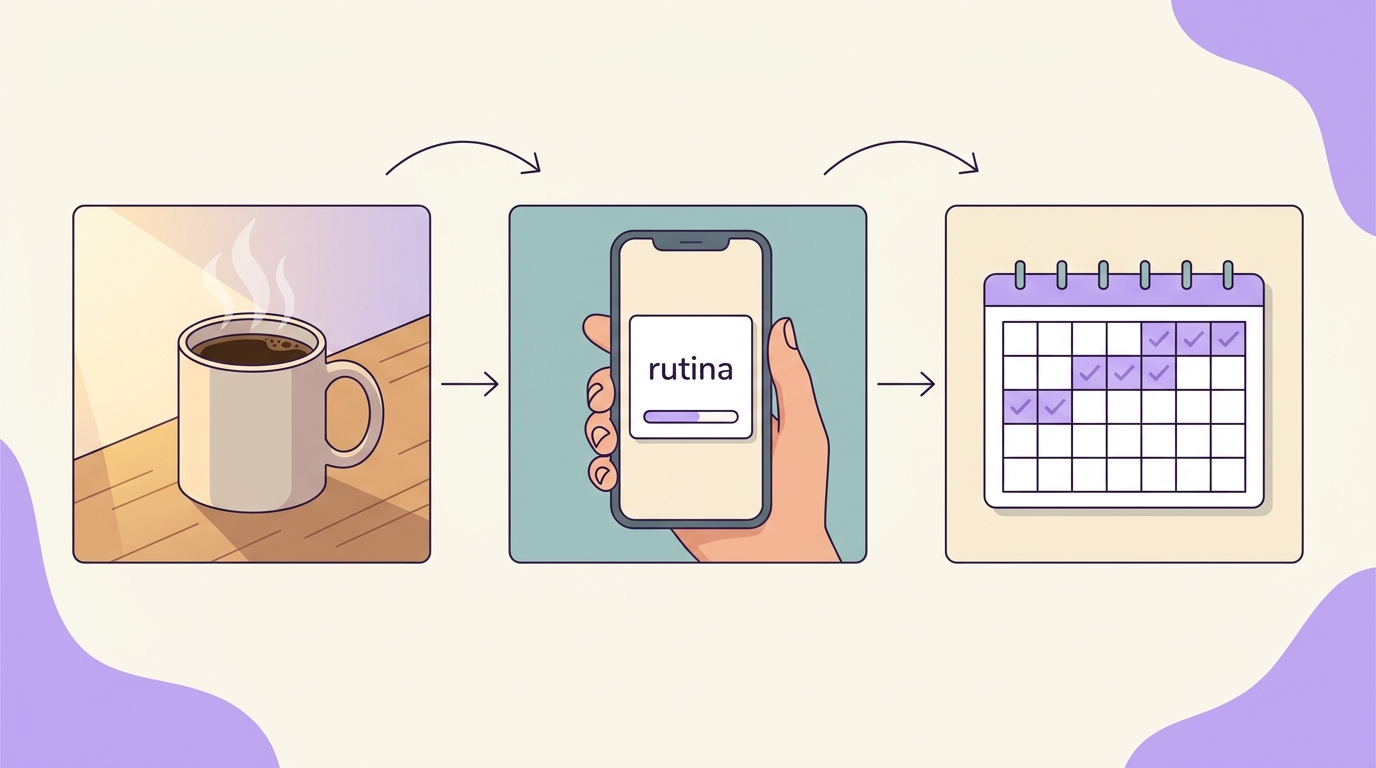
Pick an anchor near the start of the day. Anything placed after work competes with tiredness and always loses. Mornings win a little unfairly here: there is less competition.
Make the first serving embarrassingly small
Five minutes is not a compromise or an easy mode, it is a working serving. The job of the first two or three weeks is not to learn as many words as possible, but to get the session to the point where it no longer requires a decision. As long as every round is being negotiated inside your head, there is no habit yet.
Starting with 5–8 new words a day plus reviews of what is already in circulation works well in practice. That fits into those five minutes, and short daily sessions beat an hour-long weekend session over any real distance — simply because the weekend session does not happen every weekend.
There is a useful rule: stop while you still want to continue. If every round pushes you to "finally, done", opening the app tomorrow gets noticeably harder.
Remove everything standing between you and the first word
Habits are extremely sensitive to small obstacles. Unlocking the phone, finding the folder, remembering the password, choosing a deck, setting a mode — every extra step lowers the odds that the session happens at all.
What helps:
- move the app icon to the first screen, ideally to the bottom row where your thumb lands;
- decide in advance what exactly you do in those five minutes, so there is nothing to choose;
- download what you need ahead of time if you practise on the move and the connection is bad;
- put your headphones on before you open the app, if the drill has audio.
Count words, not days
A day-streak counter motivates beautifully right up until the first miss, after which it turns into a reminder of failure. Looking at what actually accumulates is far more durable: how many words are in your dictionary, how many of them count as learned, how many reviews you did this month.
Those numbers do not reset. You skipped Tuesday — on Wednesday you still have 240 words, not "day one again".
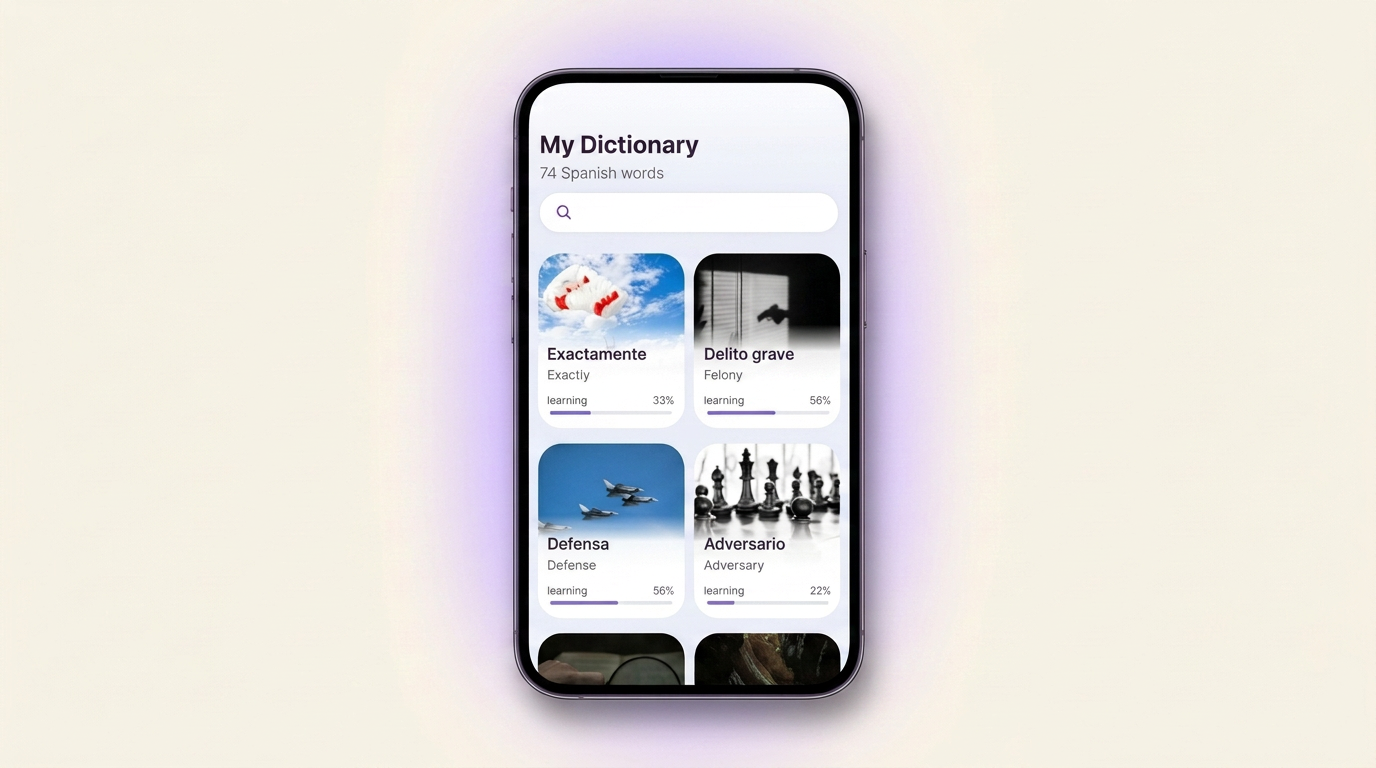
Reviews deserve a separate agreement with yourself. New words are more fun than old ones, so reviewing slips easily — and reviewing is what decides whether a word stays in your head. If you would rather not think about the schedule, let the app run it: review intervals are not something worth tracking by hand.
Decide in advance what to do about a missed day
Misses will happen: a work trip, illness, a child who would not sleep, or just a hard day. The habit survives not for the person who never misses, but for the person who already knows what they do after a miss.
Two rules are enough:
- Never miss two days in a row. One missed day is an accident; two is the start of a new schedule that does not include you.
- Keep a minimum version of the session. Have a variant for a genuinely awful day: one review, three words, ninety seconds. It exists not for those three words but to keep the chain unbroken.
How to scale up without blowing it
After three or four weeks the session stops taking effort, and the urge to add volume all at once shows up. That is the most common way to break something that was already working. Increase the serving slowly, and only after the current one has held without strain for at least two weeks.
| Period | New words per day | Goal of the stage |
|---|---|---|
| Weeks 1–2 | 5 | The session happens every day at the same moment |
| Weeks 3–4 | 8 | Reviews get done without reminders |
| Month 2 | 10–12 | A stock of words builds up that shows in your speech |
| Month 3 onward | as it feels | The session survives even a bad week |
Twelve words a day is roughly 350 words a month. Six months of that adds up to enough for everyday conversation and for watching a series without pausing to translate every other line.
How this works in VibeLing
An app will not build the habit for you, but it can take most of the friction out of it. In VibeLing a session starts straight in the drill — no deck to pick, no mode to configure. The review schedule runs itself: words you are starting to forget come back sooner, confident ones come back less often.
Words are added from wherever you met them: a series, an article, a conversation. Each one arrives with its translation, usage examples and pronunciation, so saving a word takes a few seconds instead of becoming a task of its own. In the dictionary every word shows a mastery percentage — that is the counter that does not reset after a missed day.
There is also a speak-it-out-loud drill: the word appears in English and you say it in Spanish. It is awkward on the train, but it is the fastest way to move words from "I recognise it in text" to "I can say it".
In short
- Anchor the session to an event that already happens daily, not to a time on the clock.
- Start with five minutes and five words; scale up no sooner than two weeks later.
- Shorten the path to the first word: icon on the first screen, no decisions inside.
- Watch the number of words, not the streak of days.
- Prepare a minimum version of the session and a "never two misses in a row" rule.
The first step is easier to take today than on Monday: pick your anchor, put the icon somewhere visible, and start your own word list — after that, all you have to do is never miss two days in a row.