How Often Should You Review Spanish Vocabulary?

Sound familiar? You learn twenty new Spanish words in the evening, review them all, remember them all — and a week later only two or three are left in your head. The problem isn't a "bad memory," and it isn't even how much time you put in. The problem is when you come back to what you've learned. In this article we'll break down the intervals at which you should review Spanish vocabulary so it stays with you for good — with a ready-made schedule you can start using today.
Why words fade so fast
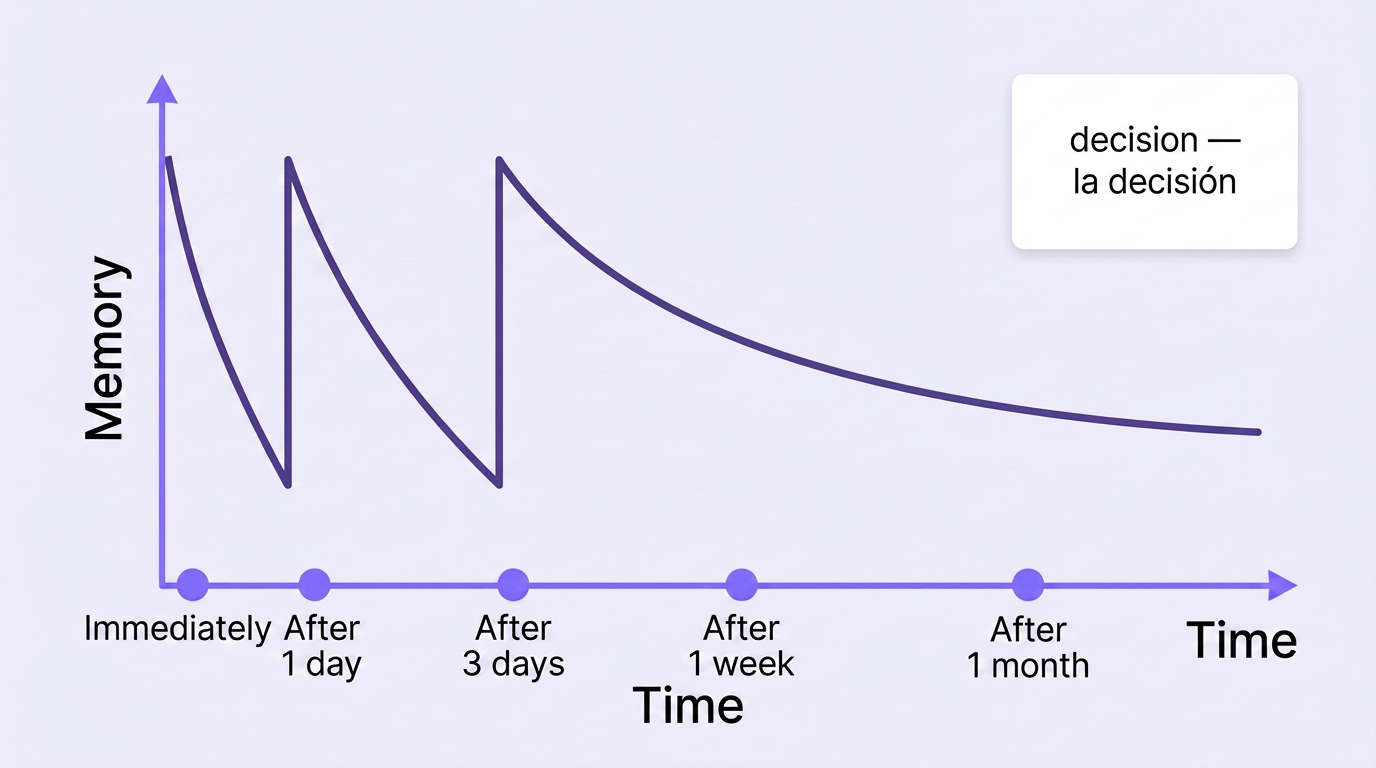
Your brain is ruthlessly practical: it only keeps what it considers useful. If a piece of information showed up once and was never needed again, it gets flagged as unimportant and quietly erased. Back in the late 19th century, psychologist Hermann Ebbinghaus described the forgetting curve: the steepest forgetting happens in the first hours and days after learning, and then the decline slows down.
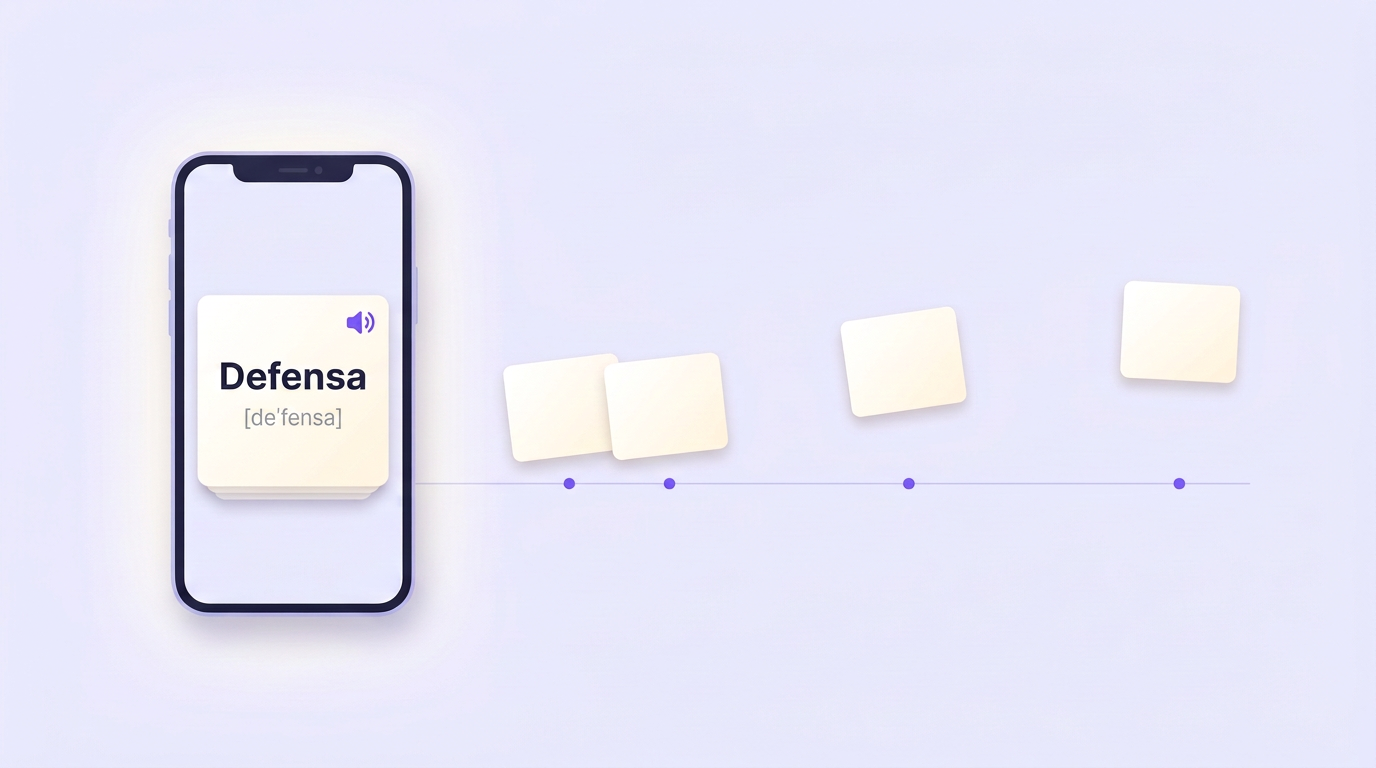
The key practical takeaway: you can't argue with forgetting, but you can use it. Every time you recall a word at the moment it's almost gone, the memory of it gets dramatically stronger — and next time it holds on longer. That's the principle behind spaced repetition: instead of reviewing "everything, every day," you review each word at its own moment, with growing intervals.
An optimal review schedule
There's no universal to-the-second formula — the intervals depend on how hard a word is and how easily it sticks for you. But here's a solid working scheme to start with:
| Review | When | What happens in your memory |
|---|---|---|
| 1st | Right after meeting the word | The word enters short-term memory |
| 2nd | 20–30 minutes later | The first impression is consolidated |
| 3rd | After 1 day | You've survived the first big wave of forgetting |
| 4th | After 2–3 days | The word starts moving into long-term memory |
| 5th | After a week | The memory trace becomes stable |
| 6th | After 2–3 weeks | The word comes back almost effortlessly |
| 7th | After 1–2 months | The word is locked in — occasional encounters are enough |
Notice the logic: the intervals grow. You don't need to review a word every day for months — that's time wasted on things you already remember. But skipping a review in the first few days means starting almost from scratch.
Reviewing means recalling, not re-reading
Second in importance only to the schedule is how you review. Skimming a "word — translation" list is nearly useless: your brain recognizes the word ("ah, seen that one") and creates an illusion of knowing. Real consolidation only happens through active recall: you see "decision" — and pull la decisión out of your own memory, not the other way around.
- Look at the English word and recall the Spanish one — it's harder and far more effective than the reverse.
- Say the word out loud — you engage auditory and motor memory.
- Recall words inside phrases: not just tomar, but tomar una decisión, tener sentido.
- Got it wrong? No big deal: the word simply needs its next review sooner than planned.
Rule of thumb: if recalling the word felt slightly difficult — you reviewed it at the perfect moment.
How many times do you need to meet a word?
Researchers give different numbers — usually somewhere between 5 and 15 encounters with a word in different contexts. The exact count depends on how similar the word is to ones you know, how much you actually need it, and how memorable your first meeting was. El taxi sticks on the first try, while abrumado ("overwhelmed") might take ten reviews — and that's completely normal.
The practical takeaway: don't sort words into "learned" and "not learned" after a single session. Every word travels its own path, and they deserve different review frequencies: easy ones — less often, stubborn ones — more often.
Typical review mistakes
- Reviewing everything every day. Exhausting and ineffective: you burn time on words you already know, and your brain never practices retrieving the almost-forgotten.
- Reviewing once a week in one big batch. By then most of the words are gone, and you're effectively learning them all over again.
- Only re-reading. Recognition is not knowledge. Without active recall, words never make it into long-term memory.
- Quitting after early wins. A word you recalled easily after three days isn't learned yet — it still needs its one-week and one-month reviews.
How to stop counting intervals by hand
The weak spot of any schedule is that someone has to run it. With twenty words, a notebook will do. With two hundred, manually tracking what's due today and what's due next week is unrealistic — that's exactly where DIY systems usually die.
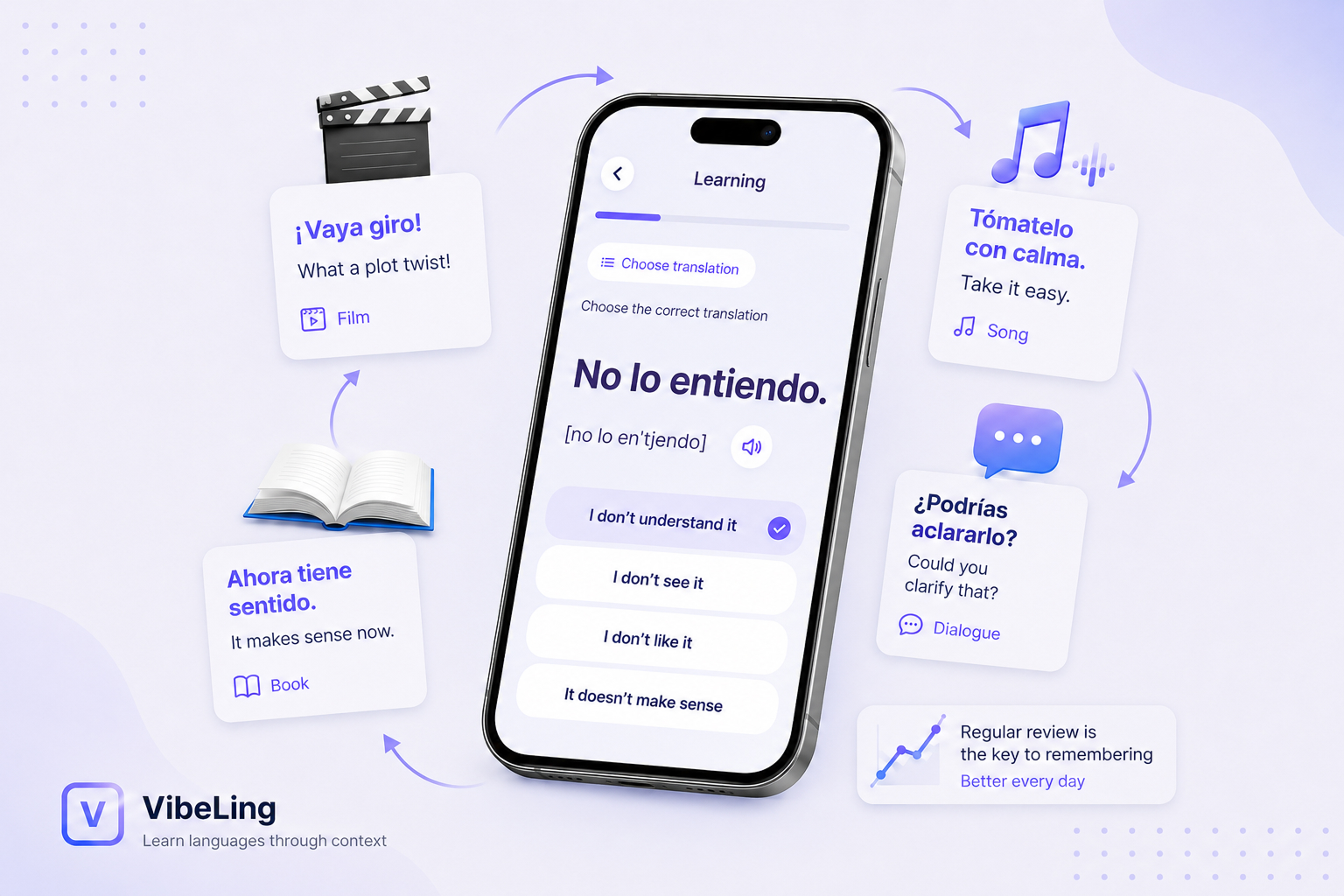
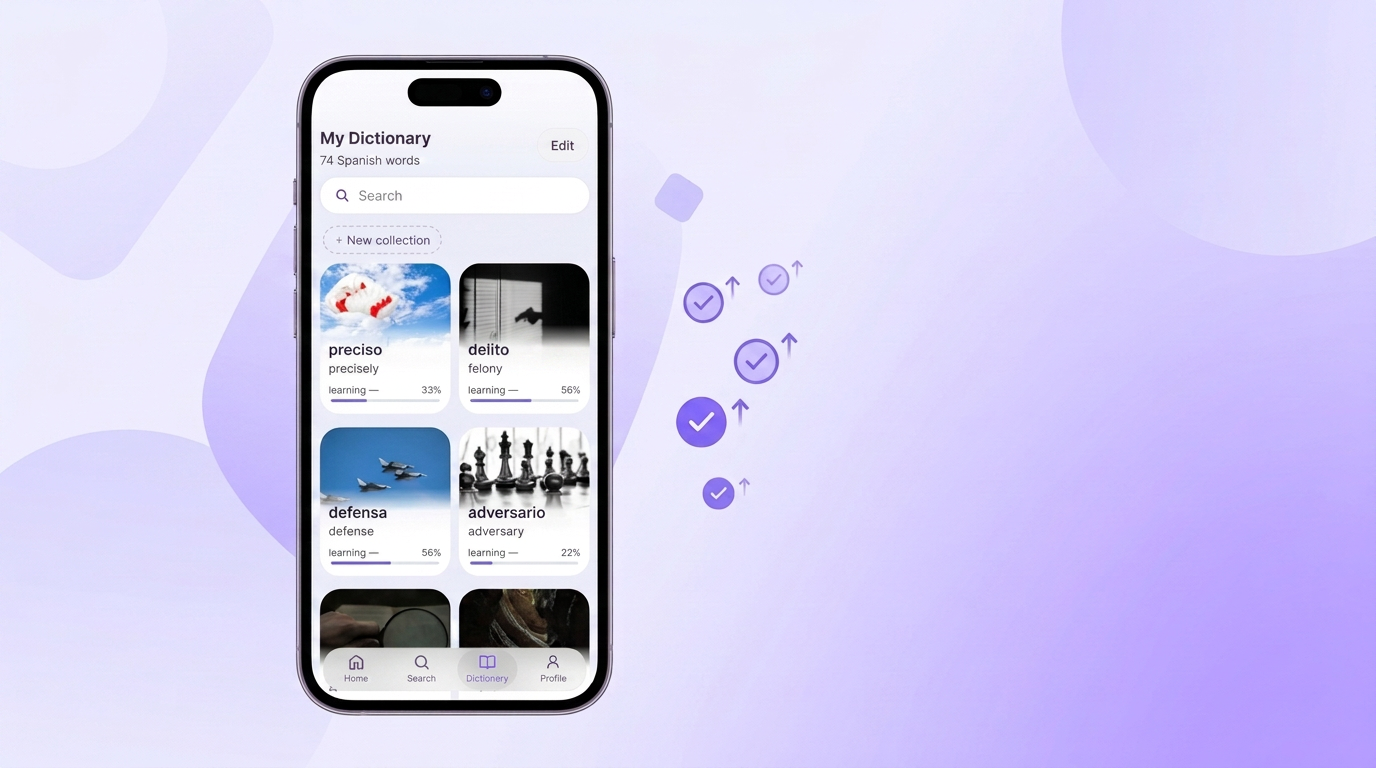
This is the job VibeLing, an app for learning Spanish vocabulary, takes off your plate. You simply add words — from a show, a book, a conversation — and the app computes the intervals for each word on its own, bringing it up in practice exactly when it's about to slip away. The exercises are built on active recall: choose the translation, fill in the missing word, say it out loud — with audio and transcription. And each word's progress bar shows you exactly where it is on its journey.
In short: your action plan
- Review new words the same day — right away, then once more after 20–30 minutes.
- Then: after a day, after 2–3 days, after a week, after 2–3 weeks, after a month.
- Review actively: recall the word yourself, out loud, in phrases.
- Hard words get more reviews, easy ones fewer.
- Hand the bookkeeping to an app and keep 10–15 minutes a day for the actual practice.
If you want to go deeper into memorization techniques, check out our guide on how to memorize Spanish words effectively, and to fit reviews into a packed day, see learning Spanish vocabulary in 10 minutes a day.
And to let the intervals count themselves, try VibeLing — add your first ten words today, and the app will remind you exactly when each one is due for review.