Spaced Repetition: The Simple Science of Never Forgetting
Last night you worked through thirty new Spanish words. A week later you can confidently recall five. A month after that, two. You put in real time, and the annoying part is that you did everything right: you looked at the translations, said them out loud, wrote them down.
The problem isn't the number of hours. The same thirty minutes can leave you with two words a month later, or with twenty-five. The difference is how those minutes are spread across days. That is what spaced repetition is built on.
What spaced repetition is
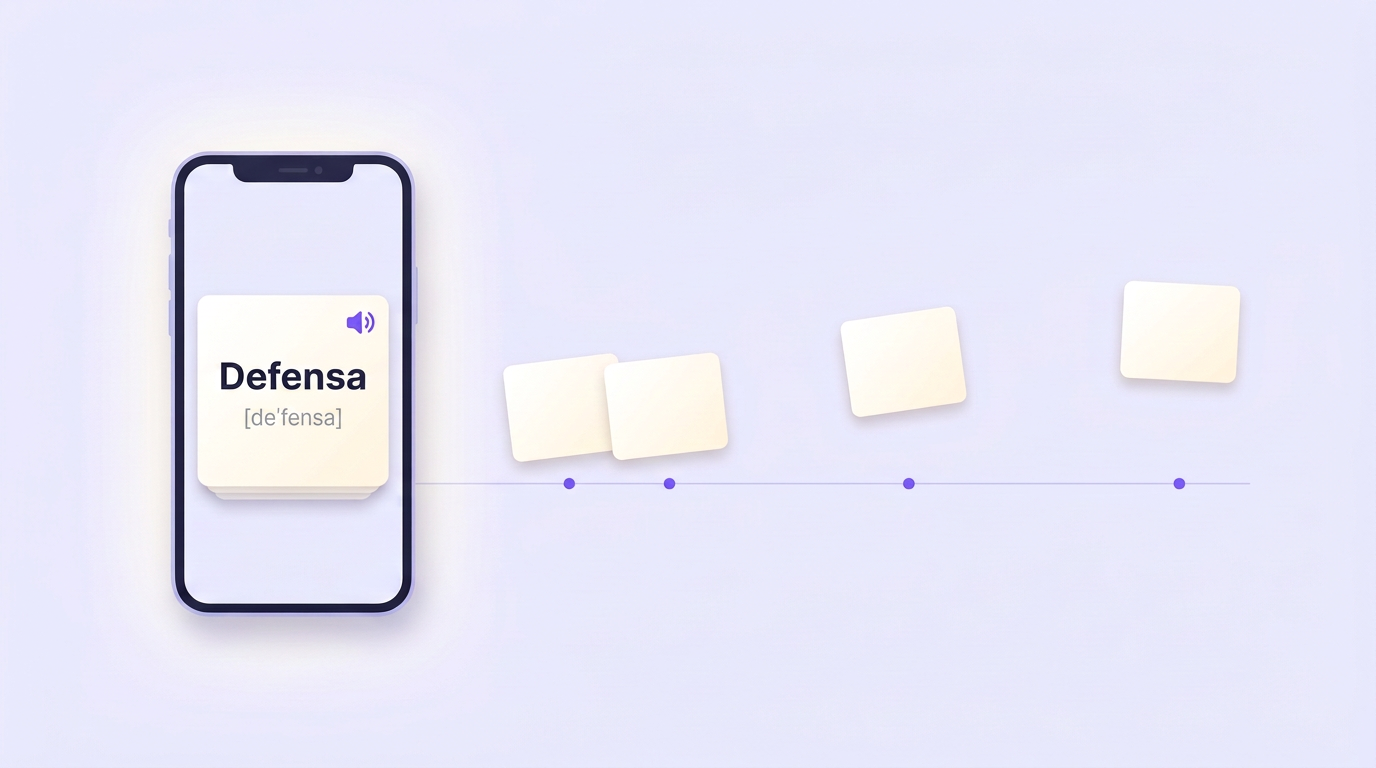
Spaced repetition is a way of distributing study over time: you come back to material after gaps that gradually grow. First you see a word again the next day, then after three days, then after a week, then after a month.
The benefit of spreading practice out is one of the most reliably confirmed results in the psychology of memory — it has been found again and again since the end of the nineteenth century, across very different kinds of material. It states something simple: for the same total study time, spaced sessions beat one long session. An hour split into six ten-minute sessions across six days does more than the same hour in one Sunday sitting.
The reason is that memory is strengthened not while you are looking at the word, but at the moment you pull it back with some effort. Repeat a word immediately and there is nothing to pull — it is still sitting on the surface. Wait until it starts to fade, then recall it anyway, and the memory trace gets noticeably stronger.
The second effect, without which the intervals do nothing
This is where a lot of people trip up. You can follow the schedule honestly and still review the wrong way, and get almost nothing out of it.
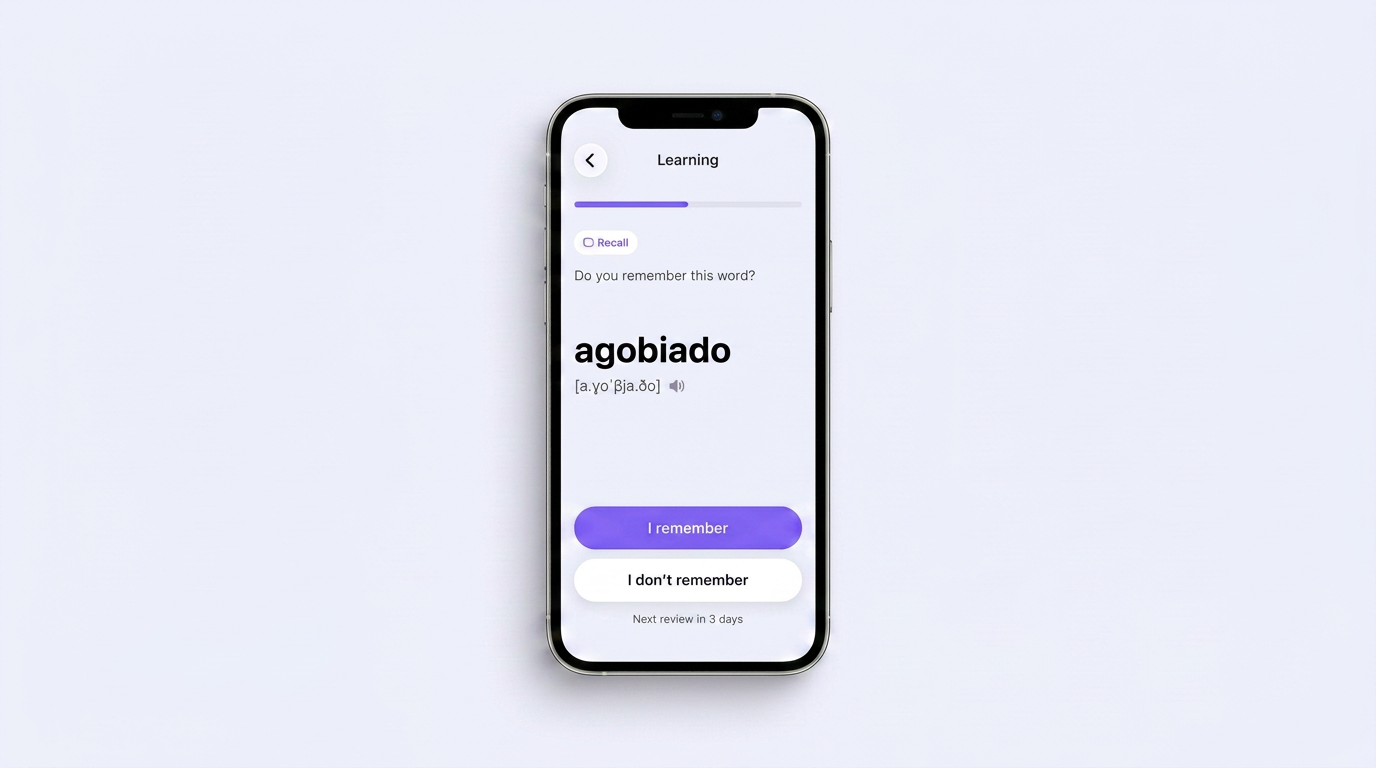
Rereading a list of word-and-translation pairs feels like work but gives memory very little. You see agobiado, next to it you see "overwhelmed", you recognise both, and your brain concludes the word is already familiar. The next day, in conversation, it doesn't come.
A different action is what works: trying to recall before you see the answer. This is known as the testing effect — the act of retrieving a word from memory strengthens it more than looking at it again. And the attempt helps even when it fails: if you genuinely tried to remember, couldn't, and then checked the answer, the word sticks better than if you had opened the translation straight away.
Hence a simple rule: every review should start with a question, not with an answer. First you try to recall, and only then check yourself.
How hard should it feel
The interval is right if you managed to recall the word, but with effort — you had to search for a second or two. That is the working point.
Too early, and it comes instantly, so the review is wasted. Too late, and it doesn't come at all, so you have to learn the word again.
That is exactly why each word needs its own interval rather than one shared by the whole batch. You will remember taxi the first time, while agobiado may take eight or ten encounters. Running both on the same schedule wastes time on the first and shortchanges the second.
How the algorithm decides when to show a word
This is the job the algorithm inside the app does. For each word it stores two things: the current interval (how many days until it shows up) and an estimate of how easy that word is for you. After every answer, both are recalculated.
| Your answer | What happens to the interval | What comes next |
|---|---|---|
| Recalled easily | Multiplied — say from 7 days to 18 | The word leaves your daily sessions for a long time |
| Recalled with effort | Grows, but cautiously: from 7 days to 10 | The word stays under observation |
| Didn't recall | Resets almost to the start | The word comes back tomorrow |
The first family of these algorithms appeared back in the eighties (SM-2, in the SuperMemo program), and half of today's flashcard apps still run on it. Modern schedulers work differently: they estimate the probability that you would recall a word today and schedule it for the day that probability drops to roughly 90%. The intent is the same — catch the moment just before the word starts to fade.
The practical conclusion is simple: calculating intervals by hand makes no sense. For twenty words a notebook is fine; for two hundred it isn't, because every word has its own due date and its own resets. Hand that arithmetic to software and keep the reviewing for yourself.
Where spaced repetition breaks
The method works, but it has a few predictable ways of falling apart. All of them are fixable.
- The snowball of due cards. You add fifty new words a day and the reviews pile up. Two weeks later the app shows four hundred words due, opening it feels grim, and you quit. The fix is a cap on new words: 5–15 a day until you know your own pace.
- Stubborn words. Everyone ends up with a dozen words that reset over and over and eat half the session. Don't keep drilling them in the same form. It's easier to relearn such a word from scratch: attach a real example, an image or a sentence of your own, and it stops fighting you.
- Recognition instead of recall. If your session is mostly picking one of four options, you are cueing off the choices every time. Honesty test: can you say the translation looking only at the word, with no options on screen?
- Words with no context. A bare word-and-translation pair transfers poorly into speech, however often you review it. A word needs the phrase it lives in: not tomar, but tomar una decisión. There's more on that in our guide to memorizing Spanish words effectively.
- Missing several days in a row. No need to panic here: the schedule doesn't burn down. Come back and clear the backlog in small portions of 15–20 words, and hold off on new ones for a while.
How this works in VibeLing
VibeLing is built around the same principle, minus the settings you'd have to learn. You add a word or phrase you ran into in a show, an article or a conversation, and the app pulls in the translation, transcription, audio and an example of use — you never assemble a card by hand.
From there the word joins your review plan. The app calculates the interval for each word and shows it when it is starting to fade: what's hard comes back more often, what's solid comes back less and less. The exercises are built on recall rather than recognition: remember the translation from the word, fill the missing word into a sentence, spell it out, say it aloud. The day is split into short sessions of ten words, so one session takes a few minutes.
The concrete schedule — how many days between reviews and how many words to take on — we covered separately in the article on how often you should review Spanish vocabulary.
Where to start
- Take 10 words you actually need, from whatever you watched and read this week.
- Attach to each one the phrase you met it in.
- Study for 10 minutes a day, and always start with an attempt to recall, not with the translation.
- Add 5–15 new words a day, no more, until you see how many reviews build up.
- After two weeks, test yourself on paper: write out every translation with no prompts.
In short
Spaced repetition isn't about willpower or hours logged. It's about two things: coming back to a word at the moment it has almost faded, and pulling it out of memory yourself every time instead of rereading it. Everything else is arithmetic, and software does the arithmetic.
If you'd like to test this on your own words rather than someone else's list, start a personal dictionary in VibeLing and add your first ten words today. The app will tell you when it's time to come back to each of them.