Best Flashcard App to Learn Spanish Words
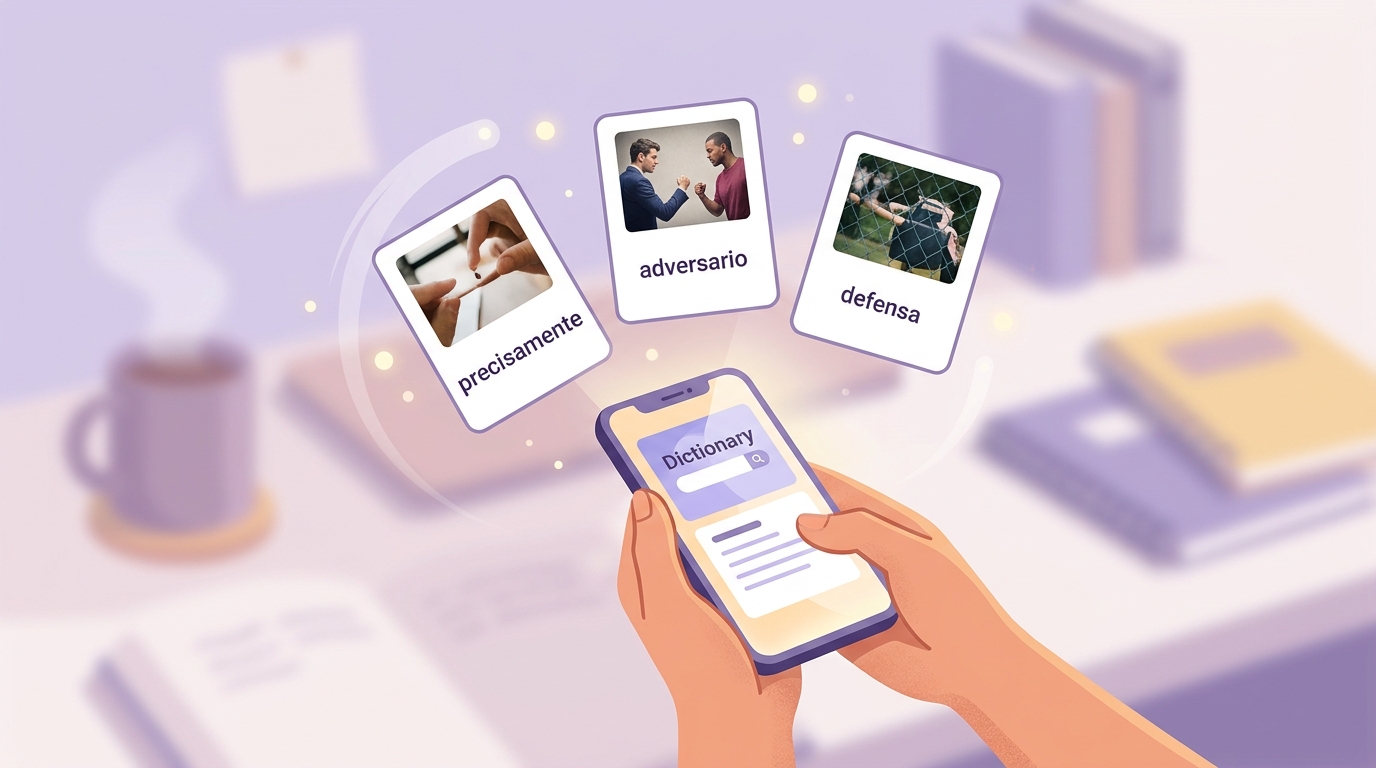
Flashcards are the oldest way to learn words, and nobody has beaten them yet. Word on one side, translation on the other, you either remembered it or you didn't. Everything else — spaced repetition algorithms, AI, gamification — is a layer built on top of that simple mechanic.
But one person turns a deck into fifteen hundred words they actually recognise in Spanish films, while another ends up with a hundred and fifty cards they haven't opened since March. The difference is almost never willpower. It's where the cards come from and what exactly the app asks you to do with them.
Why flashcards work
Two effects sit behind flashcards, and memory researchers have tested both dozens of times.
The first is active recall. When you look at adversario and try to pull the meaning out of your head, your brain does work. When you simply reread a list that says "adversario — opponent", there is no work: your eyes glide, you feel a sense of recognition, and almost nothing sticks. That's why one attempt to recall, even a failed one, beats five rereadings.
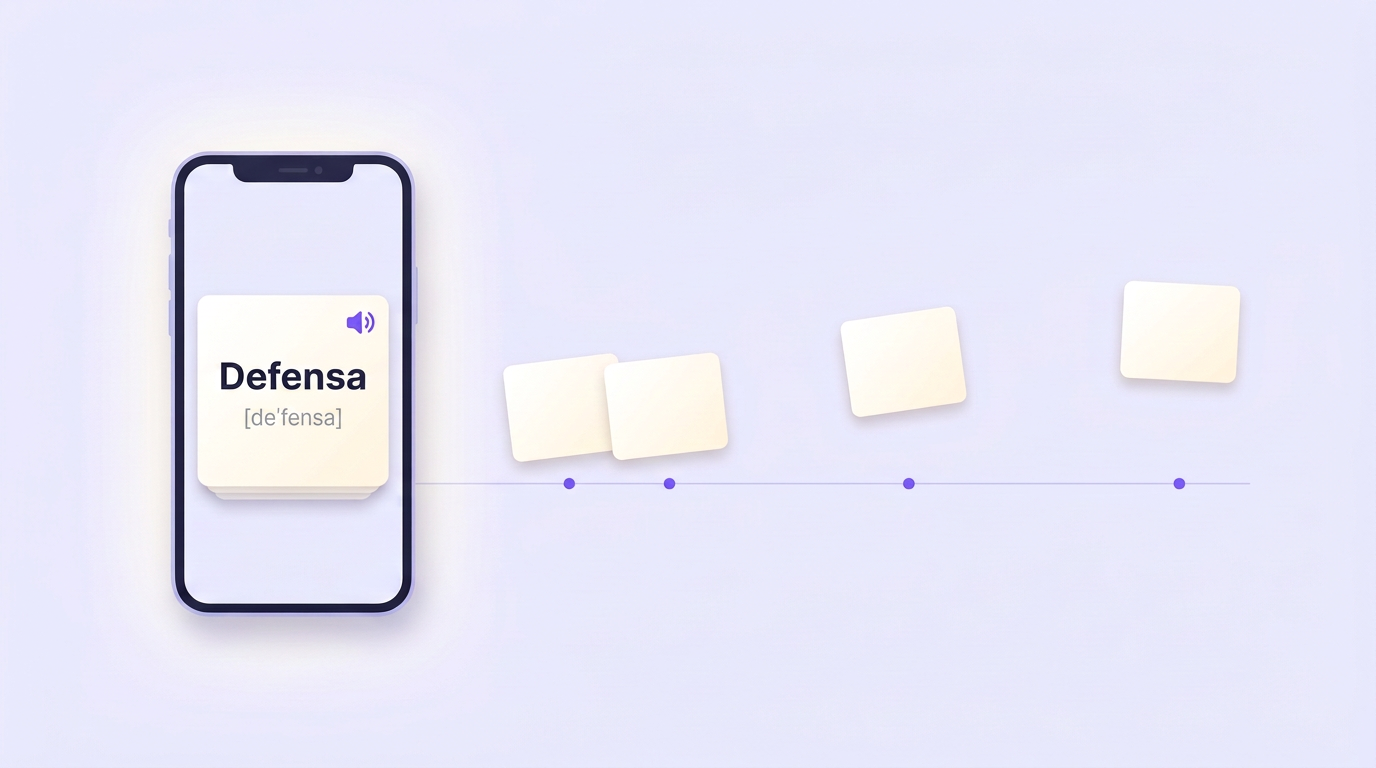
The second is spacing. A word you come back to after a day, then three days, then a week stays in memory far longer than the same word repeated five times in one evening. There's a separate breakdown of how the intervals work.
A flashcard is just convenient packaging for those two things. The whole point of a flashcard app is that you don't count intervals by hand and don't carry a shoebox of paper slips around.
Where decks usually die
There are three places a deck falls apart, and they repeat for everyone.
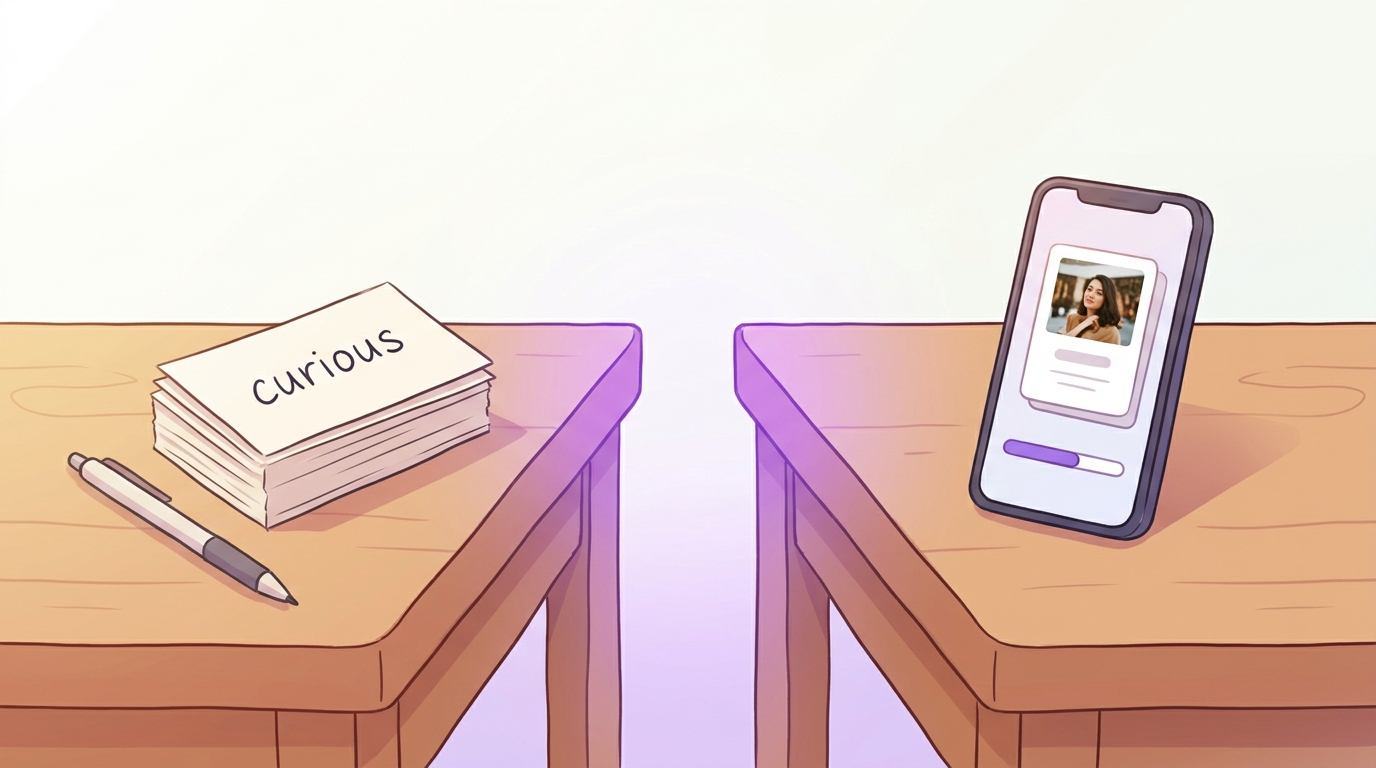
Somebody else's deck. A ready-made "1000 B2 Spanish words" set looks tempting: nothing to type in, it's all there. The problem is you don't remember why you needed any of it. A word you met yourself — in a series, in a message, in an article — arrives with context: you remember the scene, you remember not understanding the line. A word from someone else's list arrives naked, and your brain files it as noise.
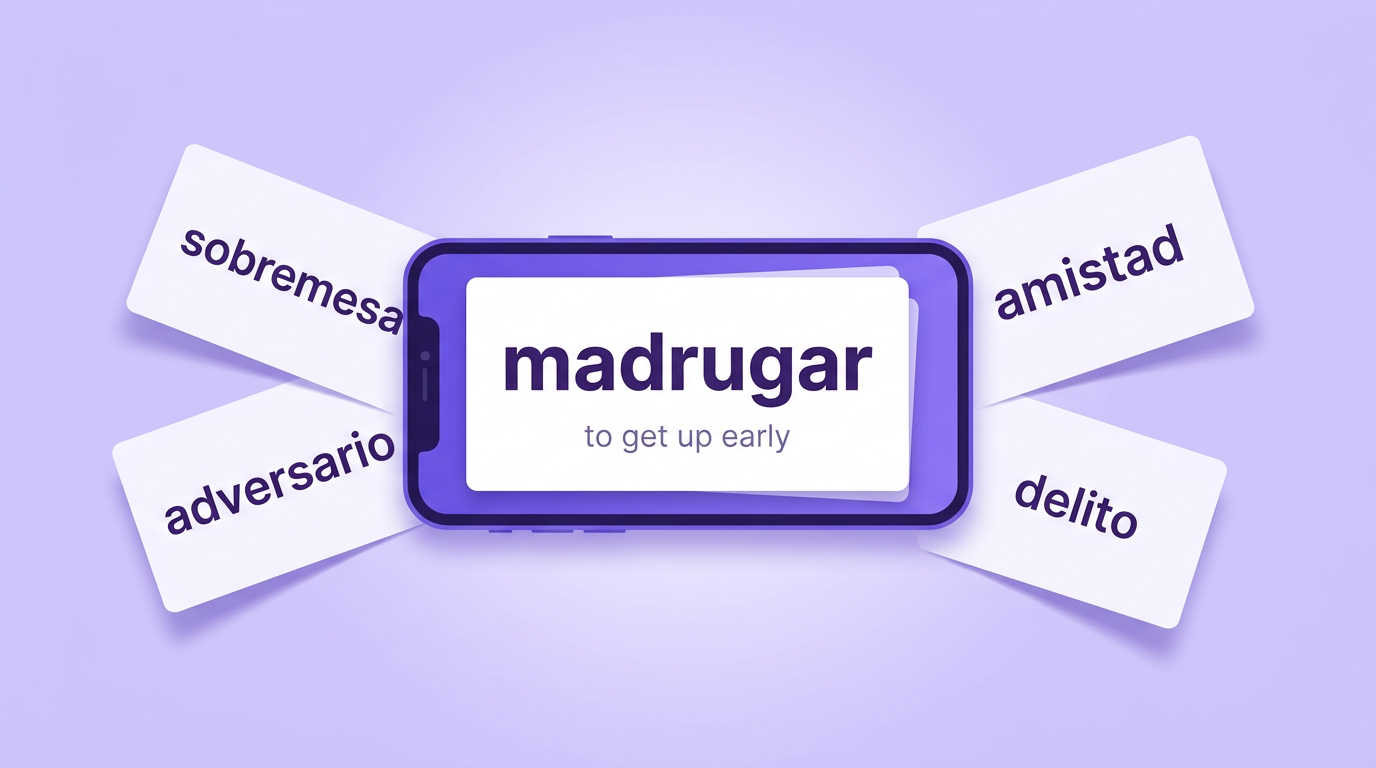
The one-way card. A classic card trains a single direction: see the Spanish word, recall the English. A month later you recognise adversario perfectly on the page, but in conversation, when you need to say "opponent", the word doesn't come. Recognition and recall are different skills, and the second one only gets trained when the question is asked the other way round.
Manual upkeep. The more an app asks you to configure before your first review — note types, templates, algorithm parameters — the higher the odds you'll set it all up and never come back. An app should start working on the first evening, not after you've read the manual.
One word, four different questions
A good flashcard app doesn't show you the same side of the same card over and over. It rotates one word through different formats, and each format pulls a different muscle.
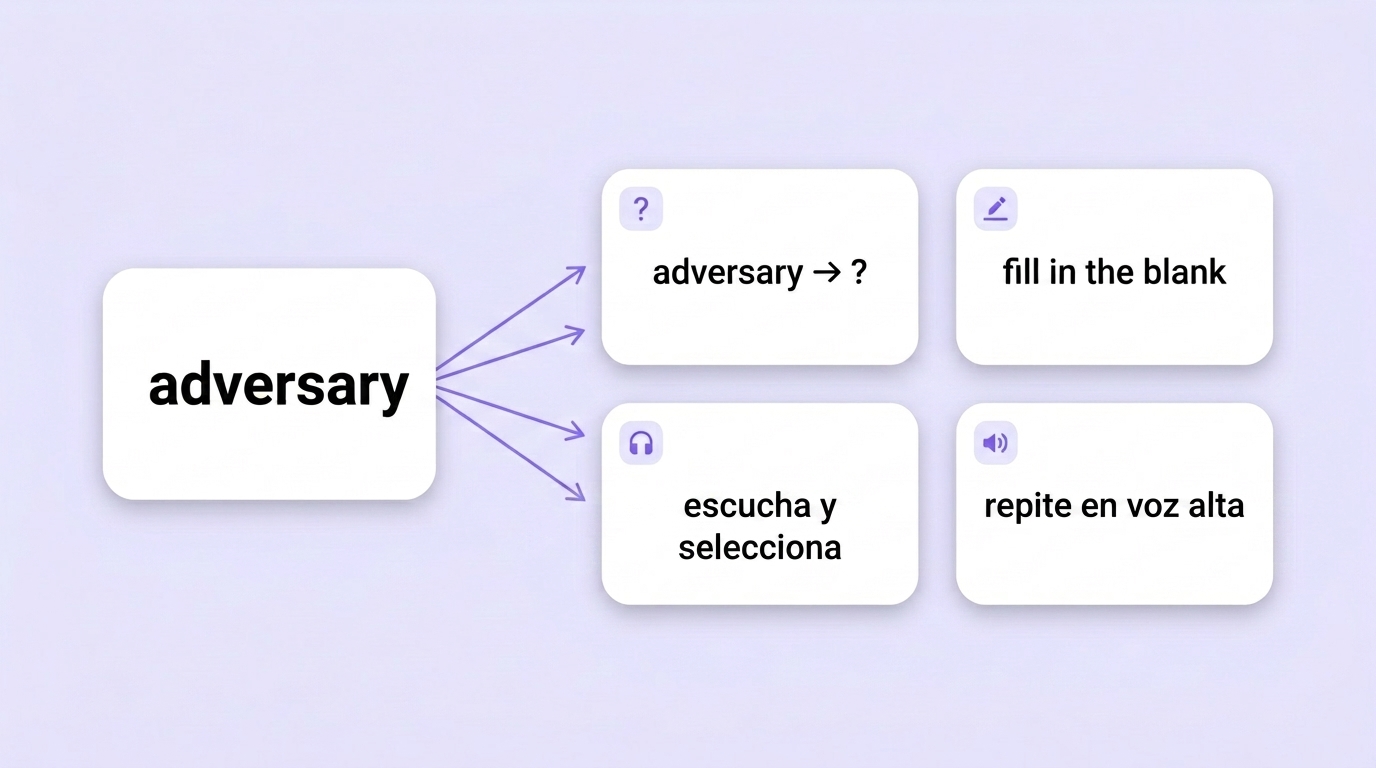
- Word → meaning. Basic recognition, the easiest one.
- Meaning → word. Active recall — the thing you actually need for speaking and writing.
- Fill in the blank. Checks whether you know which context the word belongs in. Defensa and protección both land near "protection" in English, but they sit in different sentences.
- Say it out loud. A word you've never actually said won't show up in your speech: your mouth doesn't know it.
When the same word reaches you a different way each time, review stops being mechanical. It also gets more honest: guessing a card in a four-option quiz is easy, recalling a word from nothing is not.
How VibeLing does it
VibeLing is built around the idea that cards should be collected from your own life instead of handed to you as a list.
You run into an unfamiliar word in a series, an article or a chat — you add it to the app. From there the app finishes the card for you: translation, example sentences with the word in real use, pronunciation. You never have to invent the back of the card by hand, which is exactly the step where most decks stall.
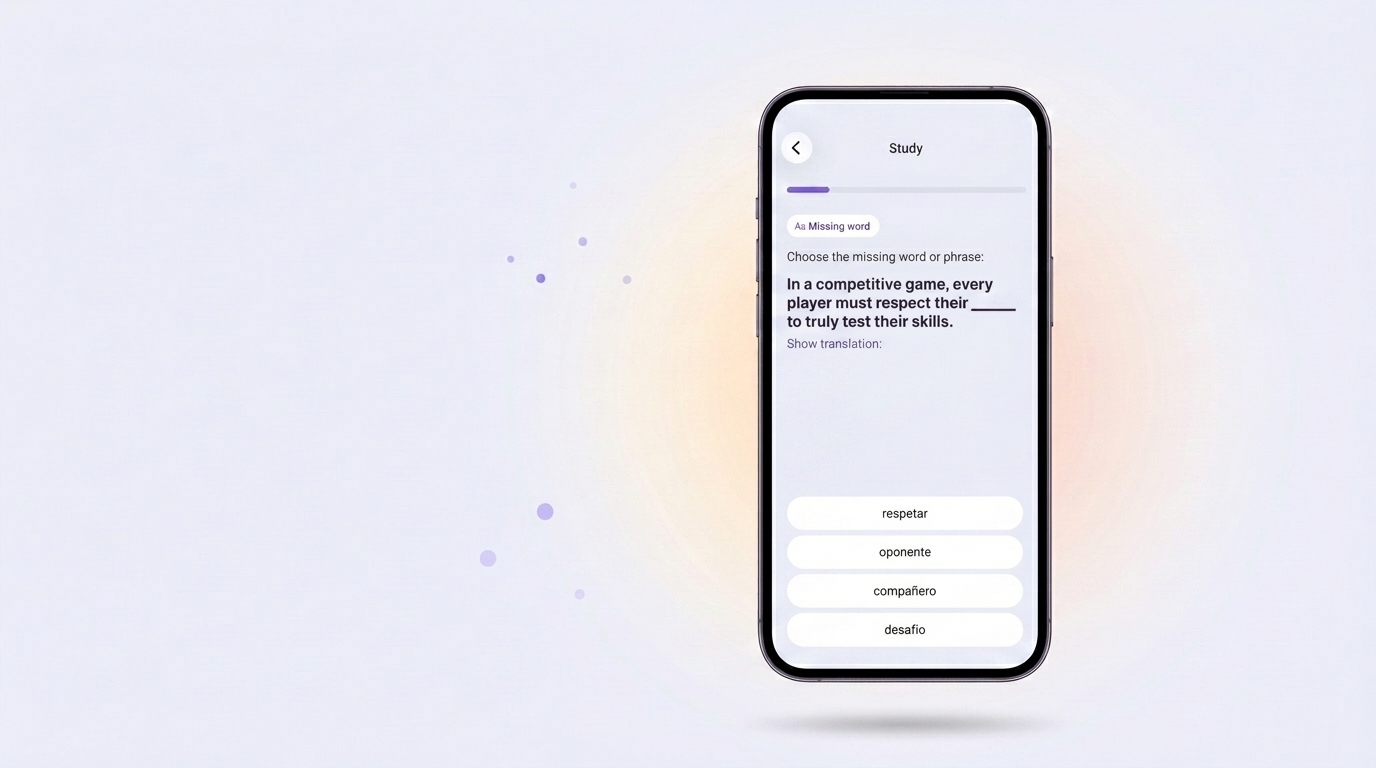
After that the word starts coming back on a spaced schedule, and in a different shape each time: pick the meaning here, fill the gap in a sentence there, say it into the microphone somewhere else. Progress is tracked per word, so your vocabulary list shows at a glance which words have settled and which are still stuck at thirty percent.
The free plan lets you add up to ten new words a day. For a normal pace that's plenty: ten a day is three thousand words a year, more than most people manage to properly lock in.
Flashcard apps worth a look
| App | Where cards come from | Review formats | Free tier |
|---|---|---|---|
| VibeLing | your own words from films, books, chats | meaning, fill-in-the-blank, audio, speaking out loud | 10 new words a day |
| Anki | your cards and shared decks | anything, if you configure it yourself | fully free on Android |
| Quizlet | a huge library of other people's sets | cards, tests, games | basic mode |
| Brainscape | your own and ready-made decks | card + self-rating from 1 to 5 | limited |
| DuoCards | your own words, browser extension included | cards, a little context | with limits |
| Memrise | ready-made courses | cards and native-speaker video | first levels |
VibeLing
Cards are built out of your own words: you add something unfamiliar, the app fills in the translation, examples and pronunciation, and after that it brings the word back on a spaced schedule through one exercise or another. There are no ready-made decks by design — you only study what you ran into yourself.
Get it: App Store · Google Play
Anki
The most powerful tool on the list and the most demanding. The algorithm is excellent, everything is configurable, and there are thousands of shared decks. The price is your time: the interface follows its own logic, and plenty of people spend half a day on their first cards. One oddity worth knowing — AnkiDroid is free on Android, while AnkiMobile costs $24.99 as a one-time purchase on iOS. If Anki feels too heavy, here's a look at simpler alternatives.
Get it: App Store · Google Play
Quizlet
Its strength is the library of ready-made sets: for any textbook and any exam, somebody has already built the deck. That's genuinely useful when you need to cover a specific word list before a test. For vocabulary you pick up in daily life it works less well — you type the cards in yourself, and the spaced mode sits behind the paid tier. More on that in this comparison of Quizlet with other apps.
Get it: App Store · Google Play
Brainscape
Built on self-rating: after every card you tell the app how confidently you recalled it, from 1 to 5, and that decides when the card returns. An honest approach, and also its weak spot — confidence is easy to confuse with recognition, and the app has no way to check you.
Get it: App Store · Google Play
DuoCards
A simple vocabulary notebook with cards and a browser extension: see a word on a page, save it to your deck. Pleasantly minimal, but there's essentially one exercise, and the reviews get repetitive.
Get it: App Store · Google Play
Memrise
Strictly speaking this isn't a flashcard app but a course with cards inside it. The short native-speaker clips are good — you hear how a word actually sounds in real speech. But you learn what the course contains, not what you ran into yourself.
Get it: App Store · Google Play
The short version
- You need to cover a specific word list for an exam or a class — Quizlet.
- You're happy digging through settings and want full control of the algorithm — Anki.
- You want to learn the words you meet yourself, with the card assembled for you — VibeLing.
Your first week
A plan almost anyone can hold to.
- For the first three days, don't study anything on purpose — just save every unfamiliar word you run into. Five to seven a day will accumulate on their own.
- Don't take on more than ten new words a day. The urge to load a hundred is strong, but a week later that hundred comes back for review on a single day and you quit.
- Review at the same moment each day — on the bus, in a queue, before bed. Tying it to a moment works better than notifications.
- Don't wrestle with words that won't stick after five tries. Delete them and add them again in a month, when you meet them in real text.
- Once a week, scroll through your whole vocabulary list — not to review, just to see it grow. That's the one kind of motivation that doesn't wear off.
The takeaway
Flashcards work if you recall instead of reread; if the words are yours rather than someone else's; and if the app brings them back on its own, in different formats, without you managing the schedule.
If that's the setup you want, start your own Spanish word list in VibeLing: save words from films and articles, and the app builds cards with translations, examples and pronunciation, then brings them back right when you're about to forget them.