How to Build Vocabulary for the DELE Exam
Preparing for the DELE almost always starts the same way: you download a list of five thousand Spanish words and start working through it. Two weeks later you are on word 300, you are tired, and on a practice test you still cannot structure a formal letter or keep the speaking task going. The problem is not laziness, and it is not the size of the list. An exam does not ask for vocabulary in general — it asks for a very specific kind.
How many words you actually need
To feel comfortable at a B2–C1 level exam, people usually talk about a range of roughly 5,000–8,000 words that you recognise while reading and listening. But that is passive vocabulary, and it builds up over years of reading and watching. The exam measures something else: what you can pull out of your head during a timed writing task and a fifteen-minute conversation. Active vocabulary is always a fraction of passive vocabulary, and it is the one you train for an exam.
If you want the numbers and the reasoning behind them, we covered it separately in how many words you need to speak Spanish. For the DELE the short answer is this: a few hundred well-chosen words move your score faster than several thousand random ones.
Which words count as exam words
DELE vocabulary splits into three layers, and each one is learned differently.
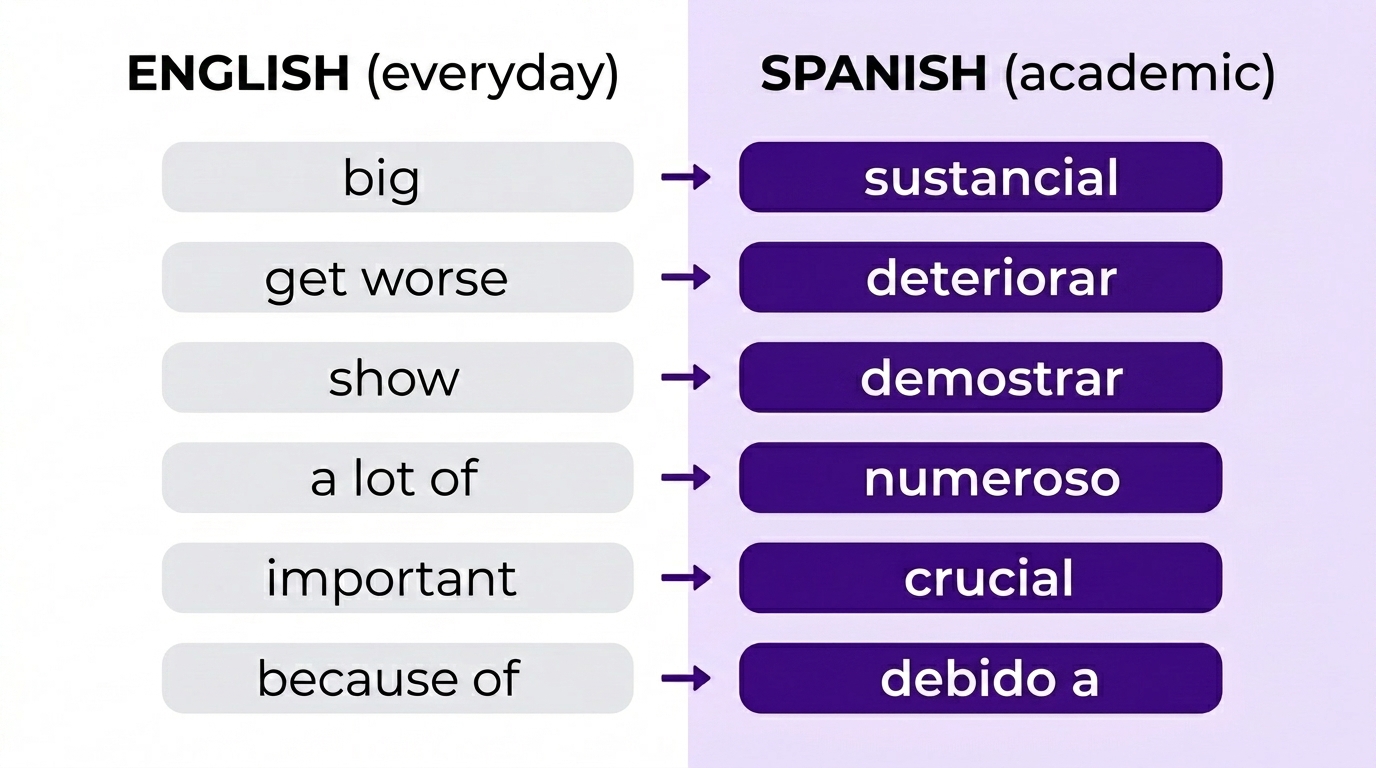
The first layer is formal and semi-academic vocabulary. These are the words that show up in articles, reports and opinion pieces regardless of the topic: significativo, planteamiento, evidencia, suponer, derivar, ámbito. Spanish has an official reference for this — the Plan curricular del Instituto Cervantes, which lists vocabulary by level from A1 to C2. Since the Instituto Cervantes also runs the DELE, this is as close as you get to a syllabus written by the examiner.
The second layer is topical. The subjects in the writing and speaking tasks repeat from year to year: education, environment, technology, health, city life and transport, work, immigration, media. For each topic you want 20–30 words and phrases so you are not describing everything with bueno and malo. For the environment that means emisiones, energías renovables, vertedero, huella de carbono; for education, plan de estudios, matrícula, formación profesional, abandono escolar.
The third layer is functional. These words do not describe the world — they steer your own speech: how to introduce an example, how to disagree politely, how to soften a claim, how to open and close a formal letter. Sin embargo, no obstante, cabe destacar, en lo que respecta a, a mi modo de ver, le saluda atentamente. It is the smallest layer and the most profitable one, because you need it in literally every task.
What each part of the exam demands
| Task | What it needs from your vocabulary |
|---|---|
| Expresión escrita, tarea 1 | Formal register and letter conventions: Estimado señor, me dirijo a usted, quedo a la espera de su respuesta |
| Expresión escrita, tarea 2 | Argument language and, at B1, describing data: aumentar, descender, una tendencia, supone un 40% |
| Expresión oral | Natural conversational markers without slang: la verdad es que, depende de, yo diría que |
| Comprensión auditiva | Everyday and workplace situations, plus regional accents from Spain and Latin America |
If you have not fixed a level yet, start with the formal layer — it is needed at every level from B1 upward. Add the level-specific material a month before the date.
The main mistake: learning synonyms in a column
The most popular piece of advice online is to swap simple words for fancy ones. That is how you end up with sentences like La utilización de bicicletas engendra sustanciales ameliorations en el ámbito urbano. An examiner does not see a rich vocabulary there. They see someone who took words out of a thesaurus without knowing how those words behave.
The rating criteria say it directly: points come off for inaccurate word choice. One correctly used crucial is worth more than three rare words dropped in the wrong place.
So learn a word together with the words it travels with — its collocations. In Spanish this matters even more than in English, because the verb is rarely the one you would guess. Tomar una decisión, not hacer una decisión. Cometer un error. Prestar atención. Tener en cuenta. Desempeñar un papel fundamental. These chunks are stored as a single unit and come back as a single unit, which is exactly what you need when the speaking task gives you a second to think.
The second rule is to learn word families. Most formal words have four or five forms, and the one you need in writing is rarely the one you memorised. Analizar — análisis — analítico — analista. Sostener — sostenible — sostenibilidad — sosteniblemente. Learning the whole family costs an extra minute and covers four times as many situations.
A review schedule built around the exam date
Exam prep has one feature that ordinary language learning does not: a hard deadline. The words have to be learned well enough that they surface on their own, and then held in that state until test day.
Spaced repetition is what does that — a word comes back exactly when you are about to forget it. We went through the mechanics in our piece on spaced repetition and why you stop forgetting. For an exam there is one extra detail: in the last two weeks, tighten the intervals so your whole active core cycles more often.
A rough ten-week plan:
| Weeks | Focus | New words per day |
|---|---|---|
| 1–4 | Formal vocabulary for your level, grouped by word family | 10–12 |
| 5–7 | Topic vocabulary across the eight recurring subjects | 8–10 |
| 8–9 | Functional layer: connectors, hedging, letter formulas | 5–6 |
| 10 | Review only, no new words | 0 |
Ten words a day looks laughable next to a list of five thousand. But ten words learned with their collocations and reviewed on schedule give you around 600 words after ten weeks that you can actually use. The five-thousand-word list, after ten weeks, usually gives you zero.
How this works in VibeLing
Running this plan in a notebook is miserable. There are hundreds of words, each with its own due date, and half your study time goes into bookkeeping. In VibeLing it happens on its own.
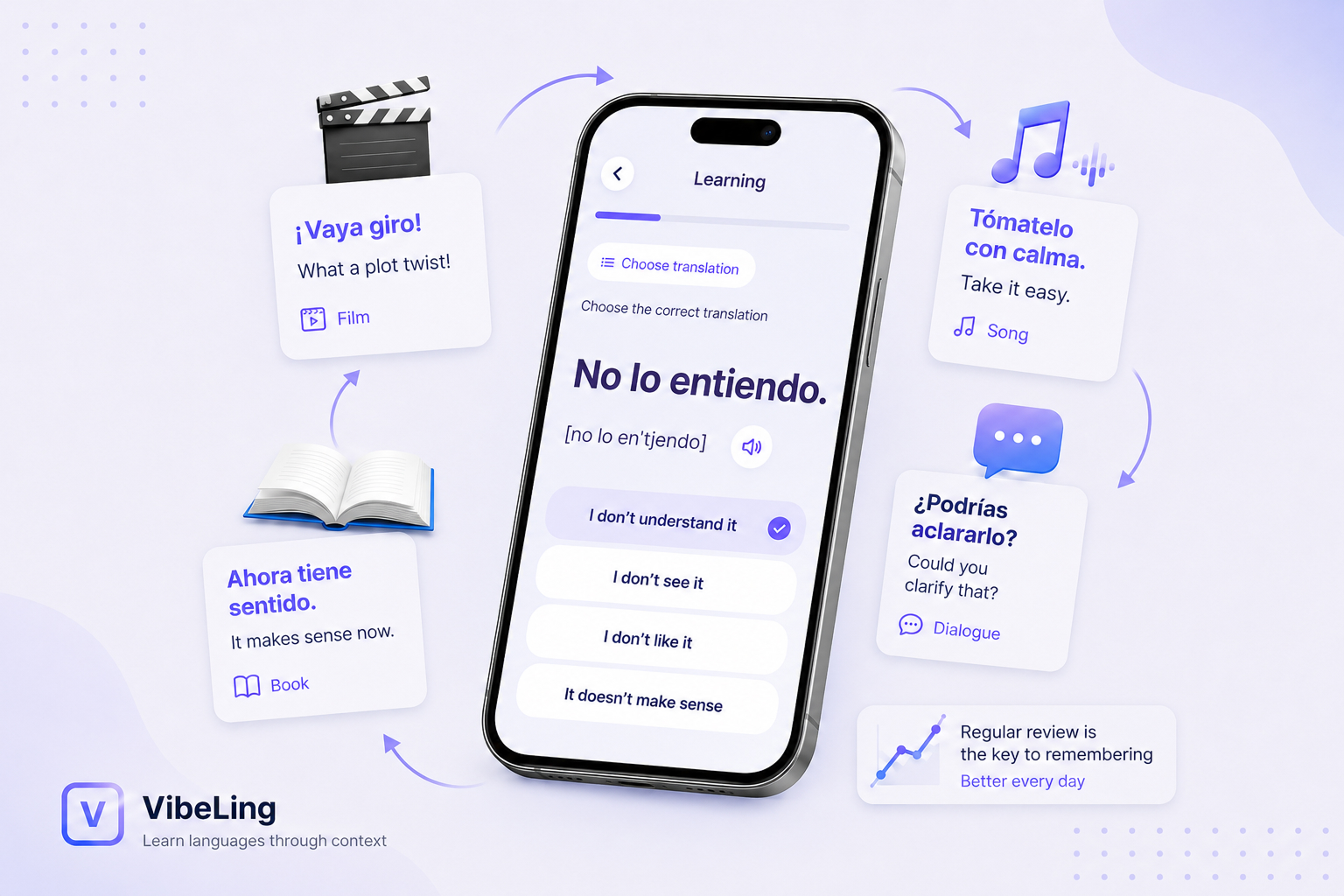
A word goes into your personal dictionary in a couple of seconds — from an article you were reading, from a podcast, from a practice test you just marked up. The app pulls in the translation, usage examples and pronunciation, so a chunk like tomar una decisión is visible right away instead of being something you look up separately. You can then split words into collections: the formal core in one, the environment topic in another, letter formulas in a third, and train whichever block your plan has reached.
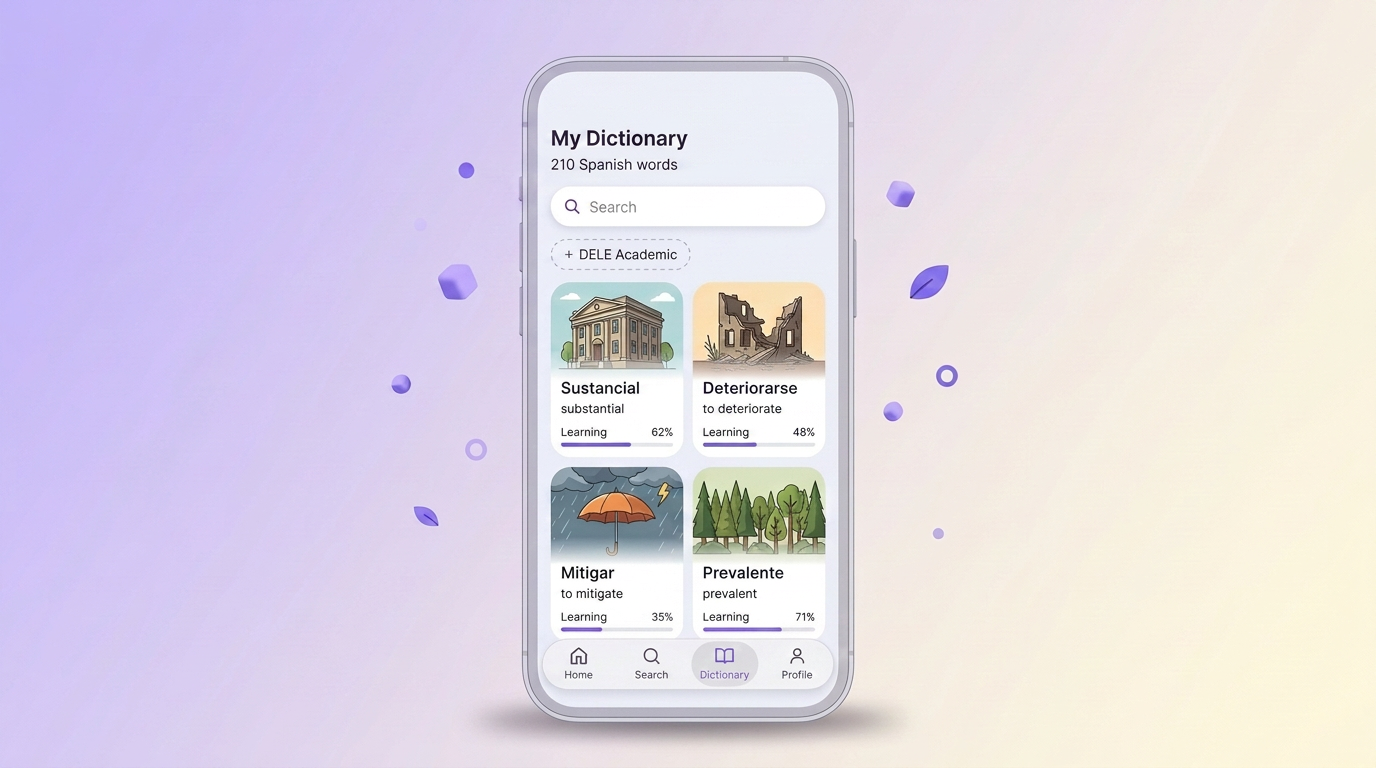
Reviews are scheduled by the app using a spaced-repetition algorithm, so nothing you learned quietly falls out of your head a month before the exam. The speaking drill earns its place too: in the oral test a word has to be recalled and pronounced, not just recognised.
In short
- Do not chase five thousand words. Take the formal vocabulary for your level, the eight recurring topics and the functional connectors — that is what a high score is made of.
- Learn a word with its collocations and its whole family of forms, not as a line in a two-column list.
- Schedule reviews and tighten the intervals as the exam date approaches.
- Ten words a day with reviews beats any list-marathon.
If you still have a couple of months before the exam, start today with ten words from your level's list. Collect them in the app, turn on reviews, and by test day you will have vocabulary you can actually reach for — not a list you once scrolled through.